Showing posts with label Features. Show all posts
Tuesday, 22 January 2013
Feature: Mazda's Le Mans Legend
To say that Le Mans is magical is to grossly undersell it. While F1 becomes ever more tiresome, ever more mired in politics and ever more dull, the 24hrs of Le Mans remains as a true beacon of motorsports greatness. It’s a combination of motor race, camping, funfair, acid trip (especially at 3am) and group experience. It’s the ultimate, and has been since 1923.
And yet, in all that long and glorious history, from the Bentley Boys to the roaring GT40s to the unstoppable Porsches to the silent Audis and Peugeots, only one Japanese car maker has triumphed in an outright win at Le Mans. Toyota has tried (and will have another crack in 2013 with its fabulous TS030 hybrid), Nissan tried, Honda dabbled but only Mazda succeeded.
Through a combination of sharp driving skills, clever manipulation of the rules and keeping their heads when all about were being lost, Mazda brought the remarkable 787B, with its eerie, howling triple-rotor rotary engine, home first in the 1991 Le Mans. And hasn’t been back since...
That could be all about to change, and we’ll get to that in a minute, but first, we took the opportunity of this remarkable 20th anniversary to talk to Irish racing legend David Kennedy, who was a lynchpin of the Mazda team in 1991.
“I was in several different motorsports businesses at the time and virtually knew every race driver as they were coming through. So I was well positioned to try and grab the next superstars coming through and bring them to the Mazda operation, after I’d driven with Mazda in the C2 category in the early eighties. So with my colleague Peirre Donaire, we were effectively the European arm of Mazda Motorsport.
“So we got hold of Nigel Stroud, who had been a designer at Porsche, and had had a hand in the dominant 956 racer, and had unique experience in building cars from aluminium honeycomb.
“The other cornerstone of the operation was a guy called Kio, who had been my mechanic in Formula 3, and between them they both bridged the gap in communication and culture between Japan and Europe, which was quite significant.”
To call Mazda the underdog in 1991 would be to lapse into understatement. Here was a small Japanese car maker, with a new car, a new team and a rotary engine going up against Porsche, Mercedes, Peugeot and Jaguar at the most storied race event in the world. How the hell did they pull it off?
“These cars were 800bhp, 230mph projectiles, they were fantastic to drive and unbelieveable to see, hurtling down the Mulsanne at 230mph, slipstreaming each other.
“But we were a very tight, very cost-effective organisation. A pure motor racing group, where as some of the other teams were maybe manufacturer heavy.
“As for the engine, the rotary was unique, and it had its advantages and disadvantages. One of the disadvantages, it never gave you engine braking, so at the end of the Mulsanne, there was no help. But we managed to get carbon brakes on the car, so then it was a benefit because no engine braking means better fuel consumption. And because it was so smooth, it was like riding a magic carpet, and very good in the wet, with very progressive power. It felt like it would go on for ever.
“Against the turbos, they would accelerate off the corner faster, but you’d catch them at the end of the straight.”
Still though, up against the might of Mercedes (with a certain Michael Schumacher in one of their cars) and multiple winners Jaguar and Porsche, and even home favourites Peugeot with the new 905 racer (which would win in 1992), Mazda looked to be an also-ran.
But there was a secret weapon. Weight.
Because of the compact, light rotary and thanks to come clever chasssis design, the 787B was actually running in a slightly different rule class to its rivals, meaning it could carry around 150kg less weight. A crucial factor. As was the main Mazda driver trio of Johnny Herbert, Bertrand Gachot and Volker Weidler. Despite both Herbert and Weidler still recovering from massive F3000 accidents, all three drove magnificently.
And as the Porsche, Mercedes and Jaguar challeneges faded all around them, the shocking-looking (that wild orange and green paint job), shocking sounding (David relates that he couldn’t sleep inbetween his driving stints because he kept listening to the distinctive rotary engine wail, heard above all the other engine noises. Herbert says much the same.) 787B worked its way up steadily through the field until, with just a few hours left, the leading Mercedes, driven by Jo Schlesser, Jochen Mass and Alain Ferte, pitted with an overheating engine, and suddenly car no. 55 was in the lead.
Famously, Johnny Herbert’s final to-the-flag two hour stint in the baking hot cockpit pretty much finished him off. He brought the car home to the chequered flag, then promply collapsed from heat exhaustion, leaving Gachot and Weidler to take to the top step of the podium without their comrade.
“There was a Japanese report done by Mazda, and as ever Japanese reports aren’t small” says Kennedy. “It was of biblical proportions, on the reasons why we had won. And on the last page it said, ‘maybe it was because the car was blessed by a Bhuddist monk at the foothills of the snow-capped Mt Fuji.’ I was there for that blessing, it was a fabulous ceremony. And sometimes you scractch your head and say who knows?”
Twenty years is a very, very long time in motor racing. For half of that time, Audi has utterly dominated at Le Mans with its mighty diesel cars, and Peugeot has only been recently able to offer it stiff opposition. But now, Jaguar, Porsche, Toyota, Bentley and others are looking at reviving their Le Mans campaigns. What of Mazda?
Well, David attended the recent 20th anniversary celebrations, which saw the 787B return to Le Mans for an emotional ceremony, one which was thronged with crowds. “You know what, I think a lot of the Mazda guys clicked that there’s something they’re missing out on.”
So there’s hope then. Hope that the Mulsanne, Arnage and Tetre Rouge will once again vibrate to a banshee rotary wail.
Labels:
1991,
24hrs,
787B,
David Kennedy,
eDrive,
endurance,
Features,
Ireland,
Johnny Herbert,
La Sarthe,
Le Mans,
Mazda,
motor sport,
rotary,
turbo,
victory
Thursday, 18 October 2012
Features: Nissan's Big Day Out
You could be forgiven for thinking, lately, that Nissan has become a one-car manufacturer. The Qashqai, so beloved of aspirational families, givein them a hint of SUV styling but keeping the hatchback running costs, has been a runaway success for Nissan, and is currently the no.2 selling car in Ireland. The only problem is that its success does tend to obscure the fact that Nissan makes other cars, and some damned exciting ones at that...
Take this GT-R, for instance. Jet black, in Spec-V form, so it gets 545bhp and is around 60kg lighter than standard. Four wheel drive that could outfox a tax accountant, paddle-shift gearbox that’s faster than an Uzi and a glowering, menacing mien. Looking for all the world like Darth Vader’s company car. This is not a mere vehicle, this is practically weaponised, a stealth bomber with wheels. And oh look, someone’s left the keys in it...
We’re down at Mondello Park and it’s lashing rain, a weather report that would normally have us huddling in the pits, trying to keep dry. But today it’s well worth the sloshy stride across to the waiting cars, because the chance to drive a GT-R is one thing, the chance to drive a GT-R when it’s wet enough to really explore the capabilities of that remarkable 4wd system is something else again.
Sit in and thumb the red starter button and the GT-R 3.8-litre V6 twin-turbo engine kicks into a smooth, gently menacing idle. In spite of its high performance credentials, it’s no harder to slide yourself aboard and acquaint yourself with the cockpit than it would be in a rental Micra. Nissan has kept things simple and user-friendly in here, and comfort levels are remarkably good. You could happily spend the day in those seats.
Tug the stubby selector for the twin-clutch transmission back to A for automatic mode. You can of course take full manual control with the column-mounted paddle shifters, but today I’m going to leave it in auto so that I can concentrate harder on not crashing. The transmission clunks into first and with no fuss at all, we trundle down the soaking pitlane.
Up till this point it’s all been drama free, but as soon as we’re past the marshaling post and under the spectator bridge, the GT-R comes to life. A quick stab of the throttle annihilates the short chute between the pits and the first corner and it’s time to get turned in. A nudge of understeer is the first sensation as the GT-R’s not insubstantial bulk tries to push straight on. It’s a fleeting sensation and the nose soon turns obediently towards the apex of the hairpin corner, the GT-R still feeling pussy-cat-ish at these sighting lap speeds.
I up the ante through the second corner and instantly the GT-R’s chassis shows its mettlre. Even a delicate squeeze of the throttle has the rear tyres skittering out in a fast arcing motion, but even before I apply opposite lock, the computer that controls the car’s motions has figured out, adjusted the brakes, traction control, stability control and 4wd split and stopped me spinning embarrassingly off. And it does the same at the next corner, and the next, and the next.
That sounds like it might be a recipe for having a smothering nanny computer on board when you’re trying to have fun, but oddly, it isn’t. The GT-R is just so capable, so easy to drive, even when driving very fast indeed, that you soon start to develop a rhythm and rapport with both the mechanical car and the electronic one. It soon becomes second nature to kick the back end out to ludicrous angles, dabbing on opposite lock all the time, confident that your own excesses and lack of skill will be safely mopped up.
And of course, there’s the sheer, nutter power of the thing. Fast enough to flatten your eyeballs and bend your ribs out of shape, the GT-R is, in spite of its astonishingly friendly nature, a true Porsche hunter, a sleek mechanical panther stalking its skittish German prey. How does 0-100kmh in a hair over 3.0secs sound, and a top speed above the magic 300kmh barrier? Nissan might even put the Spec V’s back seats back in if you ask nicely.
After all that, a 370Z, even in race-track spec with a trick diff, should seem so pedestrian, but it just doesn’t. After a hairy first lap with a lot of sliding and not a lot of throttle (just the rear-wheels driven, then) the 370Z starts to come to life, and you learn to trust the very stiff diff to plant the back end in place (and the fabulous steering to correct when it doesn’t) and suddenly the 370Z feels like its old self again. A hairy-arsed, old-fashioned rear-drive drift machine with a warbling V6 engine and a meaty, muscular gearchange. Although not as capable as the GT-R, obviously, it was if anything probably slightly more fun on a soaking Mondello International circuit.
And the Juke R? Ah, well, that’s another thing again. It looks more or less like a standard Juke, bar some crazily over-extended wheelarches and an oddly bisected roof spoiler, but underneath it’s basically a GT-R, complete with the full-fat 545bhp (not the 480bhp that the original Juke R concept had), 4wd and paddle-shift gearbox. It’s nuts, of course, but it is a real car, and you can, sort of, buy one. Assuming you have €400,000 to spare. Plus local taxes.
Is it as quick as a GT-R? Well, it was damned near impossible to catch in a straight line on the track, even if the lower, leaner GT-R would probably do it over through the corners. If Nissan would consider putting the back seats back into the Juke R, it could be the ultimate school run vehicle.
All of this was, of course, a demonstration, a reminder that Nissan, while it’s busy turning out Qashqais, Mircras and the all-electric Leaf, is still a sporty car company at heart. If the GT-R, Juke R and 370Z weren’t sufficient proof, then don’t forget the Nissan-backed DeltaWing race car that stunned the crowds at Le Mans this year and is set to have its own one-make racing series in the future. Nissan Ireland will be ramming the point home early in the new year when it introduces the Nismo sporting sub-brand to our market, starting with a hot 1.6 turbo version of the Juke, which you'll be able to bodykit-up to look like a reasonable facsimile of the Juke R.
Consider us reminded. 542bhp reminded.
Tuesday, 2 October 2012
Features: The man who puts the Jaaaaag in Jaguar
This is the man who finally got Jaguar design right, after it had languised for years, unable to break away from a slavish devotion to a classic sixties look that just didn’t work in a modern context. Ian Callum is an astonishingly talented man, with stints at Aston Martin and Ford behind him, he swept away the retro look at Jaguar and ushered in a clean, modern style, beginning with the XK and XF and onto the sometimes controversial XJ. But was that binning of retro the key to Jaguar’s recent renaissance?
“Well, it depends what you mean by retro. I think if it means deliberately copying the past in order to try and capture something from that past, it’s the wrong thing to do. I’m afraid Jaguar had fallen into that trap, a little bit. Not overtly, or even consciously, but just by not moving on quickly enough. From my point of view, it didn’t work very well."
The 2008 XF was the final nail in the coffin that Callum had prepared for Jaguar’s dark days of producing photocopies of the 1968 XJ. Out wen the sixties, in came the 21st century with a car of near perfect proportions and gorgeous detailing. Even without the retro style of the old XJ and S-Type, there was no mistaking the XF for anything other than a Jaguar. But now Callum has another tough assignment on his hands. Styling never stands still and Jaguar has to move on again. Where now?
“I’m going through that very issue at the moment, with the design team, how we go about moving on, having established the foundations. I think the key to this is not copying the past, but what we’ve tried to do with the current lineup of cars is understand the values of what Jaguar stood for in the fifties and sixties, and that’s certainly when I admired them the most, and pin down these values about modernity, about beauty of line, about purity of surface. We’ll continue with those same values; we haven’t changed those, but very much in a 21st century way. I think that this is where we wanted to get to with XF and XJ.
“Where we go to now is probably a continuation of that, we’ve made a big leap into the future, we’re now in the right place, and I think the challenge is now to move on from that in a very positive and hopefully very successful way. It’s very difficult to know how much further to take it. As a designer I perhaps always want to take it a little further than other people feel comfortable with. But we need to find that balance.”
A big move, recently, was the launch of the high performance XKR-S model, which delved into Porsche 911 GT3 territory, with an in-your-face bodykit and aerodynamic performance given preference over Jag’s traditonal GT comfort.
“I have to admit that that car is quite aggressive, although I like to use the word ‘assertive’ more. That car is overt, because it has been designed in the wind tunnel, all these appendages you see are there for a very good reason. It’s to keep the car on the road at 300kmh. Therefore they have a function and so I’m very comfortable with they way they’ve evolved. We wouldn’t do that on a less powerful car, but you’ll certainly see our cars becoming more assertive, and the simple reason for that is that the visual geography out there in the car world is very aggressive. If you go to America, people out there drive around in great big pickups and you need your cars to have a presence on the road and I think the idea of the cars becoming more subdued and a little more gentle in their attitude and their presence are probably over.”
Certainly, Callum’s latest creation, the F-Type, as fully revealed this week at the Paris Motor Show, follows these cues. Classically Jaguar proportions (long bonnet, short rear) but with aggressive (sorry, assertive) details like the deep side vents and the gaping grille. It’s a looker, that’s for sure.
“Even if a car is fairly ordinary, they need to shout a bit louder these days, and Jaguars certainly will be shouting.”
Wednesday, 26 September 2012
Features: Freelander in the desert
It’s early November and the weather is just glorious. Obviously I’m not in Ireland. I am within the walls of the Medina in the 18th century city of Essaouira on the coast of Morocco. As I wander through the old city, breathing in the fresh air of a city free of traffic I take in the splendour of a UNESCO World Heritage city and have one of those ‘how did I end up here?’ moments.
By Brian Twomey.
A group of world-weary Land Rover personnel are in Morocco to launch the new Freelander 2. The Freelander is the type of car that, for all its 4x4xfar virtues, is as likely to be inching down the M50 or circling Dublin city centre vainly looking for a parking as any other family orientated 4x4. Land Rover has brought us here to show us otherwise, that life with a Freelander doesn’t have to be like that and that the genes that made the Defender the chosen car for explorers still live on in their smallest, most practical car.
So to business. I commandeer the keys to a Freelander from one of the Land Rover girls and take to the roads leading from the isolated tarmac that passes for an airport here. The petrol Freelander is a 3.2 litre item, a straight-six that Land Rover say they co-developed with Volvo and tuned to their own requirements. It’s in the Freelander to try an convert Americans who never liked the last car. Oddly, this engine is mounted longitudally and produces 231bhp which it sends to all the wheels through a six-speed automatic gearbox with the now obligatory sporty sequential gear change option. It’s not a slow car, 0-100km/h in a claimed 8.9 seconds and 200km/h flat out, but it wouldn’t pin you in your seat in the way you’d think a big engine in a fairly small car would. It is very smooth, quiet and quite responsive but a bit blighted by the gearbox which is a touch slow to down-change when you ease the throttle down. This is a pity because generally the self-shifter is well mannered and unobtrusive.
I’d go for option B; the cheap and more economical 2.2 diesel. Two less cylinders and 160bhp mean that the Freelander is slower here but the precise six-speed manual gearbox and 400Nms of torque more then compensate. The chassis feels identical but the diesel trades high end power for low end torque making it smoother and more rewarding to drive across unpredictable terrain or twisty back roads. The smallest Land Rover is a remarkable achievement dynamically. The steering has decent levels of feel and the car responds sharply to steering inputs although Land Rover seem to making the steering in their newer models a lot lighter these days. Do the dog on it and it will push into very mild understeer but otherwise it is happy to do your bidding even at high cornering speeds. The only thing that distinguishes it as a 4x4 is the body roll which is modest by class standards but more dramatic than a similarly sized estate car.
The accomplishments of the engineers in making the Freelander drive this well is further reinforced when you venture off road. The local youth offering pale tourists a ride on his camel can’t compete with Hill Descent Control and the numerous settings Land Rover fit to everything above the Neolithic Defender. The bonnet vibrates as I strike the bottom of a sand dune with horrific force and sand is hurled over the car as it crests the top of it. The Freelander takes its punishment well although again the manual diesel wins out. To go dune bashing or rock climbing the automatic petrol has to spend a lot of time revving quite hard to maintain momentum. At one point the auto gearbox nagged that it was overheating. Admittedly a fair bit of abuse came its way but the manual diesel feels like it is suffering less in the rough stuff. In these conditions the Defender genes start to show through. As I bounce past a beached Freelander I find myself off-course, waste deep in sand at 60km/h and trying to gather it up before I drop down another dip. The sump on this thing must be yards thick…
The softness of the suspension and the sharpness of the steering come into play in the rough stuff. The ride quality is good on road but fantastic off it while the steering is always cooperating, never fighting a driver in extremis. Clamouring over rocks is impressive, if a trifle boring and to be honest I wouldn’t be risking my bling-bling alloys trying to find a shortcut onto Dollymount strand this way. That said, I spent a day trying to break a 3.2 petrol HSE and another day trying to demolish a 2.2 diesel HSE and the worst that happened was that a retaining clip under the bumper bent when I hit a 50 degree slope at national primary route speeds. I looked under the car expecting to see a puddle of oil and I got a blemish that a Pebble Beach Concours judge would miss. Not only is the off-road route Land Rover picked fun to cover but the Freelander is a fun car to do it in.
As the fleet of pre-production models sits outside the walls of the Medina, cooling in the late afternoon sunlight I step back from them. I admire the crisp, simple, conservative styling. The beautifully detailed, comfortable interior is a great venue for me to explore Africa for the first time, even if some of the fixtures don’t exactly look childproof. I admire the refinement and strength of the straight-six but to be honest I’d have the diesel as it feels more at home under the bonnet of the Freelander. My only problem is that back in Ireland I can’t think of anywhere I could use this amazing off-road ability and to buy one of these cars and never experience that would be a tremendous shame indeed.
Labels:
4x4,
action,
adventure,
desert,
dunes,
eDrive,
Features,
Freelander,
Ireland,
Land Rover,
Morocco,
off-roading,
sand,
SUV
Features: 90 Degrees North; testing inside the Arctic Circle
Glancing around is no good. You have to peer, stare and generally gaze to pick out any landmarks. All around is a soft, hazy white, upset only occasionally by the odd blue streak or grey-green line of snow-dusted trees.
The white-out is all-pervading and details, even with all the peering, seem fuzzy and indistinct. The snow that lies on everything absorbs sound, killing echoes and dampening sound waves to the point that you feel that if you screamed, the guy standing next to you wouldn’t hear it. Everything looks like it’s been taken from the front of a Christmas card, but it’s a bleak, wasteland Christmas card. A post-apocalyptic SantaLand.
Ivalo is a town in the far north of Finland, about 100km north of the Arctic circle and in uncomfortably close proximity to the former Soviet nuclear submarine base at Murmansk. Sixty years ago, frozen and U-Boat-fearing transatlantic convoy vessels would make the long and perilous trek to Murmansk to feed the Red Army’s insatiable appetite for guns, trucks, tanks and ammunition as it ground on its bone-crushing drive to Berlin. More recently, the sinister black shapes of Victor and Typhoon-class ballistic missile submarines would slip noiselessly down the fjord just to the east of Ivalo, heading out to wait, silently, for the call to unleash nuclear annihilation. More recently, those self same black organs of mass murder have been rusting uselessly at their Murmansk quaysides, leading one to ask worrying questions. Such as how much Hammerite can the Russian navy afford to paint on them before the cracks start to get too big? And is that greenish glow on the horizon Aurora Borealis or a reactor core about to go critical?
But the kind of sinister, lingering death concerns (from either freezing cold or uranium) that would put off most tourists is exactly what draws car companies to cheerful spots like Ivalo. Wide open spaces, most of them lakes that freeze over during the long, northern winter are bountiful. The ice can reach thicknesses exceeding three metres, which means that, once cleared of snow, they can be used as the smoothest, clearest test tracks you’ve ever seen. Car companies love these places. All the room to play they could ask for, few local residents to bother and the kind of unpleasant climactic conditions that will keep all but the hardiest and most determined spy photographer indoors. In other words, the perfect place to test, stretch and develop new cars and their peripheral systems to way beyond their expected limits of endurance.
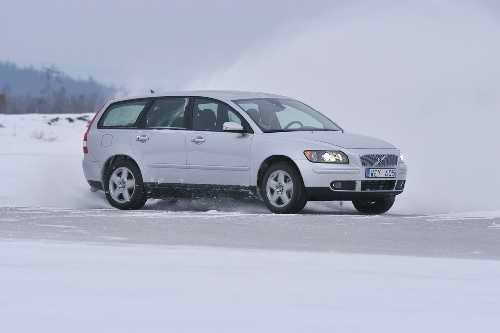
My foot is all but flat to the floor, lifting occasionally to try and balance the weight transfer from front to rear. My hands are sawing comically at the wheel, as if trapped in a cheesy sixties back-projection car chase special effect. The 2.3-litre 215bhp turbocharged five-cylinder engine is screaming to within an micron of its red-line. Outside, the studded, rally-style tyres are slipping and biting, desperately trying to balance the demands of the power I’m asking for with the available grip, of which there is, effectively, none. The studs are chewing up the ice and peppering the side windows with a fine coating of chips as the car struggles to perform the perfect parabolic arc that its dim-witted driver is attempting to scribe. Does anyone want to bet that I’m in a Volvo?
Ten years ago, you’d never have believed it, but now, thanks to a descending line of C70 coupĂ©, tearaway 850 T5 and V70 R estates, successful assaults on the British and European Touring Car championships and the arrival of the gorgeous S60 saloon, Volvo has achieved that which no other manufacturer has truly managed; a cocktail of safety and sex appeal.
Which is precisely why I’m at Volvo’s ice-bound test track (test rink?) just outside Ivalo. It’s not only an opportunity to have a first drive of the XC90 V8 and the AWD T5 version of the V50 estate, it’s also a perfect excuse to punish Volvos DSTC stability control system until it squeaks and begs for mercy.
Of course, the true trick to testing such a clever electronic system is to first sample the car’s responses with it switched off, hence the sideways tomfoolery on a polished ice skidpan. Fun it most certainly was (like all your Colin McRae Rally dreams come true in an orgy of flailing tyre studs and, I suspect, bent valve stems from over-revving the engine...) but it was also educative. Volvo has learned much in the past few years about the black and mysterious art of chassis tuning, and with the V50 being based on the same component set as the beautifully-handling new Ford Focus, the art has been drawn closer to perfection than ever. Even on a surface that’s difficult to stand upright on, and harder still to fall over on with any sense of grace, the V50 performed faultlessly. With the DSTC switched off, its responses were pure, proportional and steady. OK, so it had the benefit of those grippy, studded tyres, but even taking that into account, the V50 proved itself to be a true drivers’ car. Although you could easily accuse the steering of being too artificial in its feel, there’s no doubting the way the chassis responds to steering and throttle input. It trimmed its line when requested, pushed gently wide of the endless skidpan apex when throttle was applied and only spun out when the slip angle got beyond your correspondent’s ability to reset to the straight ahead. Sorry, but Jackie Stewart I ain’t.
Thankfully, under the bonnet is a little electronic box that does a fine impression of the canny wee three time world champ. Volvo calls it DSTC, but we all know it more generically as stability control.
Of course, the most extreme test that a stability control system can be put through is violent swerving followed by sudden braking on a slick surface. Which is why Volvo brought along a lot of cones. Now I know you and I will never likely work up the guts to start weaving in and out of the traffic cones at our nearest road works, however much fun it might sound, but any time a car company brings a bunch of journalists to a test track, the cones are always out and the word ‘slalom’ is never far from someone’s lips.
And despite the shiny surface of the frozen lake offering about as much grip as a margarine covered Tefal, the V50 still slipped between the cones with grace and aplomb. True, eventually even the clever DSTC system will run out of ideas and a few cones were missed or trampled, but even the most violent on-road emergencies usually only involve a few seconds of swerving, so the system has plenty in the bank, really.
More impressive again was the braking test. On the same stretch of polished ice, two sets of cones were placed about 800-metres apart. Line the car up at the first set and hit the accelerator as hard as you can. The studs bite as best they can and the little yellow DSTC warning light starts flashing faster than Jordan at a paparazzi convention as all 215bhp gets shunted through to the tyres. Even with the electronics parceling out the torque, and even cutting back on the throttle, the V50 still reaches about 120kmh by the second set of cones, the braking mark. Now for the good bit; remove hands from steering wheel and stand on the brake pedal with all your might. Your body tenses, the pressure on the middle pedal signalling your brain that a crash stop is about to occur. But it doesn’t. The ice doesn’t have enough grip to stop you quickly, so instead of headbutting the windscreen, you sail majestically on, losing speed gradually as the anti-lock brakes pulse rhythmically away. But despite the fact that you’re offering the steering no instructions whatsoever, the electronics are keeping the V50 on a perfect straight-ahead track. By rights, the car should have snapped into a spin and we should be neatly embedded in one of the two snowbanks that border this stretch. But no. The little Volvo doggedly holds its course until it has come to a safe and complete stop. And then the driver gets out, slips on the grip-free surface and falls over again. Do they make DSTC for boots?
Doing the same tests in the new XC90 V8 was also instructional. Designed originally only for the American market, but coming in right-hand-drive before the end of the year, the new 4.4-litre 311bhp engine is not related to the Jaguar-derived unit now serving duty in the Range Rover, Discovery and Range Rover Sport, despite which, the two units share the same cubic capacity. No, the Volvo unit is an in-house design (apparently with quite a bit of help from distant Ford Motor Company relative Yamaha, who also helped with the design of the Fiesta’s terrific little 1.25 unit that we’ve been raving about for nearly ten years now) that has been specifically created to fit in the tight confines of the XC90’s engine bay. Because the XC was designed around two long, narrow engines (the turbocharged 272bhp straight-six and the 163bhp diesel five cylinder), squeezing in a V8 was not going to be the work of a moment, especially with Volvo’s insistence that the XC90’s clever and effective front crumple zones were sacrosanct.
So the unit is astonishingly compact for a four-and-a-bit-litre engine. Overlapping cylinder bores and a clever approach to the layout of ancillaries like the alternator and fuel pump mean that it slots in neatly, if tightly, where only in-line engines have previously ventured. And it’s a fab engine, with a flood of easy going torque (440Nm) and a meaty V8 grumble that shifts up an octave to a proper scream at high rpm.
And while the XC90 doesn’t quite deport itself as well as the smaller, more nimble V50 on the ice tests (pulls to one side slightly when doing the braking tests with hands off the steering wheel, won’t drift neatly on the skidpan) it’s still mightily impressive for a big 4x4. Fun too. At the end of the braking test, there’s a wide stretch of empty, cone-free ice. Switch off the DSTC, crank on full lock and let the torque out to play. Bet you didn’t know that an XC90 can spin in its own length...
Later, out on the road and we’ve come to a halt at the long fence and tall gate that marks Finland’s border with Russia. I know that the Soviet experiment is long dead and that Russia is now a tourist-friendly (ish) place but it’s still impossible to stifle a shiver of foreboding. All around are tall pine trees and beyond them, the endless whiteness. Who knows how many have perished trying to force or sneak their way across this arbitrary line in the snow?
Clamber back into the cosy comfort of the XC90. Cars these days just seem to shrug off nature so effortlessly. It’s good to peer into the whiteness occasionally, just to remind yourself just what an impressive achievement that is.
Features: Water Wings; the Honda powerboat challenge
The salty, briny water is dripping down the neck of my waterproof jacket and my spine feels as if it’s going to shatter every time the keel of the boat drops, with a sickening crash, down into a trough. And there’s a lot of troughs.
With the usual Murphy’s Law applying, the day I chose to go for a boating trip is not bright, sunny and calm. No, the waters of the Solent estuary are choppy, foamy and reflecting the grey, heavy overcast above. Despite all of this, I’m having some of the best fun, ever.
Which is exactly point, really. Although the Honda Four-Stroke Challenge racing series is a very serious event for the competitors, the boats are designed to function as pleasure craft during the off-season, so that the owners get full use out of their investment, not just a racing craft that has to be locked up during the winter months.
The boats are called Honda Sport Cruisers (there’s also a more extreme Honda Sport Racer, deemed too hot for a novice land-lubber like myself to handle) and although Honda supplies the 150bhp outboard engine, the rest of the boat is designed and built by Cougar Powerboats in Southampton. And that’s where things get really interesting.
You see, Cougar isn’t just some crowd who slap together some sheets of fibre-glass and lob a Honda engine onto the stern. Cougar is owned and run by a guy called Steve Curtis. Not familiar with the name? Well, if you’ve an ounce of salt in your veins, you will have. Steve is the all-time king of off-shore powerboat racing, the series with the huge, twin-cockpit boats powered by twin (yes, twin) Lamborghini V12 engines that skip from wave-crest to wave-crest at nearly 200mph. And Steve is a six-time World Champion at this, with the overcrowded trophy shelf to prove it. So going for a spin in a boat built by Cougar is a bit like taking Michael Schumacher’s Ferrari for a belt.
Thankfully, the Sport Cruiser lives up to its name. It’s an absolute piece of cake to pilot, even in the choppy waters we found. There are no awkward navigation devices to learn, no arcane start-up procedure. The Honda engine fires on the turn of an ignition key, and despite being out in the open, idles and revs as quietly and smoothly as your Granny’s Civic. Controls amount to a big throttle pedal, a steering wheel and a switch for adjusting the angle of attack of the engine. Apparently, that can help you gain extra speed on straight stretches and then, with careful adjustment, grant you extra ‘grip’ on corners. Sensibly, I ask my companion from Cougar, the aptly-named Alan Goodwin, to set it to whatever is the nearest thong to idiot-proof and leave it there.
From then on in, it’s just accelerate, turn and accelerate again. Well, it’s not quite that simple. The Solent is a crowded waterway and you have to keep a sharp eye out to avoid being run over by cruise liners, oil tankers and other pleasure craft. One salt-encrusted eye, too, which makes things trickier again. And then you have to be careful of wake turbulence, which can severely unsettle your own craft, make a note of wind direction and be aware of how it affects your steering… OK, so maybe not quite as easy as all that.
Still, the boat itself is ultra-friendly. With a deep-V hull it’s manages the neat trick of feeling impressively stable while still being incredibly agile. It feels, in fact, more than a little like a water-borne Civic Type-R, all revvy engine and sixpence-sized turning circle. Max speed is only around 80-90kph on the water, but when there’s no wind (or spray) protection, that feels more than fast enough.
For about STG£35,000 you too can get your hands on one of these boats, go racing for a season and then use it to go fishing or take the family out for jaunts across the lake. And get to rub shoulders with a multiple-world champion and his mates. And get to put ‘Racing Boat Pilot’ down on any forms you happen to fill in. Which sounds like staggeringly good value to me. Bring on that salt spray, I’m hungry for more…
Many thanks to Alan, Steve and all at Universal Honda Ireland for their help, without which, this feature would not have been possible.
Labels:
adventure,
eDrive,
fast,
Features,
high performance,
Honda,
Ireland,
offshore,
outboard,
powerboat,
water
Features: Discovering Iceland
By Neil Briscoe
Photos By Nick Dimblebly
It’s four in the morning and I’ve just crawled out from the frost-bound interior of my tent. The temperature gauge has hit –15 Celsius and I’ve lost most of the sensation in my nose and fingers, the only bits of skin that were protruding from the enveloping warmth of my sleeping bag.
My deep-frozen bladder has woken me and informed that unless I stagger across to the only slightly warmer toilet, there’s going to be a and icicle accident in the tent. Outside, the quiet is all-pervading, the kind of silence you just don’t get in our crowded island. Above, the night sky is filled with stars, all far brighter and more intense, thanks to the fact that the nearest electric light is about 90km away. There are faint traces of the Aurora Borealis tinting narrow swathes of the sky a pale green and the air smells faintly of sulphur. I have never felt as remote or lonely in the universe as I have at that moment, camped out under the glories of the cosmos in one of the most astonishing landscapes this planet possesses; Iceland.
Stumbling across the small campsite, the line-up of Discoveries, all in silver, catches my tired, freezing eyes and the lonliness evaporates. It’s impossible to feel desolate when memories of river crossings, snow climbing and steep descents in the big, bluff Disco come flooding back. It’s rather like spotting your faithful horse, sleeping quietly next to the tent, preparing for the next adventure tomorrow.
And an adventure it most certainly was. The normal sequence of events for a media motoring event is fly in, drive the car, have a press conference, have a sleep and fly home again. Land Rover generally does things a little differently, but never before this different. Over the course of two days, we covered about 500km in the Discos, and a great deal of that was vertical. To illustrate the effort required, it took about 12 hours of hard driving to cover the first 250km. Iceland only has one proper, paved road; Highway 1, and once you’re off that it’s lava sand and river fords a-go-go.
This was not a new model launch. We drove the Discovery 3 last year and the car hasn’t changed since. This was more of a demonstration, a challenge. Just how far can you push a car on some of the most demanding terrain in the world before it squeaks and begs for mercy? Further than you would ever imagine is the answer.
Iceland’s an interesting place. Despite the fact that there are areas of solid rock that are younger than me, it has some of the oldest culture going. In fact, Icelandic explorers set foot on North American soil some 400 years before Columbus was even thought of, and the first non-native child born on what would become American soil was Icelandic. The population is about twice that of Cork city but the country is home to the largest glacier in Europe, and is technically the furthest west point in Europe, although the residents of Dingle get rather miffed if you point that out to them.
More importantly for the purposes of this trip, that small population is mostly strung out along Iceland’s coast, leaving the centre of the country free for glaciers, mountains, lava fields and the kind of terrain that is a pure playground for Land Rovers.
The landscape ahead looks like a set from Lord Of The Rings and it’s sometimes hard to believe that you’re not some kind of CGI special effect, kicking up computer-created dust and snow plumes as you charge across the land. The mountains aren’t spectacularly massive, but they look foreboding and craggy, especially when the low winter sun lights up the rising curls of geothermal steam and it looks like the mountains are burning.
We’re high enough to be beyond the dusty gravel tracks now and are onto snow and ice-bound trails. River crossings are plentiful, about one every five minutes at one point, and one snow slope is so steep that the entire convoy has to be winched up. Getting the first car up was a real struggle, only achieved by one of the Land Rover experts taking a fast run and letting the momentum do the work that grip was shirking. Black lava dust was splattered liberally down the sides of all the cars and would by morning have become frozen solidly in place. It took a solid hour of effort to get fifteen cars up a 100-metre slope. Now that is adventure driving as it should be…
Off roading is normally conducted at a gentle, almost walking, pace, the better to judge the ground and to avoid damaging the vehicle. Not this little expedition. We kept up speeds on stretches of gravel and snow that would boggle the mind of someone who hasn’t experienced the awesome capability of the Discovery. Bumps and jolts that would rip the suspension off a normal family car were soaked up and dealt with, with only a thump and a judder to warn the occupants of what was happening at the tyre tread. In fact, it became very surreal to be gently nudging the Discovery’s nose into three feet of icy cold water while inside the cabin, the temperature was a comfy 23 Celsius and Pink Floyd blared from the iPod. To be able to cope with terrain like this is one thing, to be able to cope and make the occupants feel cosseted is something else again.
And it 4am, things really snapped into focus. Before dinner the next day we would scale the 750-metre Myrdalsjokull glacier and drive in frenetic convoy across a black lava sand beached garnished with the photogenic wreck of a US Navy Douglas C-47, but it was that moonlit bathroom call that did it for me. To be in a place as beautifully bleak, as perishingly cold and as stunningly remote as that was incredible enough. But to look across at the Discovery corral and realise that those vehicles that had effortlessly hauled us up here would effortlessly haul us home again, well, that was just magical...
Subscribe to:
Posts (Atom)