Showing posts with label Volvo. Show all posts

Thursday, 6 December 2012

News: Volvo offering free winter checks


Winter is upon us! Ice, snow, driving rain, seeping drizzle and temperatures that would make a polar bear complain about the chill are already here, but you can relax this winter and make the most of your car even in tougher driving conditions with this special offer from Volvo Ireland.

You can now deliver your precious Swedish car into the hands of experienced Volvo-trained service technicians who will check the essentials on your car for free so that you can enjoy life with ultimate peace of mind.

The Winter Safety check consists of the following: A tyre wear and pressure check, a winter wheel change (if you want to stick winter tyres on), a general fluid check, including your car’s brake fluid, oil, coolant and washer fluid. There’s a battery check, bulb and lens check to make sure your lights are in good order, a wiper blades check, a washer check and adjustment and a  check to inspect your windscreen for damage.

When the temperature drops below 7C a change of tyres can make a real difference at your local Volvo dealer we can quickly and easily change the wheels while you relax with a coffee and browse the latest set of winter wheels now available.

With the right tyres and checks you can really make the most out of those perfect crisp winter days from the comfort and warmth of your Volvo. The Winter safety check will make sure you and your car are ready for whatever the weather and your own travel plans throw at you.

Wednesday, 28 November 2012

News: Volvo puts V60 plugin hybrid through safety wringer


Volvo has a reputation for safety that is second to none and it believes that an electrified car should be as safe as any other new Volvo car. 


This is now highlighted by the latest EuroNCAP crash test results. The new Volvo V60 Plug-in Hybrid has achieved the highest ever score for a plug-in hybrid. The five stars in the recent test, which included a frontal offset collision at 64 km/h (40 mph), demonstrates that the V60 Plug-in Hybrid has the same high safety level as the standard V60.

"We apply the same high standards to all our products. The Euro NCAP score demonstrates that the ingenious V60 Plug-in Hybrid features the same outstanding safety level as the standard car," says Jan Ivarsson, Senior Manager Safety Strategy & Requirements at Volvo Car Group.


"The Plug-in Hybrid has been exposed to an extensive test programme during the development phase, as all our new car models," says Ivarsson. "This includes full-scale crash tests with different load cases, such as frontal collision, rear and side collisions to verify that also the battery technology fulfils our stringent safety requirements. The V60 Plug-in Hybrid also offers all unique Volvo active safety functions, such as City Safety, Collision Warning with full Auto Brake and Pedestrian Detection."


Production of the new V60 Plug-in Hybrid is ramping up and the first 1,000 ‘Pure Limited' cars were sold out even before they reached the showrooms. After this initial production of cars for model year 2013, production of the Plug-in Hybrid will increase to 4,000-6,000 cars for model year 2014 – and next year's build slots are already filling up.


The Volvo V60 Plug-in Hybrid is the synthesis of close cooperation between Volvo Car Group and Swedish electricity supplier Vattenfall. The two companies have financed the development project jointly.


The driver of the V60 Plug-in Hybrid need make no compromise in their motoring by using the car's three driving modes: Pure, Hybrid and Power. Fuel consumption is just 1.8 l/100 km (48 g/km CO2) in Hybrid mode (NEDC driving cycle).


In addition, the driver can choose to cover up to 50 kilometres (31 miles) on electric power with zero tailpipe emissions - or release the combined capacity of the diesel engine and electric motor to create a performance driver's car delivering 215+70 horsepower, 440+200 Nm of torque and acceleration from 0-62 mph in 6.1 seconds. The car is due to go on sale in Ireland towards the middle of 2014, with prices likely to start from around €50,000.

Wednesday, 24 October 2012

News: Volvo announces its dealer of the year 2012


Billy Naughton Ltd, based in Tralee Co Kerry, has been announced as The Volvo Car Ireland Dealer of the Year for 2012 in a recent Volvo ceremony in Croke Park, Dublin.

Billy Naughton Ltd, who represents Volvo in Kerry, triumphed over competition from Volvo Dealers around the Country to take the award. The Volvo Car Dealer of the Year Award is based on an objective measurement of each Dealer's performance covering a broad range of areas including Customer Service, Sales and Operational Standard measurements it provides a comprehensive quality assessment of each dealership.

 “It was a very closely fought competition, and we are delighted for Billy and the team that their hard work won through. They have been part of the Volvo franchise for over 30 years and this award reflects the strong focus they have maintained on providing genuine quality customer service" added Conor Fitzpatrick, Dealer Development Manager for Volvo car Ireland

“We are delighted and Honored to be chosen as Volvo Car dealer of the Year” added Billy Naughton owner of Billy Naughton Ltd.

Billy is seen receiving the Volvo Dealer of the Year trophy from both Conor Fitzpatrick, Dealer Development Manager and Patricia Greene, Product and Marketing Manager for Volvo Car Ireland at the National Final of the Volvo World Golf Challenge held at Killeen Castle County Meath which took place recently. As well as the trophy Billy Naughton will also receive a grant to fund a business improvement project and a team party to celebrate their success.

Billy Naughton Ltd. can be contacted on 066 7121863 for all your Volvo motoring needs.

Tuesday, 23 October 2012

News: Volvo celebrates 25 years of airbags


The first Volvo car equipped with an airbag left the assembly line in 1987 – and since then the company has extended the technology with several world-firsts.


Volvo was first with both the seat-mounted side airbag and the Inflatable Curtain (IC) - and in 2012 the technology's 25th anniversary was celebrated with the introduction of the groundbreaking pedestrian airbag in the all-new Volvo V40.

"It is the first time airbag technology has been used to help protect vulnerable road users, in this case pedestrians, outside the car," says Lennart Johansson, Senior Manager for Interior safety at Volvo Car Corporation.

Lennart Johansson, who was part of the pioneering work in the 1980s, adds: "The benefit of modern airbag technology is that it takes very little space and still helps provide a good level of protection that can be optimized for the occupant and the crash situation. However, when we see a need for enhanced protection we always search for a total safety solution. The airbag is one solution and it can be combined with other measures."

Another recent example is the new knee airbag in the all-new Volvo V40. It is designed to distribute the load on the driver's lower body in a frontal collision.

The airbag has been a standard feature in all cars for several years, but in the early days both the technology and its reliability created intense debate. At that time, many of these anxieties were justified.

"Getting an airbag to deploy is not a challenge, but making it deploy at exactly the right moment is," explains Lennart Johansson, adding: "In recent years, the timing and the performance level of inflation have been in focus. And in modern airbag technology, the inflation level can be adapted to match crash severity."

The use of sophisticated radar and cameras in recent cars paves the way for the possibility of activating protective safety systems even before the impact if necessary.

A look in the rear-view mirror shows that the first airbag solutions emerged back in the early 1950s. However, the technology was far from mature. One 1955 patent describes a system similar to today's, but with the significant exception that the driver himself had to deploy the bag by pressing a button. Another early debate focused on the use of a pyrotechnic charge to inflate the airbag with gas.
A controversial bill in the United States in 1984 speeded up the airbag development process. Focusing on the dangers of not using the safety belt, the bill stipulated that within three years new cars must be equipped with protective safety devices that did not have to be activated by the occupants.


The airbag was quickly recognised by many observers as the best solution and some even believed that it even would replace the three-point safety belt that was invented by Volvo Car Corporation back in 1959.

However, Volvo successfully argued that the best safety result would be achieved by co-operation between the safety belt system and airbag technology.

"More airbags will not necessarily improve the overall safety level. It is important to regard the airbag as part of a systematic approach where the car's structure, the safety belts, the airbags and other details such as the steering column interact to ensure optimum absorption of the collision forces in an accident," comments Lennart Johansson.


In the late 1990s, the airbag became standard equipment in the Volvo 850.
In 1994, Volvo Car Corporation took the technology further by introducing a side airbag that is integrated in the seat backrest, ready to help protect the chest in a side impact.
"We took a huge step forward by making the side airbag part of our patented Side Impact Protection System that is integrated in the body structure," says Lennart Johansson.

By then, it was already time for the next world-first from Volvo Car Corporation - the Inflatable Curtain (IC).

The IC is designed to enhance head protection for both front and outer rear seat occupants in a side impact. In some car models, it is also helps protect the occupants in a rollover situation.
The roof-mounted version was introduced when the new Volvo S80 was launched in 1998 and is a standard feature in all Volvo models except the C70.

Instead, the convertible Volvo C70 is equipped with door-mounted inflatable curtains that are deployed upwards in a side collision and remain inflated to help provide protection if the car rolls over. 
Volvo has taken this technology another step further by extending the curtain to also provide enhanced protection in offset collisions and for children in the rear seat.


Airbag technology has changed a great deal since it was introduced 25 years ago - and Volvo has been one of the key players in the refinement process.

"Airbag performance has been improved significantly. Today's technology is much more adapted to the collision sequence and the way occupants are moved by the crash forces. After 25 years, refining the airbag technology is a vital part of our aim to build the safest cars in the world," explains Lennart Johansson.

Meanwhile, Volvo Car Ireland has announced that Bluetooth phone connection will now be standard on four of its most popular models, the V40, S60 and V60 ranges. This feature is part of the High Performance Audio system which includes USB connectivity, AUX-input, 8 speakers and Steering wheel audio controls.

The High Performance Audio system provides USB audio connection for iPod, iPhone and USB 2.0 memory sticks. The audio streaming and USB capability enables the driver to play music through the High performance Audio system. The driver can control the music selection through the use of the steering wheel controls. Information such as the artist name, album and track is displayed on the multi information display.

Bluetooth® technology allows safe hands-free phone calls whilst driving. This is becoming an increasingly important feature for drivers particularly in light of recent moves by the government to double penalty points for motorists caught using a mobile phone when they are driving.

The High Performance Audio system normally retails at €500. The addition of this option as a standard feature will further enhance the already generous specification levels of these models which have City Safety and a world first pedestrian airbag as standard (on V40).


Tuesday, 16 October 2012

News: Volvo's V40 R-Design and XC rock in


Volvo Car Ireland has today announced the pricing of the all-new Volvo V40 R-Design and Volvo V40 Cross Country.

Starting from €29,495 and €28,645 respectively, Volvo is now able to offer both a more sports inspired and a more rugged looking take on the V40.

The V40 R-Design has taken cues from its R-Design stable mates in the rest of the range, with a re-profiled front bumper and rear diffuser, five-spoke 17" Ixion wheels, silver matt door mirrors, unique R-Design embossed nubuck upholstery, sports floor mats, sports steering wheel and pedals. In addition to this, as standard, the V40 R-Design benefits from a TFT crystal display screen with unique blue colouring, illuminated gear-knob, unique R-Design aluminum trim and vertical LED day-running lights.

Those wanting to complement the standard specification can add active bending xenon headlights with cleaning system, rain sensor, leather-faced R-Design embossed seats, cruise control, keyless start and rear theatre lighting.

The V40 R-Design is available in the striking launch colour, Rebel Blue, unique to R-Design, along with six other colours. Prices start from €29,495 for the D2 R-Design version still benefiting from class leading CO2 emissions of 94g/km up to the D3 Geartronic R-Design available from €33,995.


Wednesday, 3 October 2012

News: Volvo plans S60, S80 update next year, all new XC90 for 2014


Volvo has confirmed plans to give both the S60 and S80 saloons a major update next year, and to follow those up with an all-new XC90 SUV in 2014.

Doug Speck, head of global marketing for Volvo, confirmed the news at the Paris motor show, although it's something of a surprise that the S60 is in for a facelift so soon after its launch. The S80, though, is long overdue for an update, with its plain front styling well and truly out of step with the rest of the current Volvo range.

Of possibly greater significance is the date set for the new XC90. The current model has been a massive sales success for Volvo since its launch in 2003, and will be a crucial cornerstone of Volvo's plans to massively expand its sales to 800,000 units globally. It's still on track to do this, despite having to slow down production in Sweden by about 10% because of the fall-off in European sales.

Even more crucially, the XC90 will be the debut vehicle for Volvo's new scaleable vehicle architecture, which will give it a Volkswagen-like ability to produce the next-generations of XC90, XC60, S60, V60, S80 and V70 all from the same basic set of components. The platform will apparently not shrink down to V40 hatchback size though (the new V40 owes a lot to the previous-generation Ford Focus) so Volvo is still seeking a partner to co-develop its next-generation of compact car.

Thursday, 27 September 2012

Road Test: Volvo V40 D2 1.6 SE


Price as tested: €28,995

+ Styling, cabin, comfort, dynamics, safety, innovation
– Poor auto ‘box, gimmicky functions, expensive and confusing options list
= Volvo's best drivers’ car should give the A3 a fright


With the new V40, Volvo is at last right-sizing its range. The previous S40 saloon and V50 estate were nice cars in their own right, but sat at confusing price and size points, half way between the likes of a BMW 1 Series and 3 Series. Now, they have been done away with (although the smaller C30 hatch will continue for a while in some markets) and replaced with a new hatchback, the V40, which aims itself right down the throat of the 1 Series, the Audi A3 and the upcoming new Mercedes-Benz A-Class, while also taking on the likes of the Alfa Romeo Giulietta or a well-specced VW Golf.

Style-wise, it certainly makes an impact and is probably Volvo's best styling effort since the clean, muscular 1995 C70. You could easily accuse it of having a few too many lines and the little inset in the rear doors, meant to homage the original P1800 coupe, is rather lost. But for all that, it's a deeply handsome car; unmistakably a Volvo but still breaking new styling ground for the brand.

Inside, much has been lifted from the existing S60 saloon and that's no bad thing. It looks gorgeous in there and quality levels are very high with, as almost goes without saying for a Volvo, comfort levels to match. Space is excellent in the front, aside from a slight lack of foot space for front passengers, while it’s fine in the back, even for tall passengers, unless you option it up with the panoramic glass roof, which robs a bit of headroom. The 'floating' centre stack has been a love-it-or-hate-it Volvo touchstone for some time now but the TFT digital instrument pack is all new. It's fitted to all but the most basic ES models (which make do with regular analogue dials) and allows you to customise the display colours and layout to your taste, flicking between Comfort, Eco and Sport modes. To be honest, it's a bit too gimmicky for its own good, with the layouts being pretty but not very intuitive and, oddly for a Volvo, needing you to distract yourself from the road ahead too frequently to figure out what's going on.

Equally gimmicky and equally pointless is the adjustable steering weight. We've come up against similar systems in the past (hello, Hyundai i30) and they are rarely, if ever, satisfactory. Yes, there is a difference in feel and effort in each mode, but it's too subtle a difference to make it worth the effort and we'd rather see a single setting that works well for all. Just leave it in Light mode and you'll be fine.

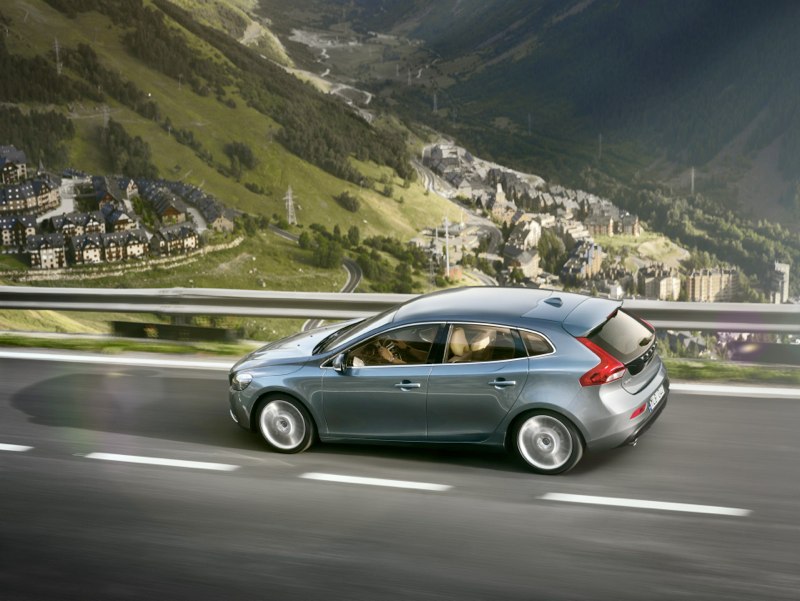
Underneath its swoopy new body, the V40 uses a mixture of old S40 mechanical parts (which also therefore means it's related to the MkII Ford Focus) and some S60 components (which itself draws on the current Ford Mondeo). The result could have been a mish-mash, but actually it works very well. As long as you avoid the optional 10mm lower Sport Suspension, the V40 combines such talents as being a refined and comfy motorway cruiser and a decently talented back-roads attacker. Certainly in the mountains above Verona, it felt agile and responsive, displayed no bad manners under than an occasional tendency to understeer at maximum effort and generally gave a good dynamic account of itself. It's not (quite) as engaging to drive as a Golf nor (anything like as much) as a BMW 1 Series, but it does do an excellent job of balancing comfort, agility and stability. Probably Volvo’s best-ever drivers’ car, in fact

The primary engine for Ireland will be the familiar 115bhp, 270Nm 1.6-litre D2 engine, which also sees service in other Volvos, various Fords and a glut of Peugeots and Citroens. It's a thoroughly decent engine, with plenty of low-down oomph, but an unfortunate habit of giving elongated growls at the top of the rev range. Not enough to seriously upset refinement, but you'll never enjoy wringing it out. Volvo claims average fuel consumption of 3.6-litres per 100km (better than 70mpg) which we got nowhere near, but then we did have the sweeping roads of the Dolomites to enjoy, so ask us again on that score once we get the V40 at home in the summer. Co2 emissions are 94g/km when fitted with 16" wheels (a class leading figure) and if you go for the optional 18" rims, that only climbs to a very creditable 99g/km. That should keep you safe from anything Michael Noonan's got planned...

Speaking of options, we need to speak of options. Volvo is offering a frankly bewildering range of optional extras on the V40, some of which can be bought individually, some of which come in packs and to be honest, we still haven't got our heads around it. The headlining safety pack, which includes Pedestrian Detection cameras, blind spot monitors, lane keeping, collision warning and active headlights seems only right and proper to fit to a Volvo, but it will set you back an extra €1,300 on this SE model, thanks to the loading of VRT and VAT on the options. Which, for ground breaking safety items, seems more than a bit churlish of the Government to charge for with one hand while simultaneously smacking us around the head with the other for not driving more safely... Fit the kit and you would almost unquestionably have the safest car in its class.

Other options include such items which you might think should come as standard, including such as Bluetooth phone connection and cruise control. Let's just say that you're going to have to do your homework if you want to spec your V40 up correctly. A couple of options to avoid are either of the twin-clutch Powershift or conventional Geartronic automatic gearboxes, both of which felt erratic and ill-matched to their engines. Ireland will take only the D2 diesel, more powerful 5-cylinder D3 2.0-litre 150bhp diesel and T3 150bhp petrol 1.6, which has a creditable 125g/km Co2 figure.

Thankfully coming as standard is Volvo's new pedestrian airbag, a vast u-shaped device that emerges from the trailing edge of the bonnet should a sensor in the front bumper detect that you've just run into someone. It works above speeds of 20kmh and below 50kmh and is part of Volvo's ambitious commitment to see that by 2020, none of its vehicles should be involved in a fatal collision. Once again, the Swedes are showing the rest of the world the way to go when it comes to safety.

Price-wise, it could find itself in a touch of difficulty though. At a basic €26,995 (for either the entry level diesel or petrol) it's right up against the cheapest BMW 1 or Audi A3. Should it have undercut them more? And is an extra €2-€3k over and above an equivalent VW Golf too much of a stretch for potential buyers? Perhaps it comes down to how well Volvo's traditional safety and environmentally friendly messages can combine with the new-found style, and whether sufficient youthful buyers can be found to whom that will appeal.

The V40 is an instantly appealing kind of car though; not just because it's pretty, not just because it's safe but because it's the kind of car that, even after a few minutes, you want to spend a lot of time with. It feels like a car that will fit neatly into a broad swathe of lifestyles, and with its understated Swedish looks and image, feels a bit more in touch with our caring, sharing times than the more overtly aggressive Germans. It's also a new beginning for Volvo, as it seeks to dramatically expand its sales under its new Chinese owners, Geely Motors. We will more than likely be seeing more versions of the V40; a faux-4x4 XC40 has already been confirmed, a four door saloon is apparently being worked on and a sporty R version is not being ruled out.

If we say the V40 is nice, that sounds like damning with faint praise, but that's exactly what it is; nice. And frankly, these days, a bit more niceness wouldn't go astray.


Facts & Figures

Volvo V40 1.6 D2 SE
Price as tested:€28,995
Range price: €26,995 to €35,995
Cubic capacity: 1,560
Power: 115bhp
Torque: 270Nm
Maximum speed: 190kmh
0-100kmh: 12.3secs
Fuel consumption: 3.6l/100km (78.5mpg)
Co2 emissions: 94g/km
Tax band: A (€160)
EuroNCAP rating: Not yet tested


Wednesday, 26 September 2012

Features: 90 Degrees North; testing inside the Arctic Circle


Glancing around is no good. You have to peer, stare and generally gaze to pick out any landmarks. All around is a soft, hazy white, upset only occasionally by the odd blue streak or grey-green line of snow-dusted trees.


The white-out is all-pervading and details, even with all the peering, seem fuzzy and indistinct. The snow that lies on everything absorbs sound, killing echoes and dampening sound waves to the point that you feel that if you screamed, the guy standing next to you wouldn’t hear it. Everything looks like it’s been taken from the front of a Christmas card, but it’s a bleak, wasteland Christmas card. A post-apocalyptic SantaLand.

Ivalo is a town in the far north of Finland, about 100km north of the Arctic circle and in uncomfortably close proximity to the former Soviet nuclear submarine base at Murmansk. Sixty years ago, frozen and U-Boat-fearing transatlantic convoy vessels would make the long and perilous trek to Murmansk to feed the Red Army’s insatiable appetite for guns, trucks, tanks and ammunition as it ground on its bone-crushing drive to Berlin. More recently, the sinister black shapes of Victor and Typhoon-class ballistic missile submarines would slip noiselessly down the fjord just to the east of Ivalo, heading out to wait, silently, for the call to unleash nuclear annihilation. More recently, those self same black organs of mass murder have been rusting uselessly at their Murmansk quaysides, leading one to ask worrying questions. Such as how much Hammerite can the Russian navy afford to paint on them before the cracks start to get too big? And is that greenish glow on the horizon Aurora Borealis or a reactor core about to go critical?

But the kind of sinister, lingering death concerns (from either freezing cold or uranium) that would put off most tourists is exactly what draws car companies to cheerful spots like Ivalo. Wide open spaces, most of them lakes that freeze over during the long, northern winter are bountiful. The ice can reach thicknesses exceeding three metres, which means that, once cleared of snow, they can be used as the smoothest, clearest test tracks you’ve ever seen. Car companies love these places. All the room to play they could ask for, few local residents to bother and the kind of unpleasant climactic conditions that will keep all but the hardiest and most determined spy photographer indoors. In other words, the perfect place to test, stretch and develop new cars and their peripheral systems to way beyond their expected limits of endurance.

My foot is all but flat to the floor, lifting occasionally to try and balance the weight transfer from front to rear. My hands are sawing comically at the wheel, as if trapped in a cheesy sixties back-projection car chase special effect. The 2.3-litre 215bhp turbocharged five-cylinder engine is screaming to within an micron of its red-line. Outside, the studded, rally-style tyres are slipping and biting, desperately trying to balance the demands of the power I’m asking for with the available grip, of which there is, effectively, none. The studs are chewing up the ice and peppering the side windows with a fine coating of chips as the car struggles to perform the perfect parabolic arc that its dim-witted driver is attempting to scribe. Does anyone want to bet that I’m in a Volvo?

Ten years ago, you’d never have believed it, but now, thanks to a descending line of C70 coupĂ©, tearaway 850 T5 and V70 R estates, successful assaults on the British and European Touring Car championships and the arrival of the gorgeous S60 saloon, Volvo has achieved that which no other manufacturer has truly managed; a cocktail of safety and sex appeal.

Which is precisely why I’m at Volvo’s ice-bound test track (test rink?) just outside Ivalo. It’s not only an opportunity to have a first drive of the XC90 V8 and the AWD T5 version of the V50 estate, it’s also a perfect excuse to punish Volvos DSTC stability control system until it squeaks and begs for mercy.

Of course, the true trick to testing such a clever electronic system is to first sample the car’s responses with it switched off, hence the sideways tomfoolery on a polished ice skidpan. Fun it most certainly was (like all your Colin McRae Rally dreams come true in an orgy of flailing tyre studs and, I suspect, bent valve stems from over-revving the engine...) but it was also educative. Volvo has learned much in the past few years about the black and mysterious art of chassis tuning, and with the V50 being based on the same component set as the beautifully-handling new Ford Focus, the art has been drawn closer to perfection than ever. Even on a surface that’s difficult to stand upright on, and harder still to fall over on with any sense of grace, the V50 performed faultlessly. With the DSTC switched off, its responses were pure, proportional and steady. OK, so it had the benefit of those grippy, studded tyres, but even taking that into account, the V50 proved itself to be a true drivers’ car. Although you could easily accuse the steering of being too artificial in its feel, there’s no doubting the way the chassis responds to steering and throttle input. It trimmed its line when requested, pushed gently wide of the endless skidpan apex when throttle was applied and only spun out when the slip angle got beyond your correspondent’s ability to reset to the straight ahead. Sorry, but Jackie Stewart I ain’t.

Thankfully, under the bonnet is a little electronic box that does a fine impression of the canny wee three time world champ. Volvo calls it DSTC, but we all know it more generically as stability control.

Of course, the most extreme test that a stability control system can be put through is violent swerving followed by sudden braking on a slick surface. Which is why Volvo brought along a lot of cones. Now I know you and I will never likely work up the guts to start weaving in and out of the traffic cones at our nearest road works, however much fun it might sound, but any time a car company brings a bunch of journalists to a test track, the cones are always out and the word ‘slalom’ is never far from someone’s lips.

And despite the shiny surface of the frozen lake offering about as much grip as a margarine covered Tefal, the V50 still slipped between the cones with grace and aplomb. True, eventually even the clever DSTC system will run out of ideas and a few cones were missed or trampled, but even the most violent on-road emergencies usually only involve a few seconds of swerving, so the system has plenty in the bank, really.

More impressive again was the braking test. On the same stretch of polished ice, two sets of cones were placed about 800-metres apart. Line the car up at the first set and hit the accelerator as hard as you can. The studs bite as best they can and the little yellow DSTC warning light starts flashing faster than Jordan at a paparazzi convention as all 215bhp gets shunted through to the tyres. Even with the electronics parceling out the torque, and even cutting back on the throttle, the V50 still reaches about 120kmh by the second set of cones, the braking mark. Now for the good bit; remove hands from steering wheel and stand on the brake pedal with all your might. Your body tenses, the pressure on the middle pedal signalling your brain that a crash stop is about to occur. But it doesn’t. The ice doesn’t have enough grip to stop you quickly, so instead of headbutting the windscreen, you sail majestically on, losing speed gradually as the anti-lock brakes pulse rhythmically away. But despite the fact that you’re offering the steering no instructions whatsoever, the electronics are keeping the V50 on a perfect straight-ahead track. By rights, the car should have snapped into a spin and we should be neatly embedded in one of the two snowbanks that border this stretch. But no. The little Volvo doggedly holds its course until it has come to a safe and complete stop. And then the driver gets out, slips on the grip-free surface and falls over again. Do they make DSTC for boots?

Doing the same tests in the new XC90 V8 was also instructional. Designed originally only for the American market, but coming in right-hand-drive before the end of the year, the new 4.4-litre 311bhp engine is not related to the Jaguar-derived unit now serving duty in the Range Rover, Discovery and Range Rover Sport, despite which, the two units share the same cubic capacity. No, the Volvo unit is an in-house design (apparently with quite a bit of help from distant Ford Motor Company relative Yamaha, who also helped with the design of the Fiesta’s terrific little 1.25 unit that we’ve been raving about for nearly ten years now) that has been specifically created to fit in the tight confines of the XC90’s engine bay. Because the XC was designed around two long, narrow engines (the turbocharged 272bhp straight-six and the 163bhp diesel five cylinder), squeezing in a V8 was not going to be the work of a moment, especially with Volvo’s insistence that the XC90’s clever and effective front crumple zones were sacrosanct.

So the unit is astonishingly compact for a four-and-a-bit-litre engine. Overlapping cylinder bores and a clever approach to the layout of ancillaries like the alternator and fuel pump mean that it slots in neatly, if tightly, where only in-line engines have previously ventured. And it’s a fab engine, with a flood of easy going torque (440Nm) and a meaty V8 grumble that shifts up an octave to a proper scream at high rpm.

And while the XC90 doesn’t quite deport itself as well as the smaller, more nimble V50 on the ice tests (pulls to one side slightly when doing the braking tests with hands off the steering wheel, won’t drift neatly on the skidpan) it’s still mightily impressive for a big 4x4. Fun too. At the end of the braking test, there’s a wide stretch of empty, cone-free ice. Switch off the DSTC, crank on full lock and let the torque out to play. Bet you didn’t know that an XC90 can spin in its own length...

Later, out on the road and we’ve come to a halt at the long fence and tall gate that marks Finland’s border with Russia. I know that the Soviet experiment is long dead and that Russia is now a tourist-friendly (ish) place but it’s still impossible to stifle a shiver of foreboding. All around are tall pine trees and beyond them, the endless whiteness. Who knows how many have perished trying to force or sneak their way across this arbitrary line in the snow?

Clamber back into the cosy comfort of the XC90. Cars these days just seem to shrug off nature so effortlessly. It’s good to peer into the whiteness occasionally, just to remind yourself just what an impressive achievement that is.


Tuesday, 25 September 2012

Road Test: Volvo XC60 Ocean Race AWD


Price as tested: €47,757

+ Looks, beautiful cabin, decent economy, ride comfort
– Awkward driving position, roly-poly handling
= Looks better down the yacht club than most

Galway resident that I am, I guess the Volvo Ocean Race means a bit more to me than just the badge on the side of a few posh Swedish motors. It’s a bi-annual pageant that’s coming to the West again this year, bringing with racing yachts, a truly global competition, a party atmosphere and the inevitable face paint stalls. It’s fun.

To mark the occasion, Volvo has of course produced a series of cars that tie in with the firm’s sponsorship of this famous round-the-world race for big sailing yachts. Tick the VOR box on your order form, and you get nice chrome kick plates, soft leather upholstery with ‘sail-inspired stitching’ and (this is my favourite bit) a loop of sail rope to pull the luggage cover back and forth with.

Underneath our Ocean Race spec XC60 was something rather more unusual. All wheel drive. Now, when the XC60 was originally launched back in 2008, it debuted as a four wheel drive car, but when the front-drive DRIVEe version was launched in 2010, we all figured that the all-paw XC60 was dead and dusted. After all, what would be the point in spending more money, more tax and more fuel on a car that’s never going to go off-road anyway?

Well, the winter snows of 2011 put paid to that assertion, and so Volvo was keen to point out that yes, you can still get an XC60 that lives up to the billing of its chunky, handsome bodywork and high ride height. We didn’t get the snow, but it could come back at any moment...

While the all-wheel-drive traction is certainly a welcome returner and it has its uses even if winter has become spring and is heading once again for summer, let’s be totally shallow and admit the real reason we like the XC60 so much; the way it looks. Yes, yes, skin deep beholders and all, this is a seriously handsome car and the VOR-spec Electric Silver Metallic paint really shows off the lines to great effect.

That beauty continues inside, where the gorgeous biscuit leather upholstery, faultless ergonomics and pretty main dials all work their usual Volvo magic. Ah, but there’s a flaw and quite a serious one. This is the first time we’d ever driven an XC60 with a manual gearbox and it has shown up a quite awful deficiency in the driving position. Quite simple, the seat points one way and the wheels and pedals point another. In fact, so bad is the offset that the only way to drive the XC60 comfortably was to steer with the right hand while resting the left on the gearshift. It honestly felt like steering from the wrong side of the car and brought on swift and merciless backache. Considering Volvo’s hitherto unimpeachable reputation for comfort, this needs sorting, and fast.

Mechanically, all is well though. The 2.4-litre five-cylinder diesel engine is not long for this world, being as Volvo is committed to replacing all its current engines with a new family of four-cylinder petrol and diesel turbos, no bigger than 2.0-litres. That’s a shame as it’s one of the very few truly characterful diesels around. With five pots beating, it sounds great when revved hard and is very refined at all other times. Decently economical too. Volvo claims 5.7-litres per 100km for the car, which you’ll never manage, but our average of 6.9l/100km seems about right for a 4wd car of this size. It’s also surprisingly sprightly, with a big slug of 420Nm of torque punching hard from low down the rev range, making it feel just a touch of a GTI SUV...

Handling wise, it’s a bit of a mixed bag. Thanks to long springs and high profile tyres, the ride is very comfy and well sorted, but the handling does suffer from too much body roll, all of which seems to happen early and at low speeds. This means that the XC is actually better on a country road than it is in town, where roundabouts can make it feel a touch lumbering and lurchy. The feel-free steering, which weights up a bit oddly depending on what you’re doing, doesn’t help either. Best to stay on the motorway, where the XC60 is in it’s element, swishing quietly along and a loping, friendly efficiency.

For the rest of the practical stuff, the rear seats are decently spacious and the boot, although a little shallower than is ideal, is fine.

So, if we get snow in July, just in time for the Volvo Ocean Race to return to Galway, XC60 AWD owners could well be quids in. As will anyone who decides to buy on; it’s a very likeable, pretty and practical car. Fix the awful driving position and there’s no doubt that this would be our favourite compact SUV.


Facts & Figures

Volvo XC60 VOR AWD D3
Price: €47,757
Range price: €43,707 to €58,445
Capacity: 2,400cc
Power: 163bhp
Torque: 420Nm
Top speed: 195
0-100kmh: 10.5sec
Economy: 5.7l-100km (49.6mpg)
CO2 emissions: 149g/km
Tax Band: C. €330 road tax
Euro NCAP rating: 5-star: 94% adult, 79% child, 48% pedestrian, 86% safety assist