Showing posts with label dynamic. Show all posts
Sunday, 25 November 2012
Road Test: BMW X1 18d Sport
Price as tested: €47,670
+ Sharp chassis, more welcoming interior, practical, plenty of poke from smaller engine
– Still looks a little awkward, pricey
= Really quite a sweet car
In just two and a half years, the BMW X1 has notched up sales of more than a quarter of a million units, and that it without it being sold in the massive US car market, a situation BMW is well on the way to rectifying. If you ever doubted the massive current global appetite for classy, compact SUVs, then doubt it no more.
There is a massive slice of my brain that rails against these cars though. Take the specific car we’re testing here; €47k’s worth of X1 18d Sport. Yes, it’s chunky, good looking (if you appreciate the current BMW design idiom) and both decently spacious and practical. But for the same money, you could be in a lower-slung, better looking, better-driving BMW 3 Series Touring, a car that I believe to be just about perfect. Yet people will continue to flock to the X1.
Which should be abhorrent to me (I just love estates) and yet, with a few days in the X1’s company it easily charmed its way into my affections.
The styling has been updated for this year, with a new bumper, front airdam, tweaked lights and some other small adjustments. Cleverly, the converging lines of the bonnet’s power bulge and the upsweep of the front bumper actually makes a subtle X-shape. Clever, that.
Inside, the quality of materials used and the fact that the centre console has been redesigned (it now faces more obviously towards the driver) is genuinely welcoming. The Sport spec helps here, with figure-hugging seats that, in spite of a distinctly offset driving position, mean long journeys are very comfy experiences. In spite of being an X1, it’s pretty close to the 3 Series in space terms, and the boot out the back is large (420-litres), deep and square. A shame that the X1 doesn’t get a separate opening glass window in the tailgate (as does the 3 Touring) but hey, you can’t have everything.
Having some cake and eating it is the very point of the newly-fitted 18d diesel engine though. In spite of the name, it’s actually a de-tuned 2.0-litre (1,995cc to be exact) and pumps out 143bhp and 320Nm of torque. Those aren’t exactly ground-shaking figures, but actually the X1 feels plenty brisk and only starts to struggle when you get into the upper reaches of the rev band. Happily, with that much low-down torque, you won’t need to do that very much, so progress is swift and relaxed.
Thanks to BMW’s clever EfficientDynamics systems (a battery of fuel-saving tech including stop-start, brake energy recovery, a low-drain air conditioning compressor and more) the X1 18d returns impressive official figures of 5.4-litres per 100km (that’s 52mpg) and 143g/km of Co2. Impressively, those figures are attained with the optional 8-speed automatic gearbox fitted, as it was to our test car. It costs a whopping €2,191 but it’s so smooth, unobtrusive and effective that it just might be worth it. An auto that genuinely calls the need for a manual into question.
BMW has also clearly been at work on its suspension setups. A few years ago, a large-wheeled (17” alloys), stiffly-sprung BMW SUV in Sport spec would have been a recipe for loosened fillings and shattered spines. This time around though, although Germanic firm-ness is still the name of the game, there is a subtle suppleness that makes everything much more relaxing. And yet the BMW traditions of sharp handling and a balanced chassis are still there in spades. Meanwhile, the X-Drive all-wheel-drive system gives you terrific confidence in changing conditions. Or just when it’s chucking it down with rain. You can get a cheaper S-Drive version with rear-wheel-drive, but if you’re buying an SUV, shouldn’t it be 4wd?
One caveat though; the steering, which although communicative and brilliant at speed just weights up too much around town and at lower speeds. It’s just too darned heavy and surely that’s not good for the likely target market for these cars.
Still, with that one small flaw in the diamond, I’ve come away from the X1 really rather liking it. No, it’s not perfect and yes, I’d still overall have a 3 Series Touring for similar money, but if you’re into the whole SUV thing (and many, many of you are) and you fancy the famed Blue and White flag of Munich on your driveway (again; many, many) then this is a good place to start.
BMW X1 X-Drive 18d Sport
Price as tested: €47,670
Price range: €35,160 to €49,010
Capacity: 1,995
Power: 143bhp
Torque: 320Nm
Top speed: 195kmh
0-100kmh: 10.1sec
Economy: 5.4l-100km (52.3mpg)
CO2 emissions: 143g/km
Road Tax Band: C. €330
Euro NCAP rating: 5-star; 87% adult, 86% child, 64% pedestrian, 71% safety assist
Thursday, 27 September 2012
Road Test: Fiat Abarth 500C
Price as tested: €31,000 (approx)
+ Styling, engine, handling, seats, quality, sense of fun
– Tiny boot and rear seats, quite thirsty, no official imports yet
= Funnest hot hatch of the moment
Like a Scottish Terrier carrying a Kalashnikov, the Fiat Abarth 500C is packing way more aggression than befits something so small. The standard 500 is cute, chic, even (whisper it) a bit girly. The Abarth is its mildly psycho brother who's into body piercing and headbutting walls.
As with all great Italian cars, the heart of the Abarth is its engine, a 1.4-litre turbo petrol developing 135bhp. 135bhp doesn't sound like much these days, but it's accompanied by a decent slug of 200Nm of torque and, in practice, there's more than enough grunt to both hoick you up the road at a suitably impressive rate and keep you making rapid gearchanges on the stubby five-speed manual, punching them through from the elbow.
When you do that, and especially during fast upshifts as you accelerate, the optional Monza exhaust (which actually adds 5bhp thanks to improved engine breathing, bringing the Abarth up to 140bhp), with its mildly hilarious quad exit pipe, bangs and growls like a grumpy howitzer battalion. It's all ludicrously entertaining, and thanks to the 500's diminutive dimensions, it all happens at a reasonable rate of consumption. 8.1-litres per 100km sounds a touch thirsty for a small car, but in the context of the fun on offer, it's a perfectly acceptable price of admission.
It always used to be the case that with high-performance Italian cars, you paid for the (glorious) engine and the rest of the car was thrown in (and together) for free. Famously, journalist and racer Paul Frére complained to Enzo Ferrari that his Testarossa Le Mans racer had such a big, flat windscreen that it was crawling down the Mulsanne Straight while the sleek Jaguars and others blasted past. "Well you know," declared Il Commentadore airily, "aerodynamics are for people who can't design proper engines..."
Thankfully, the Abarth 500 proves that such dismissiveness is truly a thing of the past for fast Fiats (effectively what Ferraris have been since the seventies; heresy I know). The 500C feels beautifully built for a start, with high levels of cabin quality and gorgeous high-backed Alcantara bucket seats. Rear space is somewhat compromised by these bulky buckets, but it was hardly all that roomy to begin with, and by choosing the C over the regular hatch 500, with its peel-back convertible roof, you are effectively resigning yourself to having no boot space to speak of. A squashy bag is about the limit.
No matter. Once you get rolling, you won't care about the practicalities. It may sound odd to say it of a stiffly sprung sporty thing with big optional alloys and watch strap Pirellis, but the Abarth actually rides better than the standard 500.It bounces around less, even though it's plainly harder than the standard car, and the steering, so remote on a normal 500, is here full of feel and delightful weight. There is simply tonnes of grip, a little hint of the back end squirming around when you corner seriously hard and an abiding sense of out and out fun and enjoyment. Occupying an even smaller amount of road than Mini's conceptually similar Cooper S Works, the 500C feels ideally suited to Ireland's twisty and narrow back roads. And because it's not over-burdened with some silly specific output, you can enjoy ringing its neck a little without attracting the attention of either sides of the legal profession.
When the going gets properly twisty and slippery, it’s best to thumb the TCC button just below the aircon controls. That activates an electronic differential which brakes an unloaded front wheel to prevent power being spun away and which also helps the Abarth’s chassis to reduce understeer to an effective minimum. Unlike some similar systems (or a pure mechanical diff) it doesn’t bring with it unnecessarily hefty steering or camber-following tendencies, it’s much more subtle and effective than that.
As yet, Abarth models are still not officially imported into Ireland, but their visa status is due to be updated any time now. For the meantime, you can personally import one (a process that I’m sure your local Fiat dealer would be more than happy to help with) and you’ll have to fork out in the region of €27,000 for the 500C, about €2,000 less for the hatch. Our test car came loaded with options including that wonderful Monza exhaust and the gorgeous high-back Sabelt seats which swelled its price by €4,000. Pricey for such a small car then, but very much worth it to my mind. Besides, try speccing a Mini Cooper S up to similar levels and see where you get to...
You could spend even more and upgrade to the Essesse kit, which brings with its more power (160bhp), uprated brakes and tweaked suspension, but the extra stiffness would probably ruin the Abarth’s rather lovely ability to flow with bad roads rather than fighting them, so I wouldn’t bother.
Personally, I'd skip the C part too (the roof is nice and all, and works at speeds of up to 80kmh, but its usability in Ireland is always going to be limited) and go for the hatch, which also brings with it a more practical boot and that slight cut in price. Would I buy one? Oh, if only I could afford it. Hot hatches have become, as a species, somewhat too refined and practical of late. Even the likes of a 200bhp Clio or DS3 can fail to provide much in the way of outright thrills, so steady and safe are they. The Abarth feels a touch more unruly, raw and on the edge than that. It's the hot hatch as she is meant to be spoken.
Fiat Abarth 500C
Price as tested: €31,000 (approx)
Price range: €12,895 to €27,000 (approx)
Capacity: 1,368cc
Power: 135bhp
Torque: 200Nm
Top speed: 205kmh
0-100kmh: 7.9sec
Economy: 6.5l-100km (43.4mpg)
CO2 emissions: 155g/km
Road Tax Band: C €330
Euro NCAP rating: 5-star adult, 3-star child, 2-star pedestrian

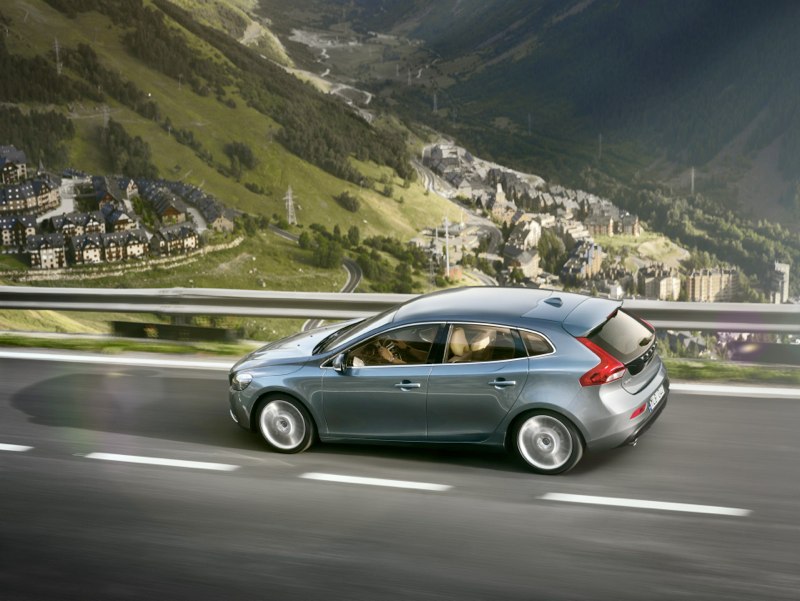
Road Test: Volvo V40 D2 1.6 SE
Price as tested: €28,995
+ Styling, cabin, comfort, dynamics, safety, innovation
– Poor auto ‘box, gimmicky functions, expensive and confusing options list
= Volvo's best drivers’ car should give the A3 a fright
With the new V40, Volvo is at last right-sizing its range. The previous S40 saloon and V50 estate were nice cars in their own right, but sat at confusing price and size points, half way between the likes of a BMW 1 Series and 3 Series. Now, they have been done away with (although the smaller C30 hatch will continue for a while in some markets) and replaced with a new hatchback, the V40, which aims itself right down the throat of the 1 Series, the Audi A3 and the upcoming new Mercedes-Benz A-Class, while also taking on the likes of the Alfa Romeo Giulietta or a well-specced VW Golf.
Style-wise, it certainly makes an impact and is probably Volvo's best styling effort since the clean, muscular 1995 C70. You could easily accuse it of having a few too many lines and the little inset in the rear doors, meant to homage the original P1800 coupe, is rather lost. But for all that, it's a deeply handsome car; unmistakably a Volvo but still breaking new styling ground for the brand.
Inside, much has been lifted from the existing S60 saloon and that's no bad thing. It looks gorgeous in there and quality levels are very high with, as almost goes without saying for a Volvo, comfort levels to match. Space is excellent in the front, aside from a slight lack of foot space for front passengers, while it’s fine in the back, even for tall passengers, unless you option it up with the panoramic glass roof, which robs a bit of headroom. The 'floating' centre stack has been a love-it-or-hate-it Volvo touchstone for some time now but the TFT digital instrument pack is all new. It's fitted to all but the most basic ES models (which make do with regular analogue dials) and allows you to customise the display colours and layout to your taste, flicking between Comfort, Eco and Sport modes. To be honest, it's a bit too gimmicky for its own good, with the layouts being pretty but not very intuitive and, oddly for a Volvo, needing you to distract yourself from the road ahead too frequently to figure out what's going on.
Equally gimmicky and equally pointless is the adjustable steering weight. We've come up against similar systems in the past (hello, Hyundai i30) and they are rarely, if ever, satisfactory. Yes, there is a difference in feel and effort in each mode, but it's too subtle a difference to make it worth the effort and we'd rather see a single setting that works well for all. Just leave it in Light mode and you'll be fine.
Underneath its swoopy new body, the V40 uses a mixture of old S40 mechanical parts (which also therefore means it's related to the MkII Ford Focus) and some S60 components (which itself draws on the current Ford Mondeo). The result could have been a mish-mash, but actually it works very well. As long as you avoid the optional 10mm lower Sport Suspension, the V40 combines such talents as being a refined and comfy motorway cruiser and a decently talented back-roads attacker. Certainly in the mountains above Verona, it felt agile and responsive, displayed no bad manners under than an occasional tendency to understeer at maximum effort and generally gave a good dynamic account of itself. It's not (quite) as engaging to drive as a Golf nor (anything like as much) as a BMW 1 Series, but it does do an excellent job of balancing comfort, agility and stability. Probably Volvo’s best-ever drivers’ car, in fact
The primary engine for Ireland will be the familiar 115bhp, 270Nm 1.6-litre D2 engine, which also sees service in other Volvos, various Fords and a glut of Peugeots and Citroens. It's a thoroughly decent engine, with plenty of low-down oomph, but an unfortunate habit of giving elongated growls at the top of the rev range. Not enough to seriously upset refinement, but you'll never enjoy wringing it out. Volvo claims average fuel consumption of 3.6-litres per 100km (better than 70mpg) which we got nowhere near, but then we did have the sweeping roads of the Dolomites to enjoy, so ask us again on that score once we get the V40 at home in the summer. Co2 emissions are 94g/km when fitted with 16" wheels (a class leading figure) and if you go for the optional 18" rims, that only climbs to a very creditable 99g/km. That should keep you safe from anything Michael Noonan's got planned...
Speaking of options, we need to speak of options. Volvo is offering a frankly bewildering range of optional extras on the V40, some of which can be bought individually, some of which come in packs and to be honest, we still haven't got our heads around it. The headlining safety pack, which includes Pedestrian Detection cameras, blind spot monitors, lane keeping, collision warning and active headlights seems only right and proper to fit to a Volvo, but it will set you back an extra €1,300 on this SE model, thanks to the loading of VRT and VAT on the options. Which, for ground breaking safety items, seems more than a bit churlish of the Government to charge for with one hand while simultaneously smacking us around the head with the other for not driving more safely... Fit the kit and you would almost unquestionably have the safest car in its class.
Other options include such items which you might think should come as standard, including such as Bluetooth phone connection and cruise control. Let's just say that you're going to have to do your homework if you want to spec your V40 up correctly. A couple of options to avoid are either of the twin-clutch Powershift or conventional Geartronic automatic gearboxes, both of which felt erratic and ill-matched to their engines. Ireland will take only the D2 diesel, more powerful 5-cylinder D3 2.0-litre 150bhp diesel and T3 150bhp petrol 1.6, which has a creditable 125g/km Co2 figure.
Thankfully coming as standard is Volvo's new pedestrian airbag, a vast u-shaped device that emerges from the trailing edge of the bonnet should a sensor in the front bumper detect that you've just run into someone. It works above speeds of 20kmh and below 50kmh and is part of Volvo's ambitious commitment to see that by 2020, none of its vehicles should be involved in a fatal collision. Once again, the Swedes are showing the rest of the world the way to go when it comes to safety.
Price-wise, it could find itself in a touch of difficulty though. At a basic €26,995 (for either the entry level diesel or petrol) it's right up against the cheapest BMW 1 or Audi A3. Should it have undercut them more? And is an extra €2-€3k over and above an equivalent VW Golf too much of a stretch for potential buyers? Perhaps it comes down to how well Volvo's traditional safety and environmentally friendly messages can combine with the new-found style, and whether sufficient youthful buyers can be found to whom that will appeal.
The V40 is an instantly appealing kind of car though; not just because it's pretty, not just because it's safe but because it's the kind of car that, even after a few minutes, you want to spend a lot of time with. It feels like a car that will fit neatly into a broad swathe of lifestyles, and with its understated Swedish looks and image, feels a bit more in touch with our caring, sharing times than the more overtly aggressive Germans. It's also a new beginning for Volvo, as it seeks to dramatically expand its sales under its new Chinese owners, Geely Motors. We will more than likely be seeing more versions of the V40; a faux-4x4 XC40 has already been confirmed, a four door saloon is apparently being worked on and a sporty R version is not being ruled out.
If we say the V40 is nice, that sounds like damning with faint praise, but that's exactly what it is; nice. And frankly, these days, a bit more niceness wouldn't go astray.
Facts & Figures
Volvo V40 1.6 D2 SE
Price as tested:€28,995
Range price: €26,995 to €35,995
Cubic capacity: 1,560
Power: 115bhp
Torque: 270Nm
Maximum speed: 190kmh
0-100kmh: 12.3secs
Fuel consumption: 3.6l/100km (78.5mpg)
Co2 emissions: 94g/km
Tax band: A (€160)
EuroNCAP rating: Not yet tested
Road Test: BMW 640d Gran Coupe
Price as tested: €120,033
+ Gorgeous, balanced chassis, mighty engine, comfort, economy, noise
– Nothing much
= Makes you feel like Batman. No higher recommendation.
Much as I foolishly did when I first drove the new BMW 6 Series convertible, I came to the Gran Coupe with some unfortunate preconceptions. Too big. Too bloated. Too much of a plutocrat barge for this day and age. A €100k car in 2012 Ireland? C'mon, that's like €30k more than Audi asks for the A7 or Mercedes wants for a CLS. Etc etc. And so on.But, just as I did with the cabrio, I (spoiler alert) came away utterly loving the car. Which just goes to prove two things. One, never underestimate BMW and, two, review the car on the road, not the car in your head...
So, what is a Gran Coupe? Well, it's the latest in a burgeoning line of car makers either adding extra doors to existing two-door coupes or chopping the rooflines of existing saloons to create saloon-coupe hybrids. The idea is to create cars with the looks and panache of coupes with most of the easy-access practicality of saloons. Thus the afforementioned CLS and A7 but also the A5 Sportback, the Volkswagen CC and sundry others currently in development.
In the specific case of the Gran Coupe, BMW has taken the standard 6 Series shell, given it a 113mm wheelbase stretch (taking to just beyond the 5-metre long mark) and crammed in a couple of extra doors. The result is a long, low wide chop-top that manages to avoid looking like a 6 Series that's turned back, Cinderalla-at-midnight-style, into a 5 Series and is frankly, pretty gorgeous. Especially in the black of our test car, which in true Father Ted fashion, wasn't actually black at all but instead very, very, very, very, very dark blue. It's gorgeous and I'm going to shut up now and just let you go and look at the photos.
Done? Good, then I'll continue...
Behind the sharks-nose grille and lights likes the 40d diesel engine, actually a 3.0-litre straight-six with twin sequential turbos – a development of the engine we've been familiar with for many years in the 535d and the old 635d. Now, it comes with some interesting figures. 313bhp is a good start but 630Nm of torque is even better again and those are combined with a 5-odd-secs 0-100kmh, claimed 50mpg fuel economy and 148g/km of Co2. That is frankly a remarkable set of figures and proof once again that BMW's chief engine designer is actually a Mr. Potter, a youthful man with glasses who displays his diploma from Hogwarts with quiet pride.
It's a truly stunning engine to be in control of, so much so that it eclipses the more headline-grabbing 560bhp petrol V8 from the M5 in my mind. Power arrives in a near-silent rush from below 1,500rpm, shunting the 630d forward in a manner that suggests that the Atchison, Topeka and Santa Fe express has derailed and smacked you, silently, up the backside. The engine only makes you aurally aware of it at higher rpm, where instead of a diesel rattle, you get a creamy, slightly rough-edged snarl. It's lovely. And addictive. Rather like cream itself.
As for economy, well almost needless to say we couldn't match BMW's claimed figure but our average, which hovered in the mid-sevens in terms of litres burned per 100km traveled (a solid 45mpg-ish) still seemed pretty good, and if we also failed to match BMW's claimed touring range of 1,300km, then a solid 8-900km still seems achievable.
Inside, in spite of the Gran Coupe's extra length, the cabin still feels intimate and tight fitting. The dash and centre console seem to bulge and swoop almost organically around the driver, allowing you to settle deep within the car, wheel pointing straight at your chest. The standard leather trim is gorgeous and inviting and the seats prove endlessly comfortable, something the old-shape 6 Series missed out on.
In the back, while it's not surprisingly not as commodious as a 5 Series, the Gran Coupe is absolutely fine for both head and legroom and unless you're the star player for your local basketball team, you should be able to get very comfy. That practicality is backed up by a 460-litre boot which should be adequate for most purposes.
To drive, that stretch in the wheelbase seems only to have improved the dynamics relative to the standard 6 coupe. Not that the standard car is lacking in any sense but just that the Gran Coupe seems to give you a wider range of options. Selecting comfort from the little toggle switch by the gear selector for the excellent 8-speed automatic transmission seems to be the best option for Irish roads. Sport is fine and won't knock your fillings out, but Comfort just gives you that extra little sense of flex that turns tackling an Irish back road from a chore to a delight. In spite of its size, the Gran Coupe can be cornered on a pin and placed to within millimetres of your desired trajectory. The steering, in any of the four modes, is always a little bit wooly and artificial feeling (something not helped by BMW's continuing insistence on fitting its M-Sport specced cars with fat, over-stuffed steering wheel rims) but the reactions of the chassis itself are wonderfully well balanced and its these that you learn to exploit, and never mind the faintly disappointing steering.
I had expected many things of the Gran Coupe, few of them good. Given the massive extra expense it asks buyers to stretch too relative to an Audi A7 or Mercedes CLS, I was certain ahead of the fact that BMW was overstretching itself, and I remain convinced that the Mercedes actually has the better sorted chassis. But the Gran Coupe, thanks in no small part to its wonderful engine, is actually a star performer and goes so far to justifying its lofty six-figure price tag that you almost begin to forgive the expense. Fabulous to drive, irrepressibly grunty and bewitching to look at, it may be a niche within a niche but that's a niche I'd happily squeeze myself into.
Actually, on a final note, the best drive I had in the Gran Coupe was not up some twisting coast road (although I did do that and it was fabulous) but a gentle 50-60km pootle to my local cinema and back. The Dark Knight Rises, the new Batman film was on, and comic book nut that I am I simply couldn't resist. Coming back out after nearly three hours of Bat-tastic Batmanery and plipping the lock on the low, dark, glowering Gran Coupe felt just perfect, and for the briefest of moments, I was Bruce Wayne. And that might just be the moment at which the Gran Coupe's price tag begins to look worth it...
BMW 640d Gran Coupe M-Sport
Price as tested: €120,033
Price range: €97,110 to €131,520
Capacity: 2,993cc
Power: 313bhp
Torque: 630Nm
Top speed: 250kmh
0-100kmh: 5.4sec
Economy: 5.6l-100km (50.4mpg)
CO2 emissions: 148g/km
Road Tax Band: C €330
Euro NCAP rating: Not yet tested
Wednesday, 26 September 2012
Road Test: Mazda CX-5 2.2d Sport
Price as tested: €29,495
+ Steering, performance, economy, refinement, quality
– Dark cabin, jiggly ride, quite pricey
= SkyActiv tech makes it frugal, Mazda engineers make it fun.
There is only one segment of the motoring world that is actually seeing much growth at the moment, and that’s the compact SUV and crossover market. It’s not hard to see why, really. Families, outgrowing hatchbacks but not fancying much the suburban sameness of estates or, worse, MPVs, are flocking in droves (well, as close as we get to droves these days) to the likes of the Nissan Qashqai, Skoda Yeti and Ford Kuga. You get the appealing SUV style you crave, the space and practicality you need but you’re not mugged every time you visit the fuel pump or pay your road tax. Everyone wins.
That being the case, pretty much every car maker is scrambling to get a foothold on the ladder that Nissan effectively invented with the Qashqai. Mazda is the latest to try its hand, but it’s going about the launch of its CX-5 rather differently to most.
For a start, Mazda is making the bold claim that the CX-5 will be the enthusiastic driver’s choice in the segment, but it’s also using the car as the launch vehicle for its new SkyActiv technology.
SkyActiv is a holisitc system that sees vehicle weights trimmed, engines made ever more efficient, transmissions made lighter and with reduced friction and every little tweak and twonk that will help push down emissions and raise fuel efficiency. It’s how Mazda is able to offer the new CX-5 with a large, torquey 2.2-litre 150bhp diesel engine yet also claim best in class Co2 emissions (119g/km, so your road tax will just be €160 for now) and fuel economy (4.6-litres per 100km claimed, or around 60mpg).
Those are impressive figures, but sadly, our necessarily brief test route didn’t allow us to put any strain on them. It’ll just have to wait for now, but in fairness to Mazda, it’s not a firm given to extravagant claims.
Or extravagant anything, really. Mazda has always been admirable for its championing of both driver pleasure and reduced vehicle weights and while that hasn’t done its sales much good of late (the firm posted a global $1.2-billion loss last year) its SkyActiv tech is much to be admired, especially as it majors on driver pleasure while delivering real-world figures that will trounce a needlessly complicated hybrid.
Driver pleasure? Oh yes, the CX-5 is indeed a sweet little thing to drive. The steering is beautifully weighted and feeds back nicely, allowing you to point the nose tight into an apex, sure in the knowledge that grip is there, even on the slippery, rain-slicked Cork roads we tested the car on.
The snick-snick six-speed gearshift helps too, much inspired by the MX-5 roadster in its weighting and motions and generally the CX-5 feels all of a piece, hingeing nicely around the driver as you tackle a twisty road.
On a cruise, it settles down nicely, and that punchy 2.2 diesel engine keeps its noise levels pleasantly low at pretty much all times. It’s a very impressive unit, pulling hard with 380Nm of torque and only betraying a diesely rattle or breathless turbo at very high rpm. If this is the future of SkyActiv, then count us in. Wind and road noise are also well suppressed, although it did give in to an occasional bout of tyre roar, depending on the surface.
You will feel everything on that surface though. Perhaps Mazda is focusing the CX-5 as the driver’s choice simply because it excuses a ride quality that’s very firm and jiggly. Even on a smooth surface, there’s a constant pitter-patter and that may prove an issue for the family market that Mazda wants to attack with the CX-5. Our test car was a Sport model, so perhaps an Executive or Sport SE would be a touch smoother.
Otherwise, on the family front, the news is good. The rear seats are spacious, the boot large and square at 500-litres and the cabin feels beautifully put together and of very high quality, even if it is a touch too dark and lacking in eye-catching detail. We love the ‘Karakuri’ rear seats though which flip down at the tug of a lever in the boot. Very handy in the B&Q car park.
Standard equipment levels are very good, with a touchscreen, Bluetooth, air conditioning and, standard across the range, a city braking system that slams on the brakes if it detects an incoming low-speed collision. If you can’ avoid that collision, the body is largely constructed of high-tensile steel and Mazda is expecting some high marks from EuroNCAP.
As well as SkyActiv, the CX-5 is also the launch point for Mazda’s new ‘Kodo’ design language, which will also be appearing on the new 6 saloon come January. From the front, it’s very effective, with a deep, bold grille, nicely detailed lights and a general air of sportiness. It’s less good around the back, though, where the CX-5 tends to blandness, but the overall style is nice and it bodes well for future models.
A word on pricing. When the 2.0-litre petrol model (which you may be tempted to ignore, but which actually has very reasonable Band B emissions of 139g/km) the CX-5’s entry price point will be €25k. For now though, it’s €28k for an Executive-spec 2.2 diesel and €29k for the Sport which Mazda reckons will be its top seller. That puts it in a very competitive spot when compared to the likes of the Ford Kuga and VW Tiguan, not to mention the premium brands, which apparently some customers are already trading into CX-5’s from, but it’s a significant amount more than you’d spend on a Nissan Qashqai or a Skoda Yeti. Mazda claims that such vehicles aren’t in the CX-5’s sphere, because of size, price, spec and engines but we reckon that some customers won’t see it that way.
Still, Mazda has made a very effective product for itself here. If the economy figures stack up, then that smooth, punchy 2.2 SkyActiv diesel is a genuine revelation and the chassis, ride aside, will be seriously pleasing when you get your CX-5 to yourself on a twisty road. Kids will appreciate the spacious rear seats and the SUV style, owners will appreciate the road tax figures and Mazda’s iron-clad reputation for reliability and quality. Fix the ride and brighten up the cabin a bit and we’d call it nigh on perfect.
Addendum: It turns out that our test car was given to us with over-inflated tyres which were running a wrecking ball through Mazda's carefully honed suspension settings. Having sampled some other CX-5s since, with correct PSI settings, we can confirm that it rides firmly, but comfortably. Nice one.
Facts & Figures
Mazda CX-5 2.2d 150 Sport
Price as tested: €29,495
Range price: €25,195 to €34,895
Capacity: 2,191cc
Power: 150bhp
Torque: 380Nm
Top speed: 202kmh
0-100kmh: 9.2sec
Economy: 4.6-100km (61.0mpg)
CO2 emissions: 119g/km
Tax Band: A. €160 road tax
Euro NCAP rating: Not yet tested
Subscribe to:
Posts (Atom)