Showing posts with label diesel. Show all posts
Thursday, 7 February 2013
Road Test: Opel Mokka 1.7 CDTI SE
Price as tested: €26,495
+ Styling, handling, quality
– Noisy & outdated engine, tight rear seats and boot
= Firmly underscores Opel's premium ambitions
Tuesday, 5 February 2013
News: Updated Kia Sorento goes on sale
The new 2013 Kia Sorento goes on sale in Ireland this week .Powered by an improved and more economical 2.2 197bhp diesel engine both trim levels available Ireland will be fitted with All Wheel Drive as standard. The Sorento is a 7-seater with the EX model priced at €37,990 and the Platinum model at € 41,790. Astonishingly, given the similar looks to the model that came out in 2010, it's all-new from the ground up.
Labels:
diesel,
eDrive,
Ireland,
Kia,
Korean,
long warranty,
low emissions,
new,
new car,
News,
reliable,
seven-seater,
sophisticated,
Sorento,
SUV,
upgraded
Thursday, 31 January 2013
News: Citroen C3 Picasso gets updated
One of our favourite cars, the Citroen CS Picasso (check out our recent long term test HERE) is getting an update and freshen up for 2013, but sad to say, there's a small note of disappointment in the news.
Labels:
Band A,
C3,
C3 Picasso,
Citroen,
compact,
diesel,
eDrive,
family,
Ireland,
low emissions,
MPV,
new car,
News,
spacious
Tuesday, 29 January 2013
Road Test: Skoda Rapid 1.6 TDI Elegance
Price as tested: €24,265
+ Simplicity, quality, reliability, space, practicality, price, styling, comfort
– A few rough edges showing through to go with that price tag, indifferent handling
= As practical and sensible as they come but we'd save up the extra for the new Octavia
If I were to say that the new Skoda Rapid is both and at once a return to classic form for Skoda and something of an unfortunate step backwards, would that be too confusing? Possibly, so let me explain.
Pre-1998, Skoda was to most people a joke and not an especially funny one. Decades of decrepitude under communist rule meant that Skoda had been starved of development funding and any reason to produce competitive, interesting cars. That changed, dramatically, with the launch of the original Octavia, funded and developed by Skoda's new owner, Volkswagen. At once, the yoke of communism was thrown off, and Skoda marched happily forwards into a new capitalist reality. Successive models, from the Fabia to the second generation Octavia to the Superb to the utterly brilliant Yeti underpinned that reality with success, both critical and financial. And with sophistication. In fact, sit into a Yeti or a Superb today and you'd be hard-pressed to tell the difference between affordable Skoda and aspirational Audi. They are that good.
But there is now an increasing trend in the motor industry towards making cheaper cars, something that the car buying public is lapping up, as the success of Dacia shows. Make something simple and affordable, and you will capture the wallets, if not the hearts, of many. So it is with the Rapid. Skoda has taken a step back from its shiny, sophisticated recent past and looked further back, to the eighties and beyond, when it made simple, affordable, useful cars. (Never mind the inept comedians of the eighties who castigated Skoda – its cars even then were better by far than their reputation would have you believe.)
The Rapid is a family-sized hatchback that occupies an unusual middle ground between the likes of the Polo and Fiesta on one side and the Golf and Focus on the other. It's narrower by far than a Focus, but also much longer, the upside of which is a cabin that, while not very broad, has lots of leg and head-room for tall passengers in both front and rear, and a massive 550-litre boot that makes the trunks of even cars like a Mondeo or Passat look underfed.
So, it pushes all the practical buttons and it's not short of sophistication either. The engine in our test car was the cutting-edge VW Group 1.6 TDI diesel, and with 105bhp and 250Nm of torque, it's both swift and economical. Skoda claims 4.4-litres per 100km fuel consumption (64mpg) and if we didn't quite manage that, we easily broke the 50mpg barrier. 114g/km Co2 emissions is a touch high though, especially when you consider that a VW Golf with essentially the same engine gets closer to 100g/km, and that means your annual tax bill will be €200. It's here that you'll find the first chink in the Rapid's armour though. The engine (or possibly its installation) is fine, but nothing more. Acceleration feels noticeably slow-witted unless you push the oddly-weighted throttle pedal all the way to its stop, and refinement isn't terrific until you settle down at a chosen cruising speed.
Inside, Skoda has made great efforts to make the cabin look and feel as sophisticated as its bigger brothers, while still costing less. It's a neat trick, and Skoda almost pulls it off. The dials are clear and look like expensive watch faces. The steering wheel feels pleasant to hold and the driving position is both comfortable and well sited. But you'll notice that there's no switches in the front to control the rear windows, the grab handles in the roof clang back into position without a nice, soft motion and the plastics on the doors and dash-top, while still of good quality, don't have that nice touchy-softy-squishy feeling.
Because of all that, the Rapid feels a distinct degree less sophisticated than its Skoda cousins. Now, that's fine in the sense that it's also much cheaper. Prices start at just €16,515 (for the 1.2 MPI petrol; an engine best avoided if you want to (a) accelerate or (b) save fuel) and the pick of the range, the 1.2 TSI turbo petrol in Ambition spec, is just €19,550, with almost identical Co2 emissions to the diesel. All well and good, and those prices include standard electronic stability control – a significant benefit.
But it just doesn't feel as good to drive as it either should or could have. The rear suspension has been done on the cheap, relatively speaking, and uses simple torsion bars instead of the more modern multi-link setup as found on most Octavias. That means the boot is massive, but the Rapid does tend to clatter over bumps, and it never feels very well sorted at the front, either. Cornering is a somewhat lazy, imprecise process with vague steering and a sense of detachment. It's a good motorway cruiser, mind, with well suppressed engine noise and only a small amount of road and tyre noise.
I guess it depends what you want from a car. The Rapid is keenly priced, practical, spacious, ruggedly built, should prove reliable and hits its marks in terms of economy and emissions. It even looks quite nice. But I reckon Skoda buyers, by and large, have moved on recently and are enjoying the sheen of quiet luxury on recent models. So, perhaps it would be best to hold off buying, save up a little more, and get your hands on the impressive new Octavia that arrives in March. The Rapid's backward glance to a simpler, more practical time is appealing in many ways, but we all want to feel a little more sophisticated these days, don't we?
Facts & Figures
Skoda Octavia 1.6 TDI 105bhp Elegance
Price as tested: €24,265
Range price: €16,515 to €24,265
Capacity: 1,598cc
Power: 105bhp
Torque: 250Nm
Top speed: 190kmh
0-100kmh: 10.4sec
Economy: 4.4l-100km (64mpg)
CO2 emissions: 114g/km VRT Band: A4. €200 road tax
Euro NCAP rating: 5-star; 94% adult, 80% child, 69% pedestrian, 71% safety assist
Wednesday, 23 January 2013
Road Test: Honda Civic 1.6 I-DTEC SE

Price as tested: €23,795
+ Terrific engine, quality, space, practicality
- Dynamically not as sharp as it should be
= Lovely engine but doubters will still need convincing
Just over a decade ago, Honda didn't make Diesel engines. In spite of the great advances that, even that long ago, had been made in making diesels smoother, gruntier and more refined, Honda regarded them as anathema. Too noisy, too smelly and just not us, old boy. We'll stick to high-revving, lightweight VTEC petrol screamers, thanks.
Given that, it was a pleasant surprise that the original 2.2-litre i-DTCi engine was, and remains, so good. And if it has taken this long to get a second, more compact, Honda diesel to the market then at least, as with John Mills' pint at the conclusion of Ice Cold In Alex, it was worth waiting for.
Honda's new 1.6-litre i-DTEC engine makes its debut in the Civic, a car which pushed Honda Ireland's sales up by a healthy 12% last year, against the background of a stagnant market. And given that the Civic's lonely 2.2-litre diesel, even with its Band A emissions, excluded Honda from the bulk of the c-segment market, its expectations for the new engine are commensurately high. It's expected not just to expand overall Civic sales, but to do so while simultaneously taking over most of the 2.2-litre's sales.
Just as well then that Honda's engineers haven't simply sleeved-down the old 2.2 to make a 1.6. The engine is new from the sump up and Honda claims that it's the lightest engine in its class. So sylph like is its weight that Honda has retuned the Civic's front suspension and steering to take advantage, with claims for improved feel and agility being made.
Honda makes great claims for its refinement, even fitting an active acoustic damping system in the cabin, and the result is indeed hushed; you only get a distinct diesel clatter when you venture beyond 2,500rpm. Better again is the performance. The 120bhp Honda gets from its 1.6 makes mincemeat of the similarly sized engines in the rival Ford Focus and VW Golf (95 or 115bhp and 105bhp respectively) and the i-DTEC engine makes a decent fist of convincing you that it's much larger in capacity,thanks to largely lag-free delivery and solid mid-range punch.
We doubt you'll ever match the claimed fuel consumption of 3.6-litres per 100km (78mpg) in real world driving, but on our brief test drive, we got 4.6l/100km (61mpg) so it's not what you'd call thirsty. 94g/km bests the standard Golf (albeit not the BlueMotion model) and Focus and means you can tax your Civic for €180 a year.
So, with the engine now bang-on the par for the class in terms of size, and potentially even class-leading in terms of its overall performance, can the Civic now meet the mighty Golf and Focus head-on?
Well, not quite but it's closer than it was before. The current Civic, when launched, seemed too detached in its driving style and too crude in its ride quality. Honda's decision to continue with a simple torsion bar rear suspension brings boons in weight, affordability and space efficiency, but it's simply not at the races when compared to Ford and VW's more complex multi-link rear ends.
So what happens is; you barrel happily into a corner in your shiny new Civic, enjoying the recalibrated steering which, while still a touch too light, feeds back a little better than before. You also notice, and enjoy, the fact that the lightweight engine means the front end is more eager to sniff out the apex. The Civic lacks the outright driver involvement of some rivals, but it's still a fun drive.
And then you hit a mid corner bump and feel the rear end bang, hop and skip. It's not as bad as the reaction you'd get from the VW Beetle (which we tested this week also and which has a similar rear suspension arrangement) but it still feels unacceptably crude compared to the best of the competition.
Which is a shame, as the rest of the Civic feels so sophisticated. I've heard some colleagues complain that the cabin feels 'too Japanese', and I can kind of see the point. The multi-level displays, a mix of analogue and digital, won't be to all tastes and yes, the surfaces and materials don't have that final Volkswagen-esque sheen of touchy-feely niceness. But the sense of sheer quality in the assembly is easily noticed. Honda has better chops when it comes to bolting together cars that last than most (even the vaunted Germans, and notwithstanding the 2.2 diesel's habit of having an expensive flywheel-related off-day) and you can feel that sense of quality in the cabin. It's very much a love/hate thing (as is the exterior styling) but for what it's worth, I like both. It's more distinctive by far than either a Toyota Auris or Mazda 3 and feels more special than a Focus or Golf. It's also more versatile, with a big cabin and those clever back seats that either fold flat horizontally or flip up vertically, like cinema seats. The payload options are almost infinite and it's the only mid-size hatch with which you'll feel truly smug in the IKEA car park...
Prices start from €23,975 for the SE model; a touch more than a Focus or Golf but it is better equipped, including climate control, stop-start and alloys as standard. If you buy into its quirkiness, or Honda's engineering-led image, then it's a more interesting alternative to the mainstream masses, and one with a deeply impressive new engine. John Mills was right, all those years ago...
Facts & Figures
Honda Civic 1.6 i-DTEC SE
Price as tested: €23,975
Range price: €21,895 to €30,395
Capacity: 1,598cc
Power: 120bhp
Torque: 300Nm
Top speed: 207kmh
0-100kmh: 10.5sec
Economy: 3.6l-100km (78mpg)
CO2 emissions: 94g/km
VRT Band: A2. €180 road tax
Euro NCAP rating: 5-star; 94% adult, 83% child, 69% pedestrian, 86% safety assist
Labels:
1.6,
Band A,
cheap road tax,
Civic,
diesel,
economical,
eDrive,
family,
frugal,
Honda,
I-DTEC,
Ireland,
Japanese,
low emissions,
new car,
reliable,
Road Test
Tuesday, 22 January 2013
Road Test: Volkswagen Beetle Sport 2.0 TDI 140
Price as tested: €28,695
+ Sexy looks, improved cabin quality and space, comfort, quality, engine
– Cheap rear suspension spoils the dynamic performance, expensive
= Grooviest looking car on the road today, but Golf is still superior
How do you review an icon? How do you pass judgement on something that's already a pillar of history? If you went on a date with Scarlett Johannson (or Brad Pitt, take your pick) would you spend dinner assessing their skin tone, their haircut, the cut of their clothes? Or would you just revel in simply being in their presence?
That's the problem facing this bitten, cynical car critic when it comes time to review the new Volkswagen Beetle. The original Beetle was the first car to break the Ford Model T's record as the best-seller of all time (a mantle since passed to the Toyota Corolla) and made a remarkable journey from being the apple of a cruel dictator's eye, to being the car of choice of the California counter-culture to its final resting place as a revered classic and a beacon of simple, rugged engineering.
Then Volkswagen attempted to have its cake and eat it. Based on a concept car, the second generation Beetle launched (with, shock, front engine and front wheel drive) in the late nineties to acclaim for its cute, cartoony styling but to criticisms for its poor interior packaging and a deeply lacklustre driving experience. Not to mention the fact that it was more expensive than the more practical Golf which replaced its ancestor, but which shared engines and chassis with the new Beetle.
Now, the record has come around again, and there's a third generation Beetle. Again, it's based on the same platform as the Golf (albeit the last-generation, MkVI Golf, not the current car) and again it's trading heavily on its iconic past.
It's very, very hard not to be sucked in by those retro lines. The overly-curved, cartoonish look of the second Beetle is gone, replaced by a car with a flatter, more aggressive roof and square, straight lines to add tension. Frankly, it's brilliant and I was instantly suckered. There are few, if any, other cars on the road right now as good looking as this and it draws a more obvious line between the original Beetle and the Porsche sports cars it inspired.
Inside too, things are better than before. Out goes the silly flower vase and in comes a neat instrument pack and a touch of the Fiat 500's cabin ambience. Obviously retro but still modernly functional. There's much better space in the back and the boot is far more practically sized and shaped than was the case on the last Beetle.
The engine's a belter too. VW's 2.0-litre 140bhp diesel engine has been around for a while, but in the Beetle it proves itself still a youthful performer. Theres's as much punch as you could wish for through the gears, yet it will still return a 50mpg average without too much effort. Stop-start would be nice for traffic duties, but hey, you can't have everything and it's refined enough to make you believe, just for a moment, that it might be petrol.
It's just a pity that the chassis isn't up to the standards of the engine, especially when the new Golf is able to provide such a classy driving environment. The Beetle's not bad, it's just not as good as it could be. The steering (which communicates with you through quite a big wheel) is nicely, even sportily weighted and the Beetle turns into corners with alacrity and precision. The problem comes from the rear suspension. The Beetle is, primarily, designed and built for the US market where price is king, so to keep costs down, VW has stuck with an old-fashioned torsion-bar rear axle. It's mechanically simple, compact (which helps with the boot space) but it cannot provide the sophistication of a more modern multi-link setup. Hit a mid-corner bump when rounding a fast corner and you'll see what I mean. The rear end thumps, kicks and even skips a little a times. It's never actually unstable, but it feels and sounds uncomfortable and discourages you from enjoying the drive.
Which is a shame, as the Beetle is a remarkably charming car. It's not just the styling this time around, as the cabin, engine and, for much of the time, the driving experience are up to snuff. The problem is, as ever, that the Golf is more capable, more spacious, more affordable and better to drive. There is a reason that the original Beetle was replaced by the original Golf and that reason hasn't really altered in the past forty years. Yes, it is a bit like taking Scarlett Johannson out and asking if there are any more at home like her, but that's the simple truth.
Facts & Figures
Volkswagen Beetle Sport 2.0 TDI 140
Price as tested: €28,695
Range price: €20,695 to €30,445
Capacity: 1,968cc
Power: 140bhp
Torque: 320Nm
Top speed: 198kmh
0-100kmh: 9.4sec
Economy: 4.9l-100km (57.6mpg)
CO2 emissions: 129g/km
VRT Band: B1. €270 road tax
Euro NCAP rating: 5-star; 92% adult, 90% child, 53% pedestrian, 86% safety assist
Labels:
2.0 TDI 140,
Beetle,
cool,
diesel,
eDrive,
frugal,
fun,
Golf,
hippy,
Ireland,
low emissions,
new car,
retro,
Road Test,
sixties,
Sport,
sporty,
Volkswagen,
VW
Wednesday, 16 January 2013
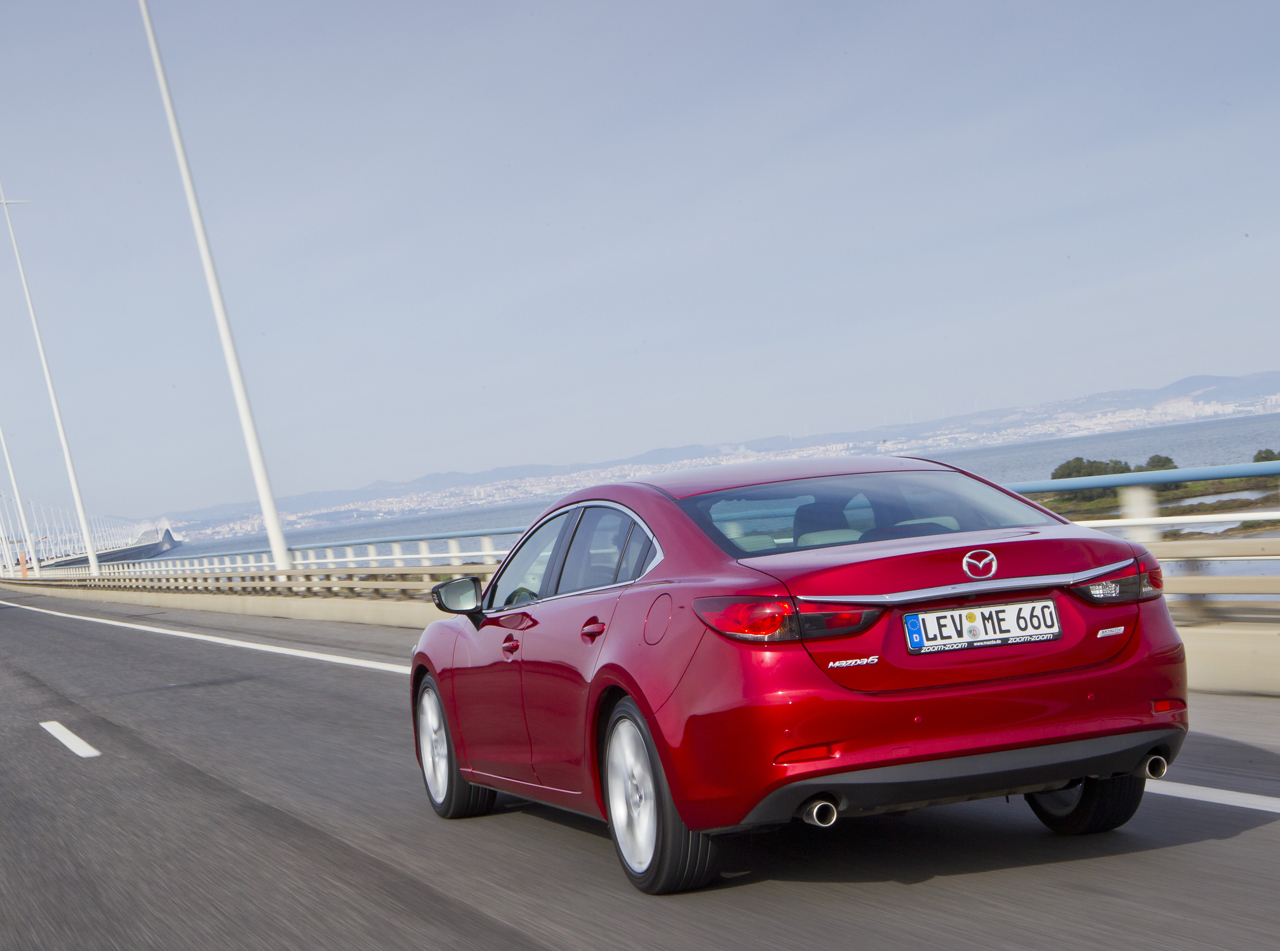
Road Test: Mazda 6 2.2 SkyActiv-D 150 Sport
Price as tested: €31,795
+ Handsome, frugal, fab to drive, solid
– Pretty much nothing
= As good a mid-size saloon as you'll find
An expensive Swiss watch has become a deep desire for so many of us. The thought of the expensive weight of all that carefully assembled stainless steel and titanium, our wrists tingling at the very thought of being topped by the logo of Omega, Rolex or Tag Heuer (delete according to taste), it's a status symbol we'd all love to have. But sadly, few of us will ever afford such a timepiece. Shame.
But what if I told you that you could have something just as good, possibly even better, for a lower cost, simply by trading in your timepiece's Swiss postcode for one from Japan? It's well known in high-end watch circles that, proud though the Swiss boys are of their products and movements, they collectively weep with jealously at the carefully crafted work of Seiko. The famed Japanese watch maker can produce wrist-wear of staggering reliability and accuracy, and no small amount of beauty, for a fraction of the cost of a Rolex.
There's something similar going on in the motoring world, too. Many of us desire a slick German sports saloon; we want our driveway to be adorned with the star of Mercedes, the four rings of Audi or the Munich colours of BMW, but their prices are just out of reach. So what if I told you that you could have a car as good to drive as a 3 Series, better looking than an A4 and more reliable than a C-Class, and all you have to do is pop into your Mazda dealer?
Most of the new 6's rivals come with 1.6 or 2.0-litre Diesel engines with outputs of around 115 to 120bhp, Band A emissions and a price tag circling the €26,000 mark. The Mazda, by contrast, has a price tag of €31,795 (for the diesel Sport model, which Mazda Ireland reckons will be its strongest seller), has a 2.2-litre engine with a muscular 150bhp and 380Nm of torque (an even more powerful 175bhp, 420Nm version is also available) and yet still hits that Band A emissions target, with 108g/km costing you just €180 a year to tax.
How has Mazda done this? Carefully, is the short answer. Its SkyActiv programme, which debuted on last year's very impressive CX-5 SUV, isn't one big whizz-bang fuel saving system but rather, like BMW's EfficientDynamics, a series of incremental improvements in every area. A little less friction here. A saving of a kilogram there. A touch less wind resistance somewhere else. It all adds up and the final sum of these parts is that low Co2 figure and a commensurately low fuel consumption of, claims Mazda, better than 65mpg on average. Part of that efficiency comes from a combination of i-Stop that kills the engine when you're waiting at the lights and a new system called i-ELOOP which uses a capacitor (like a battery; it reacts faster than a conventional battery but won't hold a charge for very long) that can power the electrical systems for up to a minute, independent of the engine, and recharges in just seconds from leftover braking energy. Clever stuff and the re-start time of the i-Stop is impressively fast.
Even so, I doubt you'll be able to match that fuel figure in real world driving, partially because almost no car ever does match its claimed figure, but partly because it's very hard to resist driving the new 6 in a somewhat brisk fashion. The last generation of 6 felt solid, planted and even a touch hefty to drive. This new one continues that tradition in part, but there's also a new-found litheness, a sense of fluidity and a truly engaging driving experience. The steering is the outright star here, feeling almost Jaguar-like in its combination of weight (except at parking speeds when it can occasionally get oddly heavy) and with great levels of feedback. It's a very confidence inspiring car, the 6, and even at very high continental motorway speeds, feels safe, secure and reactive. The ride quality, as long as you don't go for the optional 19" wheels, is also exceptionally supple.
Refined too. There's a rustle of wind noise around the mirrors at 120kmh and a touch of road and tyre noise on coarser surfaces, but the SkyActiv diesel 2.2 is impressively quiet and even manages to sound a little bit entertaining at higher rpm, with a gruff warbling noise rather than the usual bland diesel blare.
The cabin marks a particularly high point for the 6. It's very similar to the CX-5's to look at, but the quality of the materials has kicked up a notch and while it's a touch dark at times, it's also a terrifically comfy and pleasing space in which to spend time, helped in no small part by a well-located driving position and expensive-looking, clear instruments. There's good space in the back too although the boot is a touch smaller than much of the competition. Family buyers will be pleased to see that Mazda is emphasising the safety levels of the 6, with a host of new electronic aids including a city braking system that slams on the anchors if it senses you're going to run up the back of the car in front, a lane keeping warning and a blind spot monitor, as well as radar guided cruise control.
It's also a very good looking car, much more obviously so in the flesh (so to speak) than in photos, where the sweeping lines are more obvious and the muscular stance more noticeable.
That €31,000 price tag may hurt the 6's chances though. Its rivals all have significantly lower price points, even if they are for lesser engines with less equipment. Mazda is effectively competing with bottom-end versions of the BMW 3 Series and Audi A4 at that price too, and while it's a lovely car, that's a tough battle for any mainstream car maker, and Mazda has as yet no plans to try and match or beat the Koreans in the warranty war; three-year unlimited mileage is your lot.
But just as a Seiko will have true watch afficionados nodding in quiet respect, so I reckon this new Mazda 6 will have true car fans doing the same. Gorgeous, lithe to drive and solidly built, and with astonishing fuel efficiency, it's an early nod for one of the best cars of 2013.
Facts & Figures Mazda 6 2.2 SkyActiv-D Sport 150
Price as tested: €31,795
Range price: €28,745 to €38,895
Capacity: 2,191cc
Power: 148bhp
Torque: 380Nm
Top speed: 211kmh
0-100kmh: 9.1sec
Economy: 4.2l-100km (67mpg)
CO2 emissions: 108g/km VRT Band: A3. €190 road tax
Euro NCAP rating: Not yet tested
Friday, 11 January 2013
News: Renault's Captur wants to box the Juke
Teased earlier this week and now revealed here in full, the Captur takes both chassis and styling cues from the just-launched new Clio but bulks everything up into a much more muscular shape. Is it just us or are there hints of the old Avantime in the overall shape and stance? Maybe just us. Whatever, it's a handsome beast and that is just as true on the inside, where again Clio elements have been taken, put on a bit of muscle and are looking pretty darned good.
Renault is claiming best in class fuel economy and the two key engines will be the TCe three-cylinder petrol turbo and the long serving 1.5 dCi diesel, an engine which should see the Captur's emissions fall as low as 96g/km.
The Clio has already been much praised for its dynamic performance, so we can hope that the Captur will prove as invigorating to drive. Will the fact that it's shorter (slightly) the the Juke compromise interior space too much though? We'll find out when the Captur makes its public debut at the Geneva motor show.
Between this the and Peugeot 2008, it's looking like a good year for compact French SUVs...
Wednesday, 9 January 2013
News: Lexus strikes at 3 Series with dramatic new IS
You're looking at the first pics of the ultra-aggressive face of the new Lexus IS, the compact sports saloon that Lexus is hoping will, at long last, really take the fight to the heartland of the BMW 3 Series and Audi A4.
Depending on how you feel about the styling of the current Lexus GS, you may or may not love the new IS' styling, with that outrageous sucked-in grille (vampire fangs, anyone) but while we're sitting slightly on the fence at the moment, we're loving the way the grille design makes it look as if the Lexus badge is being sucked into a black hole. Cool.
Of more practical concern, the new IS is going to be longer, more spacious (good – the current one is way too small inside) and lighter. The driving position is going to be lower and more overtly sporting too, and just have a gander at those gorgeous all-digital instruments. They've been lifted more or less straight from the fantabulous V10 LF-A supercar.
There is a concern that Lexus is going to hobble itself with regard to engine choice though. Once again, only two powerplants will be available but this time around there's no diesel option, or at least none has been officially announced. For now, you'll have to choose between a 2.5-litre petrol V6 IS250 (which no-one in Ireland is going to buy) or a new IS300 Hybrid. Now, we're not 100% sure what the petrol engine component of the IS300 will be just yet, but it is already rumoured to have Co2 emissions in the region of 99g/km. Now, seeing as Toyota can get around 85g/km out of the Prius; 1.8-litre petrol hybrid, we're going to go out on a limb here and suggest that the Lexus' unit will be rather more muscular.
Will being a hybrid hold the IS back, in sales terms, against the more conventional, but very engaging to drive, BMW 320d and Audi A4 2.0 TDI? Yes, it very well could, although it should be noted that the hybrid-only GS450h is at least as engaging and enjoyable to drive as any diesel 5 Series, so if the same engineers are working on the IS300 then perhaps, at last, we'll have a compact hybrid that's as good to drive as a diesel, but just as (if not more) economical and efficient.
We'll find out more when the IS gets its official public unveiling at next week's Detroit Motor Show.
Labels:
Detroit Motor Show,
diesel,
eDrive,
F-Sport,
Hybrid,
Ireland,
IS new,
Japanese,
Lexus,
LF-A,
new car,
News,
premium,
quality,
reliable,
sports saloon,
sporty
Road Test: Hyundai i30 Tourer Deluxe 1.6 Diesel
Price as tested: €24,295
+ Spacious, practical, comfy, well made, economical, handsome
– Cabin could do with a touch more flair
= As sensible as it gets
Sensible gets a bit of a bad rap. It’s never the sensible guy who gets the girl in the movies. It’s always the maverick hero, swinging in on a bullwhip, with his hard-drinking, hard-living ways who walks off with the heroine at the end. The sensible guy is left behind, with nothing but his nice suit and steady job to keep him happy. C’mon Hollywood, can’t we do a movie where, just once, sensible comes out on top?
Certainly when it comes to buying a car, sensible is what should (and largely does) take priority. We Irish tend to buy our cars on the basis of longevity and practicality, not style and sex appeal. It’s why Toyota was a top-selling brand in Ireland long before it was a big hit in the rest of Europe.
And it explains, partly anwyay, the meteoric rise of Hyundai. Solid, Korean-built reliability, backed up by a five-year, unlimited mileage warranty and usually with a sensible, practical body shape. What’s not to love? OK, not love, perhaps, but certainly sensibly appreciate.
The good thing is that, on top of that solid layer of sensible engineering and reliability, Hyundai has of late been adding just a touch more visual and tactile appeal to its cars and the i30 Tourer we’re testing here is a good example of that.
For a start, it’s better looking than the hatchback on which it’s based, with those flowing, sharply defined lines given a little more real estate on which to strut their stuff. And yes, I know, many of you still think of estates as commercial traveller’s cars, but come on; it’s time to wake up to the appeal of an estate, and this i30 is more appealing than most.
Out back, where it counts, there’s a 528-litre boot, which is more than big enough for most growing families’ needs, and easily the equal or better of most of the more fashionable compact SUVs on the market. We’d avoid the option aluminium boot divider though. It has its uses, but it eats us a crucial inch or two of loading space, which could cause some fraught scenes in the IKEA car park...
Up front, the cabin is identical to that of the i30 hatchback, so you get cleanly designed, clear instruments, comfy seats and plenty of space. Rear seat space is good too, certainly enough for any lanky teenage offspring and, as ever with Hyundai, the build quality is exceptionally good. Just one criticism; the layout and style could do with a touch more visual flair, if it’s to match the appeal of the exterior.
No arguing with the engine though, which is the latest version of Hyundai’s 1.6 diesel. With 110bhp, it’s right on the money for the class, and a combination of 109 g/km of Co2 and claimed average fuel economy of 4.1-litres per 100km (we managed around 5.5 overall) means that it’s suitably efficient for 2013 Ireland. A little more torque would be nice, as it never feels quite so fleet of foot as, say, a Focus or a Golf, but you’ll pay just €180 a year to tax it, which isn’t bad for a car this versatile.
Versatile? In a world of MPVs and SUVs? Yes, really. The trouble with SUVs and MPVs is that they’re all great ideas and very little substance. The great thing about estates is that what they lack in whizz-bang concepts, they make up for in genuine usefulness. Fold down the back seats in the i30 and you have yourself a well-upholstered van, complete with 500kg payload. Get it up on the motorway and set the cruise control and you have as refined and comfortable a car as you could wish for. Head out on a favourite back road and you have a chassis that’s both capable and entertaining, but also one which is sadly held back by Hyundai’s three-mode steering set-up. Being able to choose between Sport, Comfort and Normal steering settings looks good in the showroom, but we’d have preferred it if Hyundai just went for one setting that satisfies, rather than three that don’t.
Still, when the €24,295 price tag for our Deluxe model test car includes air conditioning, cruise control, Bluetooth phone connection, iPod connection and every safety system you could think of, it might be rather churlish to complain about the steering setup.
What the i30 is, in the final reckoning, is a really solid and fine family car. Spacious, comfortable, reliable and useful, it pushes all the right buttons for an all-rounder that can please both kids and parents. Sensible? Yup, and this time, sensible wins.
Facts & Figures
Hyundai i30 Tourer 1.6 Diesel Deluxe
Price as tested: €24,295
Range price: €21,995 to €27,745
Capacity: 1,582cc
Power: 110bhp
Torque: 260Nm
Top speed: 185kmh
0-100kmh: 11.8sec
Economy: 4.1l-100km (68.8mpg)
CO2 emissions: 100g/km
VRT Band: A2. €180 road tax
Euro NCAP rating: 5-star; 90% adult, 90% child, 67% pedestrian, 86% safety assist
Labels:
1.6,
Band A,
deluxe,
diesel,
economical,
eDrive,
estate,
family,
Hyundai,
i30,
Ireland,
Korean,
long warranty,
low emissions,
new car,
practical,
reliable,
Road Test,
Tourer,
wagon
Tuesday, 8 January 2013
Road Test: Dacia Sandero TCe 90 Alternative
Price as tested: €11,990
+ Cheap, cheerful, well equipped, ESP as standard
– Rear seat space could be better
= Solid, undemanding and affordable
When Renault’s budget brand, Dacia, launched itself into the Irish market last summer, it did so with just 10 dealers and a single model, the Duster SUV. Except it didn’t really even have a single model, as right-hand-drive production of the Duster didn’t begin until just last week, so all Dacia could do in Ireland was show potential customers some left-hand-drive demos, with an older design of cabin than would be arriving from the factory when Irish cars rolled off the line. Sounds like a recipe for disaster, but with that astonishingly low €15,995 price tag (around €10,000 less than most direct competitors) the Duster has already been a success; it’s sold out until April, with 500 orders just starting to be filled. Just goes to show what you can do with a headline-grabbing price.
Of course, price isn’t everything and Dacia has come in for much criticism since the Duster’s launch for its attitude to safety equipment. Many reviewers were upset to notice that the Duster (an obvious family car, don’t forget) doesn’t come with standard electronic stability control, and the Lodgy MPV (currently only available in Europe) was severely marked down by crash test experts EuroNCAP.
So with the arrival of this, the second-generation Sandero small car (the first gen was never built with right hand drive) Dacia has to prove that it can expand beyond the niche appeal of the Duster and take on the big (small) boys such as the Fiesta, Polo and Yaris.
Thankfully, a quick glance at the spec sheet reveals that the Sandero does indeed come with ESP as standard, as are ABS and brake assist. Why the standard ESP on a smaller car when the Duster continues to do without? According to Dacia, it’s because the Sandero sits on an all-new platform, so under EU regulations, has to have ESP as standard. The Duster, based on the original 2004 Dacia Logan, can get away for a while without it.
For a basic price of €9,990 (around €5-6,000 less than most of the competition) the Sandero comes with four airbags, Daytime Running Lights, height adjustable headrests, 60/40 split folding rear seat, electric front windows and Radio with CD, MP3, USB and Bluetooth phone connection alongside its standard safety toys, which seems pretty generous. Step up a level to the Signature trim and you get alloys, air conditioning, a trip computer and more.
That basic model comes with an old Renault 1.2-litre petrol engine developing 75bhp, which looks alluringly priced but whose Co2 emissions of 135g/km will set you back €280 a year in motor tax. You could go for the 90bhp 1.5 dCi diesel engine, but we reckon you’re much better to upgrade yourself to the 895cc turbo three cylinder TCe 90 engine. It’s not only cutting edge (a first for a Dacia, which usually just sticks with older Renault tech) which cuts your Co2 emissions to 116g/km and your tax bill to €200.
Quite apart from which, it’s a terrific engine, pulling cleanly from low rpm and proving both entertainingly muscular and really very refined. It would be an outstanding engine in any car, but in an €11,090 Dacia (€13,090 if you want it in the ritzier Signature grade), it’s close to amazing.
If you’ve ever owned a Renault in the past decade, you can amuse yourself for a few minutes by just sitting in the Sandero’s cabin and playing Spot The Switch. A little bit of old Clio here, some Laguna there and a smattering of Megane over there. Still, while it may be a ‘bitsa’ the Sandero feels well put together and Dacia’s reliability record is generally very good. Space in the front is fine and there’s a 320-litre boot (with a rather too high loading lip) but it would be good to see a touch more legroom in the back. It’s OK back there, but taller passengers, or those loading up bulky child seats, will feel the pinch. There are a few rough edges to the quality of the plastics, and the seats are a little too narrow and perched-up for taller drivers, but otherwise there’s nothing to complain about.
That goes equally for the dynamic performance. Certainly, the Sandero’s chassis case is helped by the performance of that TCe 90 engine, whose 90bhp and 135Nm of torque help to cover up any holes in the cornering deportment, but the plain fact is that the Sandero is perfectly fine, if totally unexceptional, to drive. It rides very well, especially around town where it’s particularly good at shrugging off speed bumps, and on the motorway it feels planted and secure. On a twisty road, well, you’re not going to get up early to drive it for fun, but it’s fine, although the mute, rubbery steering discourages any attempts at enthusiastic driving.
The Sandero is an avowedly simple car, and in an era when car makers are constantly trying to surprise and delight us with yet more gadgetry and gimmickry, that’s a rather refreshing take. It’s quietly handsome (Germanic, claims Dacia, as opposed to its cousin, the more Latin Renault Clio), practical and quite fine to drive. With those temptingly low prices, and now without the caveat of having to worry about trading up to get safety equipment, it’s a tough proposition to argue with.
Facts & Figures
Dacia Sandero TCe 90 Alternative
Price as tested: €11,990
Range price: €9,990 to €14,990
Capacity: 898cc
Power: 90bhp
Torque: 135Nm
Top speed: 169kmh
0-100kmh: 11.1sec
Economy: 4.9l-100km (56mpg)
CO2 emissions: 116g/km
VRT Band: A4. €200 road tax
Euro NCAP rating: Not yet tested
Range price: €9,990 to €14,990
Capacity: 898cc
Power: 90bhp
Torque: 135Nm
Top speed: 169kmh
0-100kmh: 11.1sec
Economy: 4.9l-100km (56mpg)
CO2 emissions: 116g/km
VRT Band: A4. €200 road tax
Euro NCAP rating: Not yet tested
Labels:
affordable,
cheap,
Dacia,
diesel,
eDrive,
ESP,
family,
hatchback,
Ireland,
low Co2,
low emissions,
new car,
petrol,
Road Test,
safety,
Sandero,
small car
Sunday, 6 January 2013
News: Peugeot's crucial crossover revealed
Peugeot's crucial new 2008 crossover has broken cover for the first time and it it couldn't be coming at a more significant time for the beleaguered French car maker.
Peugeot's woes over the past 12 months have been well-publicised, and even it's much-anticipated (and critically well received) 208 supermini simply hasn't sold in the numbers Peugeot needs it to. Which makes the 208-based 2008 more important than ever, as compact SUVs are one of the few growth markets in Peugeot's traditional European heartland right now, and is just the right segment to be entering if it wants to break into Asian and American markets in the future.
The 2008's 4.1-metre length pitches it straight against the likes of the Skoda Yeti, Nissan Juke and Opel Mokka, and although the range-topping engine will be the 150bhp 1.6-litre petrol turbo, expect most to be sold with either 1.4 or 1.6-litre HDI diesels.
No official figures yet, but it's safe to assume that there will be at least one sub-120g/km model, and possibly, given the 208's frugal nature, even a sub-100g/km version. Production starts at Mulhouse in France later this year, and the 2008 will also be built in burgeoning markets like Brazil and China.
These photos were not due to be released until the 2008's official debut at the Geneva motor show in March, but French website L'Argus got hold of them and once something's on t'internet, it's leaks ahoy...
Peugeot's woes over the past 12 months have been well-publicised, and even it's much-anticipated (and critically well received) 208 supermini simply hasn't sold in the numbers Peugeot needs it to. Which makes the 208-based 2008 more important than ever, as compact SUVs are one of the few growth markets in Peugeot's traditional European heartland right now, and is just the right segment to be entering if it wants to break into Asian and American markets in the future.
The 2008's 4.1-metre length pitches it straight against the likes of the Skoda Yeti, Nissan Juke and Opel Mokka, and although the range-topping engine will be the 150bhp 1.6-litre petrol turbo, expect most to be sold with either 1.4 or 1.6-litre HDI diesels.
No official figures yet, but it's safe to assume that there will be at least one sub-120g/km model, and possibly, given the 208's frugal nature, even a sub-100g/km version. Production starts at Mulhouse in France later this year, and the 2008 will also be built in burgeoning markets like Brazil and China.
These photos were not due to be released until the 2008's official debut at the Geneva motor show in March, but French website L'Argus got hold of them and once something's on t'internet, it's leaks ahoy...
Labels:
2008,
208,
compact,
crossover,
diesel,
economical,
eDrive,
family,
French,
Ireland,
low Co2,
low emissions,
new car,
News,
Peugeot,
stylish,
SUV
Tuesday, 18 December 2012
Road Test: Fiat Punto 1.3 MultiJet
Price as tested: €15,495
+ Styling, improved quality, excellent engine, value, comfort, space
– Still too much cheap cabin plastic, not much else
= Unfairly ignored compact hatch, deserves more attention
I bet you've forgotten about the Fiat Punto. It wouldn't be hard to be fair. Since its 2000 heyday when it was one of the best selling cars in Ireland's all-time bumper year for car sales, the Punto has steadily slid down the car sales cliff, in spite of a gorgeous 2005 re-issue with Maserati-like styling by Giugiaro. In a class populated by the likes of the Ford Fiesta, Volkswagen Polo, Peugeot 208, Kia Rio and so many talented others, it's just too easy for the Punto's light to stay well and truly beneath a handy bushel.
And I'll also bet you have some pretty lazy pre-conceptions about Fiat cars in general. If you're of a certain age, rust and electrical maladies will still be top of your list when it comes to Fiat, in spite of two decades where Italian build quality has done nothing but improve.
Of course, Fiat itself has seemed to occasionally ignore the Punto. While the glamorous 500 and the practical Panda have since come along to take centre stage, the current Punto is merely a facelifted version of the car that was launched in 2005.
So, I wasn't expecting all that much when I grabbed the keys to the test car. Yet another facelift of the Punto has come along, reversing some of the rather poor styling decisions made when it became the Punto Evo in 2009, but I too had fallen prey to assuming I knew the Punto's place in the universe.
I'm therefore pleased to report that I was wrong. The updates to the latest generation have gone a long way to strengthening the Punto's hand and it's actually a much sharper competitor to the likes of the Fiesta and Polo than you would have thought. Certainly, it looks arguably better than either, and the cabin now benefits from much higher quality surfaces than before, albeit you don't have to look too hard to find hard, scratchy plastics.
There's good space in there too, and the seats are comfy while out back, the boot is big and well shaped.
The actual production version of the updated 1.3-litre MultiJet Diesel engine will have 85bhp in the Puntos you'll find in dealerships, but our test car actually had the old 75bhp version fitted. No matter, even with the rise of the clever little two-cylinder TwinAir petrol, the diesel is the Punto to have, even if it is a pricey option. Quite apart from exceptionally good economy and emissions figures (90g/km of Co2 and potentially as good as 80mpg if you're in-cred-ibly delicate with the throttle) there is the matter that its 200Nm of torque means it is a relaxed and capable long-haul car, something you could never have said of the old 1.2-litre petrol. Mind you, an extra cog in the slightly slack-shifting five-speed gearbox would help in this regard.
Also a touch slack is the steering, which feels entirely artificial and fake, which is a shame as through the clouds of over-assistance you can feel a really quite talented chassis at work. It's not quite as sharp or rewarding as a Fiesta, but it's more fun by far than most others in the class to throw around, and in spite of ever-increasing girth the Punto still feels properly small and enjoyably agile. It also rides better than it did in 2005 when I first drove it. It still jiggles a little over small, sharp surfaces, but bigger bumps are smoothed over with a deft Italianate roll of the shoulders.
Add to that a reasonably affordable list price of €15,495 which includes pretty decent equipment as standard, and the Punto's package is starting to come together really rather well. And then there's the intangible loveliness that comes with merely driving an Italian car. A little touch of flair, a merest hint of style all makes the experience that bit more enjoyable. It's not something that will appeal to all, perhaps indeed only to a select few, but it's the difference between shopping on Grafton Street or in the Grand Piazza in Milan. You just, or at least I just, feel as if you're cutting a bit more of a rakish figure climbing out of your Punto at the kerb side.
No, the Punto's not perfect, and yes, thanks to that broad public perception you will pay a harsh price come resale time, but I left it back feeling quite surprisingly sad to see it go. Character is a rare thing in an increasingly homogenised car market, and the Punto has that in buckets. To find that it also has a remarkable amount of substance to back that up was simply a welcome surprise.
Fiat Punto 1.3 JTD 85bhp
Price as tested: €15,495
Price range: €13,495 to €15,495
Capacity: 1,248cc
Power: 85bhp
Torque: 200Nm
Top speed: 170kmh
0-100kmh: 12.7sec
Economy: 3.5l-100km (80mpg)
CO2 emissions: 90g/km
Road Tax Band: A2. €180
Euro NCAP rating: 5-star adult, 4-star child, 3-star pedestrian
Wednesday, 28 November 2012
Road Test: Toyota Auris 1.4 D4D Luna
Price as tested: €23,995
+ Slick new styling, comfort, ride, refinement, quality, space, economy
– Steering still too detached, engine a bit underpowered
= We were hoping for GT86-like driver appeal, we actually got the quietest, comfiest car in the class
Toyota generally gets a lot of flack for being dull and middle of the road. Indeed, influential US website Jalopnik.com has made the words Toyota and Beige almost indivisible. But it’s an unfair rep, especially considering cars like the original Celica (and its subsequent versions), the Supra, the MR2, the brilliant new GT86, all those World Rally Championship victories and the amazing Le Mans racing cars. Beige Toyota ain’t, no matter what some snarky bloggers might say.
In fairness though, some of Toyota’s mainstream models have been a bit too quiet for their own good down through the years, and the last generation Auris was a case in point. Too subtle on the outside, with a cabin that even Toyota now admits wasn’t up to snuff means that while it always sold well, the Auris fell well behind the likes of the Ford Focus and VW Golf in critical terms.
But what’s this? A new Auris with a sharp-looking body (check out that beaky nose with the dramatic bottom grille and big cut-outs for the foglights)? Has Toyota finally injected some flair and drama into its mid-size hatch?
Well, you won’t find much drama in the engine room. The 90bhp D4D Diesel engine is about 20bhp down on most of its rivals, and you can tell that as soon as you put your foot down. Performance never quite descends into being sluggish, but neither does it have the effortless punch of, say, Ford's 1.6 TDCI. Toyota, of course, has a grunty, efficient 2.0-litre diesel already in the Avensis. What hope of it being fitted to an Auris? In the meantime, the 1.4 D4D is at least a sweet-natured unit, and very economical. Toyota claims 3.8-litres per 100km on the combined fuel cycle (around 74mpg) and that seems entirely believable, as we were gettting close to 4.0-litres per 100km when driving mostly around town. 99g/km Co2 emissions (as long as you go for the basic 15" wheels) should keep you in the lowest two of the proposed four-way-split Band A tax ratings.
It settles quickly from idle into a distant thrummy noise, and fitting in with the Auris' generally refined nature. Cabin noise levels are very low, whether you're thinking about engine, wind or road noise and the ride quality, especially around town, is truly exceptional. It all adds up to make the Auris one of the most refined, comfortable cars in its class.
It is not, however, much of a drivers' car. Off the back of the brilliant little GT86 coupe, we had hoped that some of that car's DNA might seep through into the Auris and allow it to have a tilt at the sort of pin-sharp driver appeal as displayed by the Focus and Golf. Alas, no. The Auris' steering is light, verging on over-light (think of an early seventies Jaguar XJ6 steering and you're getting there) and it leaves you feeling distanced and separated from the car. That's a shame, as beneath the mush, the chassis feels well-balanced and controlled. There is, possibly, an engaging driving tool in there somewhere, but its light is being kept defiantly sub-bushel.
Such considerations are compensated for by the fact that the cabin is spacious, bright and airy, the boot a decent size and shape (although the boot floor is made of the most unpleasantly cheap flooring material we've yet seen) and of course, the fact that the famed Toyota quality seems to be present and correct.
It is also rather handsome. Possibly less so at the back, where it descends into generic hatchback-ness, but up front, the beaky new nose with its scowling lights, LEDs and aggressive trapezoidal grille looks rather striking, certainly by Toyota standards. It seems to owe no debt to any other Toyota (save perhaps a passing resemblance to the Avensis) and if so, hopefully it is the vanguard of a new family of sharper-looking Toyotas.
Prices start at €18,995 for the 1.33 99bhp petrol in Terra trim (which notably does without such items as air conditioning or Bluetooth phone). Our bells-and-whistles 1.4 D4D Luna comes in at a very competitive €23,995 and includes climate control, Bluetooth, reversing camera, touch-screen stereo and much more.
So while the Auris might be lacking in the final sheen of GT96-like driver appeal we were hoping for, its comfort, spaciousness and its likely reliability score very highly with us. The new found style is welcome, the rest are welcome returns. No drama then, but equally, no crisis.
Toyota Auris 1.4 D4D 90 Luna
Price as tested: €23,995
Price range: €18,995 to €27,990
Capacity: 1,364cc
Power: 90bhp
Torque: 205Nm
Top speed: 170kmh
0-100kmh: 12.6sec
Economy: 3.8l-100km (74mpg)
CO2 emissions: 99g/km*
Road Tax Band: A. €160
Euro NCAP rating: Not yet tested
*When fitted with 15” steel wheels
Labels:
Auris,
Band A,
D4D,
diesel,
economical,
eDrive,
family,
hatchback,
Ireland,
low Co2,
low emissions,
new car,
quality,
reliability,
Road Test,
spacious,
stylish,
Toyota
Subscribe to:
Posts (Atom)