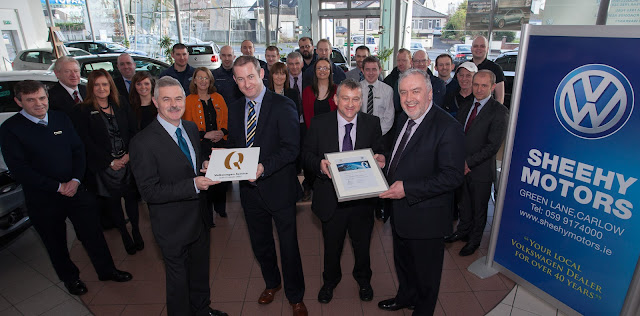
Sheehy Motors Carlow has been officially presented with the 2012 Volkswagen Service Quality award. This is a prestigious award that has an entry list of 6,300 Volkswagen Retail business partners from 27 countries. Whilst PJ O’Neill, Service Manager at Sheehy Motors attended the 2012 Gala Awards Event in Dresden, Germany in September 2012, January 14th saw the official handing over the actual award and certificate to the staff at Sheehy Motors, Carlow. Alan Bateson, Volkswagen Head of Aftersales commented, “The name of Volkswagen must not only be synonymous with outstanding vehicles, but also with top all-round service. Shawn, PJ and the team at Sheehy Motors Carlow work tirelessly to ensure all Customers are completely satisfied each and every time they visit their business. This is further displayed by their standing in the 2013 Volkswagen Service Quality Awards Table where they have occupied a top 3 position throughout the qualification period. Final results for the 2013 Awards will be known by March this year.”
Shawn Carson, Dealer Principal at Sheehy Motors Carlow said, “We are very honoured to receive such a prestigious award.Shawn paid tribute to the loyal and dedicated staff who consistently delivers exceptional levels of customer care and satisfaction.
“We would like to thank all our customers both past and present for their loyalty and support over the years. We believe if we continue to provide value for money and excellent customer service the Volkswagen brand will grow even further.”
It's not often that you hear a car company exhorting buyers not to go out and put their hands into their wallets, but that's exactly what Skoda is asking Irish car buyers to do. At least, for the moment...
You see, Skoda has this week announced specification and pricing details for their third new model in just six months with the imminent arrival of the new Octavia to Ireland. Unveiled internationally late last year the new Octavia will be available in Ireland from March with three different specification variants, both manual and automatic transmission options and five engine alternatives the new Octavia offers the Irish motorist considerable choice with prices starting from €18,995.
Originally launched in Ireland back in 1998, the Octavia has become a firm favourite with Irish motorists with more than 40,600 sold to the end of 2012. Now as Skoda enters its 20thAnniversary in Ireland, the third generation of the Octavia will see Skoda challenge not only direct competitors in the medium family segment but, thanks to its increase in size, challenge vehicles in the Mondeo-Passat-Avensis class.
The new Octavia has grown significantly in length and width, the new model is 90mm longer and 45mm wider than the outgoing Octavia. The wheelbase has grown by 108mm enabling the Octavia break the mould for spaciousness in its model segment with interior length (1,782mm), more knee room (73mm) and more headroom at the back (980mm) as well as best in class boot volume of 590 litres. The new Octavia is powered by the latest low emission TSI petrol engines as well as common rail diesel engines with Stop Start technology for excellent fuel economy. Speaking on the price reveal for the new Octavia in Ireland, Raymond Leddy Head of Marketing, Skoda Irelandsaid: “We have increased specification levels for all versions of the new Octavia. Additional airbags, Electronic Stability Control for increased safety and Stop Start Technology for reduced emissions and improved fuel economy are now standard features across the range. Stylish alloy wheels are now offered on all models with the exception of the entry Active model. In dimension terms the new Octavia is wider and has grown in length by 9cm allowing for increased cabin space and luggage capacity. Despite this growth the new Octavia has in fact shed up to 100kg in weight compared to its predecessor. Less weight equates to better fuel economy and the new Octavia in its 1.6 TDI version consumes only 3.8 litres for every 100km travelled. Leddy continued, “The new Octavia will be offered with attractive finance terms from €239 per month inclusive of servicing form Skoda Finance. The new Octavia goes on sale at Skoda Authorised retailers from 16thMarch. We would encourage anyone thinking of purchasing a new car for 2013 to consider the next generation Octavia before making that all important purchase.”
You're looking at the first pics of the ultra-aggressive face of the new Lexus IS, the compact sports saloon that Lexus is hoping will, at long last, really take the fight to the heartland of the BMW 3 Series and Audi A4.
Depending on how you feel about the styling of the current Lexus GS, you may or may not love the new IS' styling, with that outrageous sucked-in grille (vampire fangs, anyone) but while we're sitting slightly on the fence at the moment, we're loving the way the grille design makes it look as if the Lexus badge is being sucked into a black hole. Cool. Of more practical concern, the new IS is going to be longer, more spacious (good – the current one is way too small inside) and lighter. The driving position is going to be lower and more overtly sporting too, and just have a gander at those gorgeous all-digital instruments. They've been lifted more or less straight from the fantabulous V10 LF-A supercar. There is a concern that Lexus is going to hobble itself with regard to engine choice though. Once again, only two powerplants will be available but this time around there's no diesel option, or at least none has been officially announced. For now, you'll have to choose between a 2.5-litre petrol V6 IS250 (which no-one in Ireland is going to buy) or a new IS300 Hybrid. Now, we're not 100% sure what the petrol engine component of the IS300 will be just yet, but it is already rumoured to have Co2 emissions in the region of 99g/km. Now, seeing as Toyota can get around 85g/km out of the Prius; 1.8-litre petrol hybrid, we're going to go out on a limb here and suggest that the Lexus' unit will be rather more muscular. Will being a hybrid hold the IS back, in sales terms, against the more conventional, but very engaging to drive, BMW 320d and Audi A4 2.0 TDI? Yes, it very well could, although it should be noted that the hybrid-only GS450h is at least as engaging and enjoyable to drive as any diesel 5 Series, so if the same engineers are working on the IS300 then perhaps, at last, we'll have a compact hybrid that's as good to drive as a diesel, but just as (if not more) economical and efficient. We'll find out more when the IS gets its official public unveiling at next week's Detroit Motor Show.
Price as tested: €15,495 + Styling, improved quality, excellent engine, value, comfort, space – Still too much cheap cabin plastic, not much else = Unfairly ignored compact hatch, deserves more attention I bet you've forgotten about the Fiat Punto. It wouldn't be hard to be fair. Since its 2000 heyday when it was one of the best selling cars in Ireland's all-time bumper year for car sales, the Punto has steadily slid down the car sales cliff, in spite of a gorgeous 2005 re-issue with Maserati-like styling by Giugiaro. In a class populated by the likes of the Ford Fiesta, Volkswagen Polo, Peugeot 208, Kia Rio and so many talented others, it's just too easy for the Punto's light to stay well and truly beneath a handy bushel. And I'll also bet you have some pretty lazy pre-conceptions about Fiat cars in general. If you're of a certain age, rust and electrical maladies will still be top of your list when it comes to Fiat, in spite of two decades where Italian build quality has done nothing but improve. Of course, Fiat itself has seemed to occasionally ignore the Punto. While the glamorous 500 and the practical Panda have since come along to take centre stage, the current Punto is merely a facelifted version of the car that was launched in 2005. So, I wasn't expecting all that much when I grabbed the keys to the test car. Yet another facelift of the Punto has come along, reversing some of the rather poor styling decisions made when it became the Punto Evo in 2009, but I too had fallen prey to assuming I knew the Punto's place in the universe. I'm therefore pleased to report that I was wrong. The updates to the latest generation have gone a long way to strengthening the Punto's hand and it's actually a much sharper competitor to the likes of the Fiesta and Polo than you would have thought. Certainly, it looks arguably better than either, and the cabin now benefits from much higher quality surfaces than before, albeit you don't have to look too hard to find hard, scratchy plastics. There's good space in there too, and the seats are comfy while out back, the boot is big and well shaped. The actual production version of the updated 1.3-litre MultiJet Diesel engine will have 85bhp in the Puntos you'll find in dealerships, but our test car actually had the old 75bhp version fitted. No matter, even with the rise of the clever little two-cylinder TwinAir petrol, the diesel is the Punto to have, even if it is a pricey option. Quite apart from exceptionally good economy and emissions figures (90g/km of Co2 and potentially as good as 80mpg if you're in-cred-ibly delicate with the throttle) there is the matter that its 200Nm of torque means it is a relaxed and capable long-haul car, something you could never have said of the old 1.2-litre petrol. Mind you, an extra cog in the slightly slack-shifting five-speed gearbox would help in this regard. Also a touch slack is the steering, which feels entirely artificial and fake, which is a shame as through the clouds of over-assistance you can feel a really quite talented chassis at work. It's not quite as sharp or rewarding as a Fiesta, but it's more fun by far than most others in the class to throw around, and in spite of ever-increasing girth the Punto still feels properly small and enjoyably agile. It also rides better than it did in 2005 when I first drove it. It still jiggles a little over small, sharp surfaces, but bigger bumps are smoothed over with a deft Italianate roll of the shoulders. Add to that a reasonably affordable list price of €15,495 which includes pretty decent equipment as standard, and the Punto's package is starting to come together really rather well. And then there's the intangible loveliness that comes with merely driving an Italian car. A little touch of flair, a merest hint of style all makes the experience that bit more enjoyable. It's not something that will appeal to all, perhaps indeed only to a select few, but it's the difference between shopping on Grafton Street or in the Grand Piazza in Milan. You just, or at least I just, feel as if you're cutting a bit more of a rakish figure climbing out of your Punto at the kerb side. No, the Punto's not perfect, and yes, thanks to that broad public perception you will pay a harsh price come resale time, but I left it back feeling quite surprisingly sad to see it go. Character is a rare thing in an increasingly homogenised car market, and the Punto has that in buckets. To find that it also has a remarkable amount of substance to back that up was simply a welcome surprise. Fiat Punto 1.3 JTD 85bhp Price as tested: €15,495 Price range: €13,495 to €15,495 Capacity: 1,248cc Power: 85bhp Torque: 200Nm Top speed: 170kmh 0-100kmh: 12.7sec Economy: 3.5l-100km (80mpg) CO2 emissions: 90g/km Road Tax Band: A2. €180 Euro NCAP rating: 5-star adult, 4-star child, 3-star pedestrian
+ Slick new styling, comfort, ride, refinement, quality, space, economy – Steering still too detached, engine a bit underpowered = We were hoping for GT86-like driver appeal, we actually got the quietest, comfiest car in the class
Toyota generally gets a lot of flack for being dull and middle of the road. Indeed, influential US website Jalopnik.com has made the words Toyota and Beige almost indivisible. But it’s an unfair rep, especially considering cars like the original Celica (and its subsequent versions), the Supra, the MR2, the brilliant new GT86, all those World Rally Championship victories and the amazing Le Mans racing cars. Beige Toyota ain’t, no matter what some snarky bloggers might say.
In fairness though, some of Toyota’s mainstream models have been a bit too quiet for their own good down through the years, and the last generation Auris was a case in point. Too subtle on the outside, with a cabin that even Toyota now admits wasn’t up to snuff means that while it always sold well, the Auris fell well behind the likes of the Ford Focus and VW Golf in critical terms.
But what’s this? A new Auris with a sharp-looking body (check out that beaky nose with the dramatic bottom grille and big cut-outs for the foglights)? Has Toyota finally injected some flair and drama into its mid-size hatch?
Well, you won’t find much drama in the engine room. The 90bhp D4D Diesel engine is about 20bhp down on most of its rivals, and you can tell that as soon as you put your foot down. Performance never quite descends into being sluggish, but neither does it have the effortless punch of, say, Ford's 1.6 TDCI. Toyota, of course, has a grunty, efficient 2.0-litre diesel already in the Avensis. What hope of it being fitted to an Auris? In the meantime, the 1.4 D4D is at least a sweet-natured unit, and very economical. Toyota claims 3.8-litres per 100km on the combined fuel cycle (around 74mpg) and that seems entirely believable, as we were gettting close to 4.0-litres per 100km when driving mostly around town. 99g/km Co2 emissions (as long as you go for the basic 15" wheels) should keep you in the lowest two of the proposed four-way-split Band A tax ratings.
It settles quickly from idle into a distant thrummy noise, and fitting in with the Auris' generally refined nature. Cabin noise levels are very low, whether you're thinking about engine, wind or road noise and the ride quality, especially around town, is truly exceptional. It all adds up to make the Auris one of the most refined, comfortable cars in its class.
It is not, however, much of a drivers' car. Off the back of the brilliant little GT86 coupe, we had hoped that some of that car's DNA might seep through into the Auris and allow it to have a tilt at the sort of pin-sharp driver appeal as displayed by the Focus and Golf. Alas, no. The Auris' steering is light, verging on over-light (think of an early seventies Jaguar XJ6 steering and you're getting there) and it leaves you feeling distanced and separated from the car. That's a shame, as beneath the mush, the chassis feels well-balanced and controlled. There is, possibly, an engaging driving tool in there somewhere, but its light is being kept defiantly sub-bushel.
Such considerations are compensated for by the fact that the cabin is spacious, bright and airy, the boot a decent size and shape (although the boot floor is made of the most unpleasantly cheap flooring material we've yet seen) and of course, the fact that the famed Toyota quality seems to be present and correct.
It is also rather handsome. Possibly less so at the back, where it descends into generic hatchback-ness, but up front, the beaky new nose with its scowling lights, LEDs and aggressive trapezoidal grille looks rather striking, certainly by Toyota standards. It seems to owe no debt to any other Toyota (save perhaps a passing resemblance to the Avensis) and if so, hopefully it is the vanguard of a new family of sharper-looking Toyotas.
Prices start at €18,995 for the 1.33 99bhp petrol in Terra trim (which notably does without such items as air conditioning or Bluetooth phone). Our bells-and-whistles 1.4 D4D Luna comes in at a very competitive €23,995 and includes climate control, Bluetooth, reversing camera, touch-screen stereo and much more.
So while the Auris might be lacking in the final sheen of GT96-like driver appeal we were hoping for, its comfort, spaciousness and its likely reliability score very highly with us. The new found style is welcome, the rest are welcome returns. No drama then, but equally, no crisis.
Toyota Auris 1.4 D4D 90 Luna Price as tested: €23,995 Price range: €18,995 to €27,990 Capacity: 1,364cc Power: 90bhp Torque: 205Nm Top speed: 170kmh 0-100kmh: 12.6sec Economy: 3.8l-100km (74mpg) CO2 emissions: 99g/km* Road Tax Band: A. €160 Euro NCAP rating: Not yet tested
Price as tested: €28,550 + Styling, engine, handling – Driving position = Puts Merc right at the top of the premium hatch tree I can still remember clearly the last time I drove an old-shape A-Class. You remember? The tall, slightly geeky looking one that was big on space but small on styling and driver appeal. I can still recall heading north up the M1 motorway, just passing the exit for Skerries and thinking “I just don’t like this.” And that was odd, because I should have. I liked, and still do like, most Mercedes cars. I appreciate cars that are clever, spacious and useful and the old A was all of those things. But I just couldn’t appreciate the shopping-trolley handling, the awkward driving position or, especially on that warm August day, the feeble, non-air-conditioned ventilation. While the old A certainly had its followers and was one of the most genuinely innovative cars of the past two decades, it just never resonated with customers the way that rivals like the BMW 1 Series and Audi A3 did. I think that might all be about to change because on a chilly November afternoon, I have now driven the all-new A-Class and suddenly, Mercedes’ smallest car has snapped into sharp focus. Gone is the tall, spacious MPV-like body of before, and gone with it the clever ‘sandwich’ floor arrangement (originally designed to leave space for the batteries for a proposed electric version) and in comes properly gorgeous, low-slung styling with a prominent bonnet and a cab-backward stance. The new A really is very handsome indeed and that alone should increase its potential sales by a significant figure. Inside, you no longer get the massive space of the old one, but then you do now get a cabin that looks like it has come from a proper Mercedes. The big, iPad-style control screen in the centre of the dash looks like it should be a touch-screen (sadly it isn’t) and the retro-sixties-style circular air vents are a nice touch. Slip behind the chunky, sporty, three-spoke steering wheel and you will instantly find the A-Class’ one major flaw. Its driving position. If you’re tall, then you’ll have to sit low to the floor and with your knees splayed out. That’s not a major issue, but at this point the angle of the throttle pedal becomes distinctly awkward and the pedal’s light action means you can’t rest your foot on it when holding a constant speed – you have to hover your foot over it all the time. That’s going to cause major leg ache on a long journey and will expose the fact that the A doesn’t have standard-fit cruise control. Ah well, perfection is unattainable in nature and all that, so let’s press on and see what the new A-Class does well. And the answer to that question is; pretty much everything else. The 109bhp 180 CDI diesel engine is actually a 1.5-litre unit and while you wouldn’t think it would be especially muscular, it actually provides really decent amounts of poke. The 260Nm of torque is the key figure here, as is the A’s 1,395kg kerb weight. Stir the six-speed manual gearbox with a touch of vigour and you’ll never be less than impressed with its straightline performance, all of which is delivered while it averages a claimed 3.8-litres per 100km (74mpg) and emits as little as 98g/km of Co2, depending on which size of alloy wheels you specify. To drive, at first, the A feels a little loose-limbed and remote. Trickling through traffic, there’s little or nothing to tell you that this is anything other than another comfort-oriented Mercedes. But get it on to a twisty, properly challenging road and the A-Class really comes alive. The steering weights up (without becoming intrusively heavy) and the chassis really starts to sing, allowing you to fully exploit the diesel grunt. It’s not merely precise, predictable and poised; it’s actually fun. In fact, it’s so good to drive that it just manages to nick the driver appeal trophy from the rear-drive BMW 1 Series. To all of those talents you can add a cabin that’s decently spacious in the rear and a boot that’s large and square enough to make the A-Class feel truly practical. At €28k for this most basic of diesel models, you can’t say that it’s exactly affordable but at long last, the A-Class does the job it was originally designed to do; to offer a truly desirable, properly Mercedes driving experience in a compact package at a compact price. Mercedes-Benz A180 CDI Price as tested: €28,995 Price range: €26,435 to €41,230 Capacity: 1,461 Power: 109bhp Torque: 260Nm Top speed: 190kmh 0-100kmh: 11.3sec Economy: 3.8l-100km (74mpg) CO2 emissions: 98g/km Road Tax Band: A. €160 Euro NCAP rating: Not yet tested
+ Space, quality, comfort, steering, off-road ability, styling – Cabin too plain for this price level, some refinement issues = A solid SUV from Honda, but will find life tough against sharp competition
It seems almost crazy to think of it now, but back when the original Honda CR-V was launched, the Japanese brand controlled one quarter of the Irish SUV market. Back in 1998, it seemed, we just couldn't get enough of one of the original soft-roaders.
Spool forward to 2012 and things have changed rather a lot, not least of which, the CR-V itself. The outgoing generation was larger than before, and centered around a Diesel engine rather than the petrol-focused original. High in quality and comfort, it was a rival to the likes of the BMW X3 and Audi Q5 as much as its more obvious sparring partners, the Toyota RAV 4 and Ford Kuga. But good car though it was, the outgoing CR-V had to content itself with a much smaller slice of the market, not least because instead of the mere handful of rivals the 1998 original had to contend with, now there is an army of them.
With this new generation model of CR-V, Honda will be trying to claw back some of that original sales dominance and it's going about that in three distinct ways.
For a start, the new CR-V carries over the previous models' two most successful features; its cabin space and its 2.2-litre 148bhp diesel engine. The spacious interior and cavernous boot mark the new CR-V out as one of the few SUVs that can actually boast proper Utility; you can really cram it full of people and cargo, not something you can say for all of its rivals.
Meanwhile, the still-excellent 2.2-litre iDTEC engine, while it lacks outright power compared to such rivals, is still smooth, punchy and impressively economical. It has even managed to drop a tax band, from Band D to Band C, saving owners a significant amount in annual motor tax.
The second strand to the CR-V's strategy is its styling, which looks much bluffer and more striking than it did before. The old CR-V always looked a touch apologetic. This new one is much more assertive, and all the better for it.
Finally, Honda has realised that it must compete on price, and the most affordable version of the new CR-V clocks in with a €37,795 price tag – within €1,000 of its most significant new rival, the new Hyundai Santa Fe.
The CR-V can even trade equipment and specification blows with the Hyundai, for while it lacks some toys as standard (such as Bluetooth phone connection, and it also lacks the Hyundai's seven seat layout) the CR-V comes with four wheel drive as standard.
And that all-wheel-drive is not just there for show. Honda was quite happy for us to take our test car off into the muddy outback, slipping and sliding over surprisingly tough terrain. Few owners, if any, will put it to the test, but the CR-V can certainly tackle the rough stuff.
On the smooth, it's as good as ever, retaining the old CR-V's combination of tidy handling, a comfortable ride quality and sharp, alert steering. Again, it's very close to the Hyundai in dynamic terms, and that's a good ball park to be in.
There are two let-downs to the CR-V though, and both of them are inside. We've already mentioned the excellent space, and the seats, both front and rear, are comfy and supportive. But there's a lack of flair to the cabin design and layout, a sense of plain-ness that disappoints, especially given Honda's premium-status aspirations.
That's not helped by a distinct, bassy boom that comes up from under the boot floor, and makes its presence known throughout the cabin from speeds as low as 70kmh. It's a black mark against the CR-V's refinement, which is a shame.
Those two issues apart, though, it's hard not to like the CR-V. The new styling is pleasingly distinctive, the engine and chassis as good as ever and the cabin and boot as spacious as you could hope. We can't think of a good reason why it wouldn't be close to the top of your SUV shopping list.
Well, actually, there is one good reason. It's that this 2.2-litre, 4WD CR-V might not be the best CR-V to buy. Later in 2013, there will be a front-wheel-drive CR-V, using Honda's all-new 1.6-litre Diesel engine, that will be more affordable again and will, apparently, boast astonishingly low 99g/km Co2 emissions, putting this large, spacious SUV on a tax band par with the likes of a Volkswagen Golf and Ford Focus. So while we like this new generation of CR-V, it might be worth holding off on buying one for a while yet...
Honda CR-V 2.2 iDTEC SE Price as tested: €37,795 Price range: €37,795 to €50,095 Capacity: 2,199cc Power: 148bhp Torque: 350Nm Top speed: 190kmh 0-100kmh: 9.7sec Economy: 5.6l-100km (51mpg) CO2 emissions: 149g/km Road Tax Band: C. €330 Euro NCAP rating: Not yet tested
+ Startling economy, refinement, comfort, deportment – Occasionally jiggly ride, feels a bit too big = Astonishingly, one of the most economical all-round cars we have ever tested I know I should be getting used to it by now. I know that BMW has been pulling economical and emissions rabbits out of hats since its Efficient Dynamics programme was introduced back in 2007. But the overall economy of this 520d ED simply startled me. It is staggering to think that this large, comfortable, luxurious saloon should be able to average better than 50mpg. But it can. Far better under certain circumstances.
We’re used, on these pages, to pillorying car makers for not being able to produce vehicles that an reproduce their claimed fuel consumption figures in the real world. The fact that cars can achieve such figures, under rigorous laboratory conditions is admirable. And it is only because the EU tests cars under those stringent laboratory conditions that we can make a properly scientific comparison between the performance of different cars. The figures are all recorded under identical conditions, so they are comparable. By contrast, comparing the figures we achieve under normal user conditions is the scientific equivalent of sticking a finger in the air to gauge wind speed. Yes, the cars we test on these pages are driven, generally, over the same network of road, but the conditions for each test can be wildly different. Wind, ambient temperature, traffic and a thousand other factors all come into play, so take both official and observed figures with a pinch of salt.
However, and having said all that, the 520d ED is only the second car (the first was a VW Golf BlueMotion) that actually matched its claimed economy figure. Not over my whole week with the car (that figure worked out at 5.4-litres per 100km, or 52mpg) but on one long journey, between Schull in West Cork and Cork city, the 520d averaged exactly 4.5-litres per 100km, or 62.7mpg. Precisely the figure that BMW quotes for it.
That was not achieved after stripping the car of excess weight and driving like a nun on her way to confession. The car was full of both people and luggage, and while I was observing the posted speed limit, neither was I exactly hanging around.
This, I remind you, is in a large, executive saloon with comfortable space for four adults, leather, aircon, sundry electronic gadgets and an all-up weight of 1,695kg. It has 184bhp for heaven’s sake, and sprints from 0-100kmh in a GTI-like 8.1secs. Yet its Co2 emissions rating is just 119g/km, thwarting the Government’s plan to punitively tax such tax-band-busting executive cars. Quite why Phil Hogan and Michael Noonan want to tax people out of such astonishingly efficient vehicles at a time when it costs more than €100 to brim their fuel tanks is possibly one for the conspiracy theorists...
As for the rest of the car, it’s standard 5 Series fare; subtly handsome body, deftly balanced chassis, ideally weighted (if less than perfectly communicative steering) and a handsome, beautifully made cabin. Its only flaw is its size, which seemed unremarkable when first we drove the current 5, but since testing the brilliant new 3 Series, it seems suddenly too broad, too big for Irish roads. Odd that, but it just goes to prove that the 3, as it always has been, is the natural gravitational centre of the BMW range.
But when you see a 520d ED pass by, don’t be tempted down the Government’s daisy path of assuming the owner to be a jammy bastard who should be compelled to pay through the nose for his or her road tax. Instead, appreciate the simple, yet effective engineering (weight reduction, active electronics to control the radiator grille, the brake energy recovery, the stop-start etc) that has gone in to trimming its consumption and emissions, and be thankful that such technology, so much more useful in daily driving than expensive, heavy hybrid tech, is already trickling through to more mundane, more affordable cars.
Despite its plutocratic nature, the 520d has already started a revolution against the rising cost of fuel. Arise, brothers and sisters...
Facts & Figures
BMW 520d EfficientDynamics Price as tested: €43,985 Range price: €43,530 to €134,430 Capacity: 1,995cc Power: 184bhp Torque: 380Nm Top speed: 226kmh 0-100kmh: 8.1sec Economy: 4.5-100km (62.7mpg) CO2 emissions: 119g/km Tax Band: A. €160 road tax Euro NCAP rating: 5-stars; 95% adult, 83% child, 78% pedestrian, 100% safety assist
+ Styling, front seat comfort and space, equipment, economy – Ride a touch firm, awkward rear seat entry, tiny boot = Up, up and hooray
Sometimes the old schedule just works out nicely, and this week, instead of my usual book-a-convertible-for-the-dead-of-November I actually managed to book both the new Fiat Panda and the new Volkswagen Up to test drive within a few days of each other. So, while this is not strictly a twin-test, it will be almost impossible to review the Up without reference to the Panda, so close are they as rivals.
The first and most significant thing to note about the Up is its almost staggeringly low price. Here is a car with a pukka Volkswagen badge (a large and prominent one too) on its nose that you can get on your driveway for under €11k. €10,995 is the starting price, for the most basic Take Up model, which will be pretty basic, but even going for the specced-up High Up as tested here, you’re still going to be spending significantly less than €14k.
And there is a lot of spec. As standard, a High Up comes with 15” alloys, air conditioning, heated seats, ESP, City Emergency (which, Volvo-like, slams on the anchors if it detects an incoming collision at low speeds), leather steering wheel and gearshifter, front fogs and an ‘easy entry’ function for flipping the driver’s seat forward.
Our test car, in addition to all that, had the optional Maps & More sat-nav and infotainment system, controlled by a neat little removable touch screen, which only added a very reasonable €370 to the price tag.
So, from within, the Up really doesn’t feel like a diminutive city car at all, at least not in this specification. The broad fascia, with its big sweep of body colour, the surprisingly low-set , comfy seats and the panoramic view out of the windscreen all combine to make it feel bigger and more grown up than you might have expected.
From the outside, it looks tiny though; almost as broad as it is long and styled in a very easy-on-the-eye Mies-Van-Der-Rohe style; all rigorous subjugation of form to function’s control. However, there are some issues, statically speaking. Space in the back seats is reasonable. If you’ve got small kids, they’ll fit fine but the front seat occupants may have to budge up a bit to allow space for bulky child car seats. Getting in the back is a bit of a faff, though. As mentioned, our car came with the (optional) Easy Entry system that’s supposed to return the seat back to its original position once you’ve flipped it forward to let someone in or out of the back. But it doesn’t work, or at least, not very well and the position and motion of the lever that flips the seat means it’s impossible to do one-handed. OK, such problems will be irrelevant once the five-door Up arrives in the summer, but it’s a pain for now. While we’re at it, the boot is just too small. Officially, it’s 251-litres, which is quite decent but it’s very narrow and certainly won’t take a kid’s buggy. The boot in the Panda is much better shaped and more useful.
On the road, though, the Up begins to claw back serious ground. With a wheel at each corner, you would expect the handling to be go-kart-like, in the vein of the original Mini. The fact that this is not the case (at least not yet) is a mild disappointment, but the Up’s refinement, comfort and generally very useful performance more than compensate.
The dinky little 999cc three-cylinder engine thrums with typical off-beat three-pot gurgles when you rev it, but once up to a cruising speed it’s actually very quiet. Around town, the gearing is ideally set so that when pootling along at 50kmh, you’re actually up into fifth gear, saving a dramatic amount of fuel. Although the lack of stop-start is a bit of a surprise, the Up doesn’t actually seem to need it. We managed a very impressive 5.4-litres per 100km average (that’s better than 50mpg, and looks good against VW’s official claimed figure of 4.7l/100km, 60mpg) and squeezed more than 500km out of it before the refueling light came on. That easily beats our 7.4l/100km average in the 1.2 Panda.
With such town-friendly gearing, you’d expect the Up to be a desperate chore on the motorway, but it’s not. That broad track makes it feel very stable and surefooted, it doesn’t get bounced around by side-draughts much and there’s just enough torque in the engine to keep it on the boil when mixing with other fast moving traffic. The low-set seats (unfashionable for a space-efficient city car) make a long journey much more comfy than in high-set rivals like the Panda, too.
Dynamically, it’s well sorted but a bit vanilla. It goes, stops and steers just as it should, with lovely steering weight and feel, but not much enthusiasm for being hustled. The more hyperactive Panda is more fun to drive, but oddly, it also rides better than the Up. Maybe it’s the short dimensions but the Up felt a bit too firmly sprung for our tastes, certainly for a car that’s destined to mostly be soaking up cracked and broken city streets and speed ramps.
In the end, the Up is exactly what you think it is; a Volkswagen that;s been shrunk down to city car size. It has similar quality, refinement and comfort to its bigger brothers (although it won’t take much looking around the cabin to spot where VW’s been cutting the cost corners), is remarkably frugal (another Volkswagen trait) and looks utterly brilliant, especially in the bright red of our test car. The fiddly seat mechanism will be nulled by the arrival of the five door, but the boot does remain awkwardly small.
Overall, we just (juuuuust) prefer the new Fiat Panda, thanks to its more practical boot and sharper chassis, but the Up’s combination of VW-badge desirability, remarkable economy and tempting price means it’s hard to see them doing anything other than flying out of showrooms.
See the Up’s City Emergency Braking in Action:
Facts & Figures
Volkswagen High Up 1.0 75bhp Price as tested: €13,265 Range price: €10,995 to €13,265 Capacity: 999cc Power: 75bhp Torque: 95Nm Top speed: 171kmh 0-100kmh: 13.2sec Economy: 4.7-100km (60.1mpg) CO2 emissions: 108g/km Tax Band: A. €160 road tax Euro NCAP rating: 5-stars; 89% adult, 80% child, 46% pedestrian, 86% safety assist