Showing posts with label compact. Show all posts
Thursday, 7 February 2013
Road Test: Opel Mokka 1.7 CDTI SE
Price as tested: €26,495
+ Styling, handling, quality
– Noisy & outdated engine, tight rear seats and boot
= Firmly underscores Opel's premium ambitions
Tuesday, 5 February 2013
Road Test: Ford B-Max 1.0 EcoBoost Titanium
Price as tested: €23,170
+ Doors, comfort, engine, chassis, quality
– 1.0 not economical enough, needs more space in the back
= Better than the diesel version but still flawed
Labels:
1.0,
affordable,
B-Max,
Band A,
compact,
EcoBoost,
eDrive,
family,
Ford,
Ireland,
low emissions,
MPV,
new car,
Road Test,
sliding doors,
spacious,
turbo
Thursday, 31 January 2013
News: Citroen C3 Picasso gets updated
One of our favourite cars, the Citroen CS Picasso (check out our recent long term test HERE) is getting an update and freshen up for 2013, but sad to say, there's a small note of disappointment in the news.
Labels:
Band A,
C3,
C3 Picasso,
Citroen,
compact,
diesel,
eDrive,
family,
Ireland,
low emissions,
MPV,
new car,
News,
spacious
Friday, 11 January 2013
News: Renault's Captur wants to box the Juke
Teased earlier this week and now revealed here in full, the Captur takes both chassis and styling cues from the just-launched new Clio but bulks everything up into a much more muscular shape. Is it just us or are there hints of the old Avantime in the overall shape and stance? Maybe just us. Whatever, it's a handsome beast and that is just as true on the inside, where again Clio elements have been taken, put on a bit of muscle and are looking pretty darned good.
Renault is claiming best in class fuel economy and the two key engines will be the TCe three-cylinder petrol turbo and the long serving 1.5 dCi diesel, an engine which should see the Captur's emissions fall as low as 96g/km.
The Clio has already been much praised for its dynamic performance, so we can hope that the Captur will prove as invigorating to drive. Will the fact that it's shorter (slightly) the the Juke compromise interior space too much though? We'll find out when the Captur makes its public debut at the Geneva motor show.
Between this the and Peugeot 2008, it's looking like a good year for compact French SUVs...
Tuesday, 8 January 2013
News: Renault attmepts to, ahem, Captur our attention
Teasing is usually a very good way to get people's attention. Well, it works in the school playground anyway, and Renault is obviously keen on getting our attention with this teaser image of the new Captur compact crossover.
Renault hasn't dipped its toes in the SUV world since the pretty disastrous debut in 2008 of the Koleos, a car about which the less said, the better. This new Captur should be a beast of a very different feather though, and while the image above may be cropped and monkeyed with, you can easily see the influence of the handsome new Clio shining through.
Oddly, the Captur will share a chassis with one of its most important rivals, the Nissan Juke, and will come to the market with the familiar 1.5 and 1.6 dCi diesel engines and the new three-cylinder turbo 900cc petrol TCe units too.
We'll get more details, and images, of the Captur at the end of this week, and it will get its full public debut at the Geneva Motor Show in March.
Sunday, 6 January 2013
News: Peugeot's crucial crossover revealed
Peugeot's crucial new 2008 crossover has broken cover for the first time and it it couldn't be coming at a more significant time for the beleaguered French car maker.
Peugeot's woes over the past 12 months have been well-publicised, and even it's much-anticipated (and critically well received) 208 supermini simply hasn't sold in the numbers Peugeot needs it to. Which makes the 208-based 2008 more important than ever, as compact SUVs are one of the few growth markets in Peugeot's traditional European heartland right now, and is just the right segment to be entering if it wants to break into Asian and American markets in the future.
The 2008's 4.1-metre length pitches it straight against the likes of the Skoda Yeti, Nissan Juke and Opel Mokka, and although the range-topping engine will be the 150bhp 1.6-litre petrol turbo, expect most to be sold with either 1.4 or 1.6-litre HDI diesels.
No official figures yet, but it's safe to assume that there will be at least one sub-120g/km model, and possibly, given the 208's frugal nature, even a sub-100g/km version. Production starts at Mulhouse in France later this year, and the 2008 will also be built in burgeoning markets like Brazil and China.
These photos were not due to be released until the 2008's official debut at the Geneva motor show in March, but French website L'Argus got hold of them and once something's on t'internet, it's leaks ahoy...
Peugeot's woes over the past 12 months have been well-publicised, and even it's much-anticipated (and critically well received) 208 supermini simply hasn't sold in the numbers Peugeot needs it to. Which makes the 208-based 2008 more important than ever, as compact SUVs are one of the few growth markets in Peugeot's traditional European heartland right now, and is just the right segment to be entering if it wants to break into Asian and American markets in the future.
The 2008's 4.1-metre length pitches it straight against the likes of the Skoda Yeti, Nissan Juke and Opel Mokka, and although the range-topping engine will be the 150bhp 1.6-litre petrol turbo, expect most to be sold with either 1.4 or 1.6-litre HDI diesels.
No official figures yet, but it's safe to assume that there will be at least one sub-120g/km model, and possibly, given the 208's frugal nature, even a sub-100g/km version. Production starts at Mulhouse in France later this year, and the 2008 will also be built in burgeoning markets like Brazil and China.
These photos were not due to be released until the 2008's official debut at the Geneva motor show in March, but French website L'Argus got hold of them and once something's on t'internet, it's leaks ahoy...
Labels:
2008,
208,
compact,
crossover,
diesel,
economical,
eDrive,
family,
French,
Ireland,
low Co2,
low emissions,
new car,
News,
Peugeot,
stylish,
SUV
Tuesday, 20 November 2012
Road Test: Mercedes-Benz A180 CDI
Price as tested: €28,550
+ Styling, engine, handling
– Driving position
= Puts Merc right at the top of the premium hatch tree
I can still remember clearly the last time I drove an old-shape A-Class. You remember? The tall, slightly geeky looking one that was big on space but small on styling and driver appeal. I can still recall heading north up the M1 motorway, just passing the exit for Skerries and thinking “I just don’t like this.”
And that was odd, because I should have. I liked, and still do like, most Mercedes cars. I appreciate cars that are clever, spacious and useful and the old A was all of those things. But I just couldn’t appreciate the shopping-trolley handling, the awkward driving position or, especially on that warm August day, the feeble, non-air-conditioned ventilation.
While the old A certainly had its followers and was one of the most genuinely innovative cars of the past two decades, it just never resonated with customers the way that rivals like the BMW 1 Series and Audi A3 did.
I think that might all be about to change because on a chilly November afternoon, I have now driven the all-new A-Class and suddenly, Mercedes’ smallest car has snapped into sharp focus.
Gone is the tall, spacious MPV-like body of before, and gone with it the clever ‘sandwich’ floor arrangement (originally designed to leave space for the batteries for a proposed electric version) and in comes properly gorgeous, low-slung styling with a prominent bonnet and a cab-backward stance. The new A really is very handsome indeed and that alone should increase its potential sales by a significant figure.
Inside, you no longer get the massive space of the old one, but then you do now get a cabin that looks like it has come from a proper Mercedes. The big, iPad-style control screen in the centre of the dash looks like it should be a touch-screen (sadly it isn’t) and the retro-sixties-style circular air vents are a nice touch.
Slip behind the chunky, sporty, three-spoke steering wheel and you will instantly find the A-Class’ one major flaw. Its driving position. If you’re tall, then you’ll have to sit low to the floor and with your knees splayed out. That’s not a major issue, but at this point the angle of the throttle pedal becomes distinctly awkward and the pedal’s light action means you can’t rest your foot on it when holding a constant speed – you have to hover your foot over it all the time. That’s going to cause major leg ache on a long journey and will expose the fact that the A doesn’t have standard-fit cruise control.
Ah well, perfection is unattainable in nature and all that, so let’s press on and see what the new A-Class does well. And the answer to that question is; pretty much everything else. The 109bhp 180 CDI diesel engine is actually a 1.5-litre unit and while you wouldn’t think it would be especially muscular, it actually provides really decent amounts of poke. The 260Nm of torque is the key figure here, as is the A’s 1,395kg kerb weight. Stir the six-speed manual gearbox with a touch of vigour and you’ll never be less than impressed with its straightline performance, all of which is delivered while it averages a claimed 3.8-litres per 100km (74mpg) and emits as little as 98g/km of Co2, depending on which size of alloy wheels you specify.
To drive, at first, the A feels a little loose-limbed and remote. Trickling through traffic, there’s little or nothing to tell you that this is anything other than another comfort-oriented Mercedes. But get it on to a twisty, properly challenging road and the A-Class really comes alive. The steering weights up (without becoming intrusively heavy) and the chassis really starts to sing, allowing you to fully exploit the diesel grunt. It’s not merely precise, predictable and poised; it’s actually fun. In fact, it’s so good to drive that it just manages to nick the driver appeal trophy from the rear-drive BMW 1 Series.
To all of those talents you can add a cabin that’s decently spacious in the rear and a boot that’s large and square enough to make the A-Class feel truly practical.
At €28k for this most basic of diesel models, you can’t say that it’s exactly affordable but at long last, the A-Class does the job it was originally designed to do; to offer a truly desirable, properly Mercedes driving experience in a compact package at a compact price.
Mercedes-Benz A180 CDI
Price as tested: €28,995
Price range: €26,435 to €41,230
Capacity: 1,461
Power: 109bhp
Torque: 260Nm
Top speed: 190kmh
0-100kmh: 11.3sec
Economy: 3.8l-100km (74mpg)
CO2 emissions: 98g/km
Road Tax Band: A. €160
Euro NCAP rating: Not yet tested
Tuesday, 23 October 2012
Road Test: Ford B-Max 1.5 TDCI Titanium
Price as tested: €23,050
+ Clever doors, space, practicality, quality, comfort
– Diesel engine lacks punch, ride too firm
= Clever and useful but ride and performance lacking
I cannot hear the phrase “sliding doors” and not think of the eponymous movie of the late 1990s starring Gwyneth Paltrow. It’s about a woman whose future apparently takes two divergent courses, with the dividing line being whether or not the sliding doors close on her as she tries to catch a train. Not sure why such an otherwise forgettable romcom should stick with me, but it’s always at the back of my mind whenever I drive a car with, well, you know.With the Ford B-Max (and its sliding doors) Ford will be trying to both create a new future for itself and erase memories of an unhappy past. That’s because the company’s previous effort in the mini-MPV arena, the little Fusion, was largely critically panned, even if it did have its loyal customers. The new B-Max’s only similarity to the Fusion, thankfully, is that both cars shared their mechanicals with a sister Fiesta. The B-Max is more clearly a junior MPV, though, owing much to the sharp-looking C-Max for its styling. And wait until you see its trick doors . . .
Up front, and behind that beaky nose, is a range of three petrol and one diesel engines, with the highlights being the new 1.5-litre 75bhp TDCI diesel and the brilliant 1.0-litre three-cylinder EcoBoost turbo petrol, which Ford Ireland’s people reckon will prove to be the best seller. The base model comes with a 1.4-litre petrol engine, and you can have the old 105bhp 1.6-litre petrol if you fancy an automatic transmission.
With its sweet-revving nature and 119g/km CO22 emissions, the 1.0 EcoBoost is definitely the star of the range, especially as the new 1.5 TDCI engine is actually a bit of a disappointment. Thankfully, an early cold-start clatter dies away as the engine warms, to be replaced by generally very good refinement; but it’s very short on grunt, lacking the kind of low-down punch we’ve come to associate with diesel engines. The creakingly long 16.5sec 0-100kmh run confirms its gutlessness. It is capable of a claimed 68mpg compared to the 1.0 petrol’s 55mpg, though but the bald fact is that, foot to the boards in third gear, I was really having to wait around and wait for the B-Max to pick up speed. On this brief acquaintance, I'd say that Ford's new 1.5 diesel isn't half the engine the existing 1.6 TDCI is. Which is worrying, as eventually a whole family based on the 1.5 will replace the 1.6...
Ford has slipped up a touch with the driving experience too, for my money. In trying to keep Ford’s now-traditional sporty chassis dynamics, the B-Max has gone a bit too far down the stiff suspension route, and the upshot is a ride quality that never settles down and frequently jiggles. Fine in a sporty, spry hatchback but not what you want in a family-oriented people mover. Yes, the sharp steering and good body control are welcome, but I’d have happily traded both in for a comfier ride.
There's also a sense that the whole car feels top-heavy, which in spite of the too-firm ride, means it feels as if the roof is heading towards the ditch under brisk cornering loads. Not a pleasant feeling and in general I think Ford should be heading back to the drawing board with the B-Max's suspension settings. As a final caveat though, our Titanium model was riding on big-ish rims, so possibly a lesser spec version with smaller wheels might feel a touch better.
The B-Max does have one whizz-bang ace up its sleeve, though: SYNC, Ford’s new phone-friendly infotainment system, which is easy to use, useful and, Ford claims, potentially live-saving, automatically dialling the emergency services if it detects you’ve had a crash. It’ll even read your text messages to you.
It's almost laughably easy to use (albeit we couldn't get the text message reading system to work with my iPhone 4S) and the option to be able to plumb your music into the car either by Bluetooth or USB cable is a nice one.
SYNC on its own is almost impressive enough to warrant a recommendation for the B-Max, and the doors and space are truly family-optimised. Fix the ride and install a punchier diesel engine and you could happily see it in your future.
Ford B-Max 1.5 TDCI Titanium
Price as tested: €23,050
Price range: €19,170 to €26,430
Capacity: 1,490cc
Power: 74bhp
Torque: 190Nm
Top speed: 157kmh
0-100kmh: 16.5sec
Economy: 4.0l-100km (68.9mpg)
CO2 emissions: 109g/km
Road Tax Band: A. €160
Euro NCAP rating: 5-star; 92% adult, 84% child, 67% pedestrian, 71% safety assist
News: VW introduces Taigun, but loses profit
Volkswagen adds Taigun but drops profit. Has the financapocalypse finally gotten its dirty fingers into VW?
This is the new Taigun, a concept compact crossover that Volkswagen has just shown at the Sao Paulo motor show in Brazil. Why there? Simply because Brazil's burgeoning economy is one of the boom markets for new cars at the moment, and VW is keen to capitalise on its already strong market position there.
We've been told in recent weeks that VW is working on a new range of crossovers and SUVs, but this is a bit smaller than we expected. Instead of being a Polo-based rival to the likes of the Nissan Juke and Mini Countryman, it's actually built on the same platform as the VW Up, and is smaller again than the Juke.
It is a big bigger than the Up mind, with a 50mm longer wheelbase and a much bigger boot.
It gets a turbocharged version of the Up's 1.0-litre 75bhp petrol engine, boosting power to 100bhp. And will it make production? Almost certainly, in spite of VW saying that it's just a concept for now, and you can expect Skoda, Seat and Audi versions too.
It't not all good news for VW though. The German car giant is due to announce third quarter earnings of around €2.3-billion this week, which sounds great, but is actually a whopping 21% down on the same period last year.
Of course, some of that can be attributed to the fact that the ever-popular Golf is on a run-out now while we await the start of sales for the new MkVII version, but there's no doubt that the European car sales crisis has finally reached the door of VW Towers.
Thursday, 4 October 2012
News: Suzuki refreshes Jimny 4x4, but not for us. :-(

It's not on sale in Ireland any more (shame) but Suzuki is not only keeping the little Jimny off-roader in production, it's actually updating it.
It was the high emissions of the standard 1.3 petrol engine that killed off Irish sales (still no diesel after all these years) but elsewhere in Europe and the world, buyers will now be able to get a Jimny with a new bonnet, grille and bumper, some new cabin trim, new colours and the option of heated seats for the first time.
The Jimny may have been a bit crude on the road but it was a properly good off-roader with astonishing mud-plugging ability. We kinda miss it...
Thursday, 27 September 2012
Road Test: Skoda Rapid 1.2 TSI

Price as tested: €17,500 (approx)
+ Sweet engine, space, quality, crisp styling, price
– Bumpy suspension, plain interior
= A simpler Skoda than of late, a return to the brand’s roots
The new Rapid, named unselfconsciously for the old rear-engined Skoda saloon of the eighties (as well as other, more venerable Skoda models) represents a slight, but significant, change of tack for the Czech firm. In recent years, Skodas have become ever more sophisticated, and their prices have risen to reflect this. Step into a Superb saloon or a Yeti crossover, and you are confronted with interiors and equipment that are easily the equal of any Audi or Mercedes.
The Rapid, while not a backward step, draws more from Skoda's more utilitarian past. While it retains a level of sophistication appropriate to a modern Volkswagen group car, it feels like a simpler, more straightforward car.
And, thankfully for those of us looking at vastly reduced car buying budgets, its price will reflect that. A basic Rapid, fitted oxymoronically with a 75bhp 1.2-litre petrol engine, will cost around €15,995 when it goes on sale in November, and that price will include electronic stability control.
The Rapid also represents a subtle shift in the centre of gravity in the Skoda range. Until now, the Octavia had been Skoda's core model; a rival to the Ford Focus in price and demeanour, even if its physical size drifted closer to the likes of the Mondeo. The Rapid is more obviously Focus-sized, albeit narrower than the norm for the class, and its arrival will allow the new Octavia, due next year, to grow in size and luxury to be a true Mondeo rival. The larger Superb will get even bigger again next time around, close to BMW 5 Series size. The Rapid, Skoda expects, will shortly become its second-best selling model after the Octavia, sold globally and the spearhead of a massive renewal of the Skoda range. New or facelifted models will be launched every six months over the next few years as Skoda seeks to double its current sales.
Mechanically, the Rapid reflects the idea that it is meant to be a simpler, more affordable car. Instead of being based on the VW Group's high-tech new MQB platform, it uses a mixture components, some lifted from the current Polo and Jetta. That means a straightforward torsion bar rear suspension, which allows the Rapid to have a truly cavernous 550-litre boot, but also means that you'll feel a lot more of the road surface than you would in some rival cars. The boot also has quite a long drop over the loading lip down to the floor; not a problem when putting things in, but it could prove awkward when reaching in to extract heavier items. The rest of the Rapid's cabin is very well-executed, with high quality (although noticeably not soft-touch) surfaces and clear, bright instruments. Rear legroom and headroom are excellent but you'll notice that the cabin is quite narrow, and larger passengers will occasionally clonk elbows, and the front armrest frequently gets in the way of your elbow when changing gear.
As with the Ford Focus 1.0-litre Ecoboost we tested recently, the Rapid also offers a compelling reason to switch back from diesel to petrol power, especially if your average mileage is relatively low. The 85bhp 1.2 TSI turbo petrol engine (which should roughly split the difference between the basic model and the bigger-selling 1.6 TDI 105bhp diesel's circa €19,000 price tag) feels lively, spins eagerly and sounds crisp and sharp to the ear. Its fuel consumption figures hover around the 55mpg mark (which seems achievable) and its 119g/km Co2 rating means it matches, for now, the diesel in terms of motor tax.
If the Rapid has a failing it's in that low-cost suspension setup. We've been spoiled ever since the launch of the original 1998 Ford Focus by family cars that ride and handle with increasing sophistication and precision. The Rapid is not by any means a bad car to drive, but the way the rear suspension constantly jiggles and jitters over poor surfaces is annoying. On a smoother road, with smooth driver inputs, the Rapid begins to feel more fluent and it settles into an enjoyable rhythm, but you're never going to drive it for the sheer pleasure of it.
No matter, reckons Skoda; this is a car aimed squarely at cost-conscious families and in that regard it squares up excellently. That tempting entry price (albeit for an engine what will likely prove underpowered, especially if you're using the Rapid's 500-odd-kg payload) will be sufficient for many, but the Rapid's other qualities (space, comfort, Band A & B emissions, Skoda's excellent reliability reputation) should also prove deal-sealers. The fact that, although a hatchback, it looks like a four-door saloon and its simple, rugged nature will also doubtless appeal to more traditional Irish car buying minds. Mind you, it's worth pointing out that Seat will shortly be launching a new Toledo, mechcanically identical to the Rapid, and likely close on price too. Nothing like a bit of sibling rivalry...
While the Rapid is pretty much an innovation-free zone, Skoda has kept up its reputation for leaving in some small, pleasant touches. An ice-scraper tucked into the fuel filler cap for one, a phone and music player interface front and centre on the dashboard (not tucked awkwardly away as many rivals do) for another. Small touches, but they add up.
And in a quiet way, it's stylish. It won't draw eyeballs like a Lamborghini, but the new corporate Skoda 'face' (deep-set headlamps either side of a discreetly-chrome-ringed, wing-shaped grille) is handsome and the rest of the Rapid, although plain, looks pleasingly chiselled and chunky.
From the perspective of the road test writer, the Rapid is a tough car to get especially wound up about. There is no screaming V12 engine, nor cutting-edge battery or hybrid technology to rhapsodise about. Nor is there curvaceous styling or razor sharp chassis responses.
But speaking for a moment as a car buyer and a family man living on a budget, it's very appealing. Spacious, solid, pleasant and affordable. In that sense, you could easily see it pleasing a great many buyers.
Skoda Rapid 1.2 TSI
Price: €17,500 (approx)
Range price: €15,995 to TBA (approx)
Capacity: 1,197cc
Power: 85bhp
Torque: 160Nm
Top speed: 183kmh
0-100kmh: 11.8sec
Economy: 5.1-100km (55.3mpg)
CO2 emissions: 119g/km
Tax Band: A. €160 road tax
Euro NCAP rating: Not yet tested
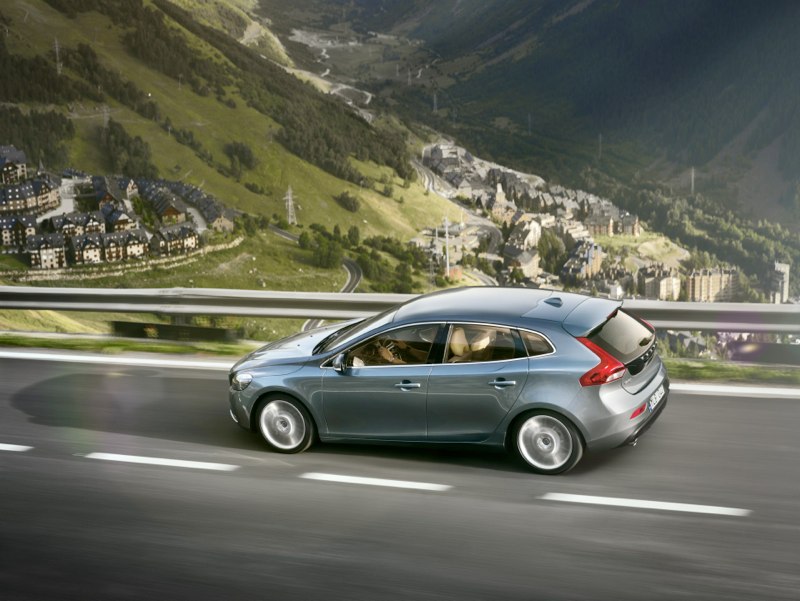
Road Test: Volvo V40 D2 1.6 SE
Price as tested: €28,995
+ Styling, cabin, comfort, dynamics, safety, innovation
– Poor auto ‘box, gimmicky functions, expensive and confusing options list
= Volvo's best drivers’ car should give the A3 a fright
With the new V40, Volvo is at last right-sizing its range. The previous S40 saloon and V50 estate were nice cars in their own right, but sat at confusing price and size points, half way between the likes of a BMW 1 Series and 3 Series. Now, they have been done away with (although the smaller C30 hatch will continue for a while in some markets) and replaced with a new hatchback, the V40, which aims itself right down the throat of the 1 Series, the Audi A3 and the upcoming new Mercedes-Benz A-Class, while also taking on the likes of the Alfa Romeo Giulietta or a well-specced VW Golf.
Style-wise, it certainly makes an impact and is probably Volvo's best styling effort since the clean, muscular 1995 C70. You could easily accuse it of having a few too many lines and the little inset in the rear doors, meant to homage the original P1800 coupe, is rather lost. But for all that, it's a deeply handsome car; unmistakably a Volvo but still breaking new styling ground for the brand.
Inside, much has been lifted from the existing S60 saloon and that's no bad thing. It looks gorgeous in there and quality levels are very high with, as almost goes without saying for a Volvo, comfort levels to match. Space is excellent in the front, aside from a slight lack of foot space for front passengers, while it’s fine in the back, even for tall passengers, unless you option it up with the panoramic glass roof, which robs a bit of headroom. The 'floating' centre stack has been a love-it-or-hate-it Volvo touchstone for some time now but the TFT digital instrument pack is all new. It's fitted to all but the most basic ES models (which make do with regular analogue dials) and allows you to customise the display colours and layout to your taste, flicking between Comfort, Eco and Sport modes. To be honest, it's a bit too gimmicky for its own good, with the layouts being pretty but not very intuitive and, oddly for a Volvo, needing you to distract yourself from the road ahead too frequently to figure out what's going on.
Equally gimmicky and equally pointless is the adjustable steering weight. We've come up against similar systems in the past (hello, Hyundai i30) and they are rarely, if ever, satisfactory. Yes, there is a difference in feel and effort in each mode, but it's too subtle a difference to make it worth the effort and we'd rather see a single setting that works well for all. Just leave it in Light mode and you'll be fine.
Underneath its swoopy new body, the V40 uses a mixture of old S40 mechanical parts (which also therefore means it's related to the MkII Ford Focus) and some S60 components (which itself draws on the current Ford Mondeo). The result could have been a mish-mash, but actually it works very well. As long as you avoid the optional 10mm lower Sport Suspension, the V40 combines such talents as being a refined and comfy motorway cruiser and a decently talented back-roads attacker. Certainly in the mountains above Verona, it felt agile and responsive, displayed no bad manners under than an occasional tendency to understeer at maximum effort and generally gave a good dynamic account of itself. It's not (quite) as engaging to drive as a Golf nor (anything like as much) as a BMW 1 Series, but it does do an excellent job of balancing comfort, agility and stability. Probably Volvo’s best-ever drivers’ car, in fact
The primary engine for Ireland will be the familiar 115bhp, 270Nm 1.6-litre D2 engine, which also sees service in other Volvos, various Fords and a glut of Peugeots and Citroens. It's a thoroughly decent engine, with plenty of low-down oomph, but an unfortunate habit of giving elongated growls at the top of the rev range. Not enough to seriously upset refinement, but you'll never enjoy wringing it out. Volvo claims average fuel consumption of 3.6-litres per 100km (better than 70mpg) which we got nowhere near, but then we did have the sweeping roads of the Dolomites to enjoy, so ask us again on that score once we get the V40 at home in the summer. Co2 emissions are 94g/km when fitted with 16" wheels (a class leading figure) and if you go for the optional 18" rims, that only climbs to a very creditable 99g/km. That should keep you safe from anything Michael Noonan's got planned...
Speaking of options, we need to speak of options. Volvo is offering a frankly bewildering range of optional extras on the V40, some of which can be bought individually, some of which come in packs and to be honest, we still haven't got our heads around it. The headlining safety pack, which includes Pedestrian Detection cameras, blind spot monitors, lane keeping, collision warning and active headlights seems only right and proper to fit to a Volvo, but it will set you back an extra €1,300 on this SE model, thanks to the loading of VRT and VAT on the options. Which, for ground breaking safety items, seems more than a bit churlish of the Government to charge for with one hand while simultaneously smacking us around the head with the other for not driving more safely... Fit the kit and you would almost unquestionably have the safest car in its class.
Other options include such items which you might think should come as standard, including such as Bluetooth phone connection and cruise control. Let's just say that you're going to have to do your homework if you want to spec your V40 up correctly. A couple of options to avoid are either of the twin-clutch Powershift or conventional Geartronic automatic gearboxes, both of which felt erratic and ill-matched to their engines. Ireland will take only the D2 diesel, more powerful 5-cylinder D3 2.0-litre 150bhp diesel and T3 150bhp petrol 1.6, which has a creditable 125g/km Co2 figure.
Thankfully coming as standard is Volvo's new pedestrian airbag, a vast u-shaped device that emerges from the trailing edge of the bonnet should a sensor in the front bumper detect that you've just run into someone. It works above speeds of 20kmh and below 50kmh and is part of Volvo's ambitious commitment to see that by 2020, none of its vehicles should be involved in a fatal collision. Once again, the Swedes are showing the rest of the world the way to go when it comes to safety.
Price-wise, it could find itself in a touch of difficulty though. At a basic €26,995 (for either the entry level diesel or petrol) it's right up against the cheapest BMW 1 or Audi A3. Should it have undercut them more? And is an extra €2-€3k over and above an equivalent VW Golf too much of a stretch for potential buyers? Perhaps it comes down to how well Volvo's traditional safety and environmentally friendly messages can combine with the new-found style, and whether sufficient youthful buyers can be found to whom that will appeal.
The V40 is an instantly appealing kind of car though; not just because it's pretty, not just because it's safe but because it's the kind of car that, even after a few minutes, you want to spend a lot of time with. It feels like a car that will fit neatly into a broad swathe of lifestyles, and with its understated Swedish looks and image, feels a bit more in touch with our caring, sharing times than the more overtly aggressive Germans. It's also a new beginning for Volvo, as it seeks to dramatically expand its sales under its new Chinese owners, Geely Motors. We will more than likely be seeing more versions of the V40; a faux-4x4 XC40 has already been confirmed, a four door saloon is apparently being worked on and a sporty R version is not being ruled out.
If we say the V40 is nice, that sounds like damning with faint praise, but that's exactly what it is; nice. And frankly, these days, a bit more niceness wouldn't go astray.
Facts & Figures
Volvo V40 1.6 D2 SE
Price as tested:€28,995
Range price: €26,995 to €35,995
Cubic capacity: 1,560
Power: 115bhp
Torque: 270Nm
Maximum speed: 190kmh
0-100kmh: 12.3secs
Fuel consumption: 3.6l/100km (78.5mpg)
Co2 emissions: 94g/km
Tax band: A (€160)
EuroNCAP rating: Not yet tested
Subscribe to:
Posts (Atom)