Showing posts with label cool. Show all posts

Tuesday, 22 January 2013

Road Test: Volkswagen Beetle Sport 2.0 TDI 140

 
Price as tested: €28,695

+ Sexy looks, improved cabin quality and space, comfort, quality, engine
– Cheap rear suspension spoils the dynamic performance, expensive
= Grooviest looking car on the road today, but Golf is still superior
How do you review an icon? How do you pass judgement on something that's already a pillar of history? If you went on a date with Scarlett Johannson (or Brad Pitt, take your pick) would you spend dinner assessing their skin tone, their haircut, the cut of their clothes? Or would you just revel in simply being in their presence?

That's the problem facing this bitten, cynical car critic when it comes time to review the new Volkswagen Beetle. The original Beetle was the first car to break the Ford Model T's record as the best-seller of all time (a mantle since passed to the Toyota Corolla) and made a remarkable journey from being the apple of a cruel dictator's eye, to being the car of choice of the California counter-culture to its final resting place as a revered classic and a beacon of simple, rugged engineering.

Then Volkswagen attempted to have its cake and eat it. Based on a concept car, the second generation Beetle launched (with, shock, front engine and front wheel drive) in the late nineties to acclaim for its cute, cartoony styling but to criticisms for its poor interior packaging and a deeply lacklustre driving experience. Not to mention the fact that it was more expensive than the more practical Golf which replaced its ancestor, but which shared engines and chassis with the new Beetle.

Now, the record has come around again, and there's a third generation Beetle. Again, it's based on the same platform as the Golf (albeit the last-generation, MkVI Golf, not the current car) and again it's trading heavily on its iconic past.

It's very, very hard not to be sucked in by those retro lines. The overly-curved, cartoonish look of the second Beetle is gone, replaced by a car with a flatter, more aggressive roof and square, straight lines to add tension. Frankly, it's brilliant and I was instantly suckered. There are few, if any, other cars on the road right now as good looking as this and it draws a more obvious line between the original Beetle and the Porsche sports cars it inspired.

Inside too, things are better than before. Out goes the silly flower vase and in comes a neat instrument pack and a touch of the Fiat 500's cabin ambience. Obviously retro but still modernly functional. There's much better space in the back and the boot is far more practically sized and shaped than was the case on the last Beetle.

The engine's a belter too. VW's 2.0-litre 140bhp diesel engine has been around for a while, but in the Beetle it proves itself still a youthful performer. Theres's as much punch as you could wish for through the gears, yet it will still return a 50mpg average without too much effort. Stop-start would be nice for traffic duties, but hey, you can't have everything and it's refined enough to make you believe, just for a moment, that it might be petrol.

It's just a pity that the chassis isn't up to the standards of the engine, especially when the new Golf is able to provide such a classy driving environment. The Beetle's not bad, it's just not as good as it could be. The steering (which communicates with you through quite a big wheel) is nicely, even sportily weighted and the Beetle turns into corners with alacrity and precision. The problem comes from the rear suspension. The Beetle is, primarily, designed and built for the US market where price is king, so to keep costs down, VW has stuck with an old-fashioned torsion-bar rear axle. It's mechanically simple, compact (which helps with the boot space) but it cannot provide the sophistication of a more modern multi-link setup. Hit a mid-corner bump when rounding a fast corner and you'll see what I mean. The rear end thumps, kicks and even skips a little a times. It's never actually unstable, but it feels and sounds uncomfortable and discourages you from enjoying the drive.

Which is a shame, as the Beetle is a remarkably charming car. It's not just the styling this time around, as the cabin, engine and, for much of the time, the driving experience are up to snuff. The problem is, as ever, that the Golf is more capable, more spacious, more affordable and better to drive. There is a reason that the original Beetle was replaced by the original Golf and that reason hasn't really altered in the past forty years. Yes, it is a bit like taking Scarlett Johannson out and asking if there are any more at home like her, but that's the simple truth.


Facts & Figures

Volkswagen Beetle Sport 2.0 TDI 140


Price as tested: €28,695

Range price: €20,695 to €30,445

Capacity: 1,968cc


Power: 140bhp


Torque: 320Nm


Top speed: 198kmh


0-100kmh: 9.4sec


Economy: 4.9l-100km (57.6mpg)


CO2 emissions: 129g/km

VRT Band: B1. €270 road tax


Euro NCAP rating: 5-star; 92% adult, 90% child, 53% pedestrian, 86% safety assist 

Monday, 1 October 2012

News: Mercedes announces Irish prices for the new A-Class


Mercedes-Benz's new A-Class will cost from €26,435 when it goes on sale in December, says Motor Distributors, Mercedes' Irish importer.


Mercedes has announced that it will be giving pride of place in Ireland to two models from their new A-Class range, both of which are due to arrive here in December. One will be an A180 petrol version at €26,435 (ex works) and the other an A180 CDI diesel version at €28,550 – the latter model being the one predicted to take the spotlight in Ireland, thanks in part to its greener CO2 emissions of just 98g/km.

Billed as the car that many believe will introduce the luxury car maker to a completely new, younger generation of customers, both models will come in a choice of three specifications and equipment lines – Style Pack, Urban Pack and Sports Pack. Entry models sold here will all be equipped with the Style Pack option – a package that includes items which, were they purchased separately, would have a value equivalent to €1,600.

To highlight what is seen as one of the A-Class’ USPs – its iPhone and iPad compatibility - the launch plan being put together by Mercedes-Benz will major heavily on Facebook and smart phone App technology to create an ‘interactive platform’ whereby prospective customers can scroll through its features to select the model that suits them best.

Since its debut at the Geneva Motor Show earlier this year, queues for the new A-Class have already begun to form, here and around the globe. With over 40.000 orders already placed even before production has commenced, Mercedes-Benz has had to supplement production capacity to meet expected demand.

As different from its predecessor as it is possible to be, the new A-Class sits some 18cm closer to the ground – a lower-slung posture that gives it a distinctly sporty, youthful appearance. Built on the B-Class platform, its on board high-tech functionality is such that iPhone Siri voice-activated units and iPad music and Apps can be played through the car’s infotainment system.

All engines offer an idle-stop system as standard, linked to a six-speed manual or seven-speed dual-clutch automatic transmission. Front-wheel drive, the new A-Class has a new four-link rear suspension system with a range of settings on offer that includes an optional sports setting with direct steer. Collision Prevention Assist, Attention Assist, Adaptive Brake Assist and Brake Hold are all part of its standard safety features.

Thursday, 27 September 2012

Road Test: Fiat Abarth 500C


Price as tested: €31,000 (approx)

+ Styling, engine, handling, seats, quality, sense of fun
– Tiny boot and rear seats, quite thirsty, no official imports yet
= Funnest hot hatch of the moment


Like a Scottish Terrier carrying a Kalashnikov, the Fiat Abarth 500C is packing way more aggression than befits something so small. The standard 500 is cute, chic, even (whisper it) a bit girly. The Abarth is its mildly psycho brother who's into body piercing and headbutting walls.

As with all great Italian cars, the heart of the Abarth is its engine, a 1.4-litre turbo petrol developing 135bhp. 135bhp doesn't sound like much these days, but it's accompanied by a decent slug of 200Nm of torque and, in practice, there's more than enough grunt to both hoick you up the road at a suitably impressive rate and keep you making rapid gearchanges on the stubby five-speed manual, punching them through from the elbow.

When you do that, and especially during fast upshifts as you accelerate, the optional Monza exhaust (which actually adds 5bhp thanks to improved engine breathing, bringing the Abarth up to 140bhp), with its mildly hilarious quad exit pipe, bangs and growls like a grumpy howitzer battalion. It's all ludicrously entertaining, and thanks to the 500's diminutive dimensions, it all happens at a reasonable rate of consumption. 8.1-litres per 100km sounds a touch thirsty for a small car, but in the context of the fun on offer, it's a perfectly acceptable price of admission.

It always used to be the case that with high-performance Italian cars, you paid for the (glorious) engine and the rest of the car was thrown in (and together) for free. Famously, journalist and racer Paul Frére complained to Enzo Ferrari that his Testarossa Le Mans racer had such a big, flat windscreen that it was crawling down the Mulsanne Straight while the sleek Jaguars and others blasted past. "Well you know," declared Il Commentadore airily, "aerodynamics are for people who can't design proper engines..."

Thankfully, the Abarth 500 proves that such dismissiveness is truly a thing of the past for fast Fiats (effectively what Ferraris have been since the seventies; heresy I know). The 500C feels beautifully built for a start, with high levels of cabin quality and gorgeous high-backed Alcantara bucket seats. Rear space is somewhat compromised by these bulky buckets, but it was hardly all that roomy to begin with, and by choosing the C over the regular hatch 500, with its peel-back convertible roof, you are effectively resigning yourself to having no boot space to speak of. A squashy bag is about the limit.

No matter. Once you get rolling, you won't care about the practicalities. It may sound odd to say it of a stiffly sprung sporty thing with big optional alloys and watch strap Pirellis, but the Abarth actually rides better than the standard 500.It bounces around less, even though it's plainly harder than the standard car, and the steering, so remote on a normal 500, is here full of feel and delightful weight. There is simply tonnes of grip, a little hint of the back end squirming around when you corner seriously hard and an abiding sense of out and out fun and enjoyment. Occupying an even smaller amount of road than Mini's conceptually similar Cooper S Works, the 500C feels ideally suited to Ireland's twisty and narrow back roads. And because it's not over-burdened with some silly specific output, you can enjoy ringing its neck a little without attracting the attention of either sides of the legal profession.

When the going gets properly twisty and slippery, it’s best to thumb the TCC button just below the aircon controls. That activates an electronic differential which brakes an unloaded front wheel to prevent power being spun away and which also helps the Abarth’s chassis to reduce understeer to an effective minimum. Unlike some similar systems (or a pure mechanical diff) it doesn’t bring with it unnecessarily hefty steering or camber-following tendencies, it’s much more subtle and effective than that.

As yet, Abarth models are still not officially imported into Ireland, but their visa status is due to be updated any time now. For the meantime, you can personally import one (a process that I’m sure your local Fiat dealer would be more than happy to help with) and you’ll have to fork out in the region of €27,000 for the 500C, about €2,000 less for the hatch. Our test car came loaded with options including that wonderful Monza exhaust and the gorgeous high-back Sabelt seats which swelled its price by €4,000. Pricey for such a small car then, but very much worth it to my mind. Besides, try speccing a Mini Cooper S up to similar levels and see where you get to...

You could spend even more and upgrade to the Essesse kit, which brings with its more power (160bhp), uprated brakes and tweaked suspension, but the extra stiffness would probably ruin the Abarth’s rather lovely ability to flow with bad roads rather than fighting them, so I wouldn’t bother.

Personally, I'd skip the C part too (the roof is nice and all, and works at speeds of up to 80kmh, but its usability in Ireland is always going to be limited) and go for the hatch, which also brings with it a more practical boot and that slight cut in price. Would I buy one? Oh, if only I could afford it. Hot hatches have become, as a species, somewhat too refined and practical of late. Even the likes of a 200bhp Clio or DS3 can fail to provide much in the way of outright thrills, so steady and safe are they. The Abarth feels a touch more unruly, raw and on the edge than that. It's the hot hatch as she is meant to be spoken.


Fiat Abarth 500C
Price as tested: €31,000 (approx)
Price range: €12,895 to €27,000 (approx)
Capacity: 1,368cc
Power: 135bhp
Torque: 200Nm
Top speed: 205kmh
0-100kmh: 7.9sec
Economy: 6.5l-100km (43.4mpg)
CO2 emissions: 155g/km
Road Tax Band: C €330
Euro NCAP rating: 5-star adult, 3-star child, 2-star pedestrian


Road Test: Volvo V40 D2 1.6 SE


Price as tested: €28,995

+ Styling, cabin, comfort, dynamics, safety, innovation
– Poor auto ‘box, gimmicky functions, expensive and confusing options list
= Volvo's best drivers’ car should give the A3 a fright


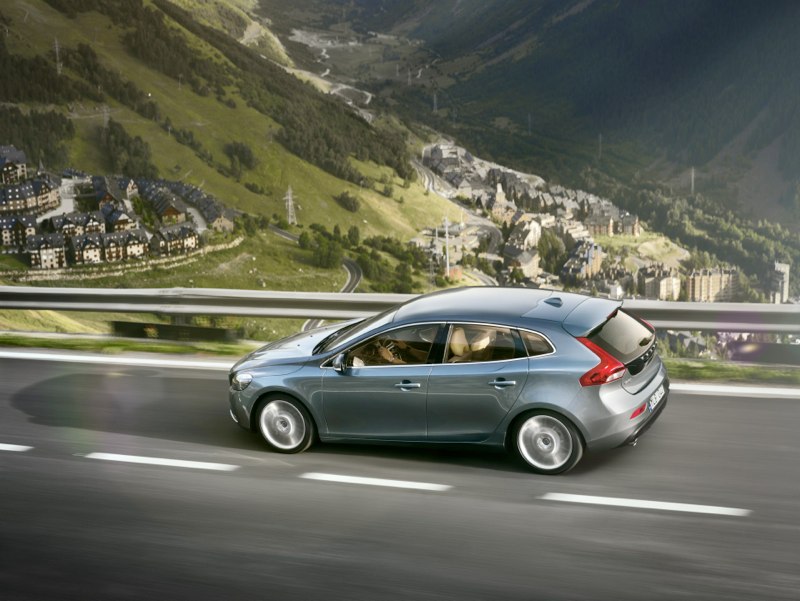
With the new V40, Volvo is at last right-sizing its range. The previous S40 saloon and V50 estate were nice cars in their own right, but sat at confusing price and size points, half way between the likes of a BMW 1 Series and 3 Series. Now, they have been done away with (although the smaller C30 hatch will continue for a while in some markets) and replaced with a new hatchback, the V40, which aims itself right down the throat of the 1 Series, the Audi A3 and the upcoming new Mercedes-Benz A-Class, while also taking on the likes of the Alfa Romeo Giulietta or a well-specced VW Golf.

Style-wise, it certainly makes an impact and is probably Volvo's best styling effort since the clean, muscular 1995 C70. You could easily accuse it of having a few too many lines and the little inset in the rear doors, meant to homage the original P1800 coupe, is rather lost. But for all that, it's a deeply handsome car; unmistakably a Volvo but still breaking new styling ground for the brand.

Inside, much has been lifted from the existing S60 saloon and that's no bad thing. It looks gorgeous in there and quality levels are very high with, as almost goes without saying for a Volvo, comfort levels to match. Space is excellent in the front, aside from a slight lack of foot space for front passengers, while it’s fine in the back, even for tall passengers, unless you option it up with the panoramic glass roof, which robs a bit of headroom. The 'floating' centre stack has been a love-it-or-hate-it Volvo touchstone for some time now but the TFT digital instrument pack is all new. It's fitted to all but the most basic ES models (which make do with regular analogue dials) and allows you to customise the display colours and layout to your taste, flicking between Comfort, Eco and Sport modes. To be honest, it's a bit too gimmicky for its own good, with the layouts being pretty but not very intuitive and, oddly for a Volvo, needing you to distract yourself from the road ahead too frequently to figure out what's going on.

Equally gimmicky and equally pointless is the adjustable steering weight. We've come up against similar systems in the past (hello, Hyundai i30) and they are rarely, if ever, satisfactory. Yes, there is a difference in feel and effort in each mode, but it's too subtle a difference to make it worth the effort and we'd rather see a single setting that works well for all. Just leave it in Light mode and you'll be fine.

Underneath its swoopy new body, the V40 uses a mixture of old S40 mechanical parts (which also therefore means it's related to the MkII Ford Focus) and some S60 components (which itself draws on the current Ford Mondeo). The result could have been a mish-mash, but actually it works very well. As long as you avoid the optional 10mm lower Sport Suspension, the V40 combines such talents as being a refined and comfy motorway cruiser and a decently talented back-roads attacker. Certainly in the mountains above Verona, it felt agile and responsive, displayed no bad manners under than an occasional tendency to understeer at maximum effort and generally gave a good dynamic account of itself. It's not (quite) as engaging to drive as a Golf nor (anything like as much) as a BMW 1 Series, but it does do an excellent job of balancing comfort, agility and stability. Probably Volvo’s best-ever drivers’ car, in fact

The primary engine for Ireland will be the familiar 115bhp, 270Nm 1.6-litre D2 engine, which also sees service in other Volvos, various Fords and a glut of Peugeots and Citroens. It's a thoroughly decent engine, with plenty of low-down oomph, but an unfortunate habit of giving elongated growls at the top of the rev range. Not enough to seriously upset refinement, but you'll never enjoy wringing it out. Volvo claims average fuel consumption of 3.6-litres per 100km (better than 70mpg) which we got nowhere near, but then we did have the sweeping roads of the Dolomites to enjoy, so ask us again on that score once we get the V40 at home in the summer. Co2 emissions are 94g/km when fitted with 16" wheels (a class leading figure) and if you go for the optional 18" rims, that only climbs to a very creditable 99g/km. That should keep you safe from anything Michael Noonan's got planned...

Speaking of options, we need to speak of options. Volvo is offering a frankly bewildering range of optional extras on the V40, some of which can be bought individually, some of which come in packs and to be honest, we still haven't got our heads around it. The headlining safety pack, which includes Pedestrian Detection cameras, blind spot monitors, lane keeping, collision warning and active headlights seems only right and proper to fit to a Volvo, but it will set you back an extra €1,300 on this SE model, thanks to the loading of VRT and VAT on the options. Which, for ground breaking safety items, seems more than a bit churlish of the Government to charge for with one hand while simultaneously smacking us around the head with the other for not driving more safely... Fit the kit and you would almost unquestionably have the safest car in its class.

Other options include such items which you might think should come as standard, including such as Bluetooth phone connection and cruise control. Let's just say that you're going to have to do your homework if you want to spec your V40 up correctly. A couple of options to avoid are either of the twin-clutch Powershift or conventional Geartronic automatic gearboxes, both of which felt erratic and ill-matched to their engines. Ireland will take only the D2 diesel, more powerful 5-cylinder D3 2.0-litre 150bhp diesel and T3 150bhp petrol 1.6, which has a creditable 125g/km Co2 figure.

Thankfully coming as standard is Volvo's new pedestrian airbag, a vast u-shaped device that emerges from the trailing edge of the bonnet should a sensor in the front bumper detect that you've just run into someone. It works above speeds of 20kmh and below 50kmh and is part of Volvo's ambitious commitment to see that by 2020, none of its vehicles should be involved in a fatal collision. Once again, the Swedes are showing the rest of the world the way to go when it comes to safety.

Price-wise, it could find itself in a touch of difficulty though. At a basic €26,995 (for either the entry level diesel or petrol) it's right up against the cheapest BMW 1 or Audi A3. Should it have undercut them more? And is an extra €2-€3k over and above an equivalent VW Golf too much of a stretch for potential buyers? Perhaps it comes down to how well Volvo's traditional safety and environmentally friendly messages can combine with the new-found style, and whether sufficient youthful buyers can be found to whom that will appeal.

The V40 is an instantly appealing kind of car though; not just because it's pretty, not just because it's safe but because it's the kind of car that, even after a few minutes, you want to spend a lot of time with. It feels like a car that will fit neatly into a broad swathe of lifestyles, and with its understated Swedish looks and image, feels a bit more in touch with our caring, sharing times than the more overtly aggressive Germans. It's also a new beginning for Volvo, as it seeks to dramatically expand its sales under its new Chinese owners, Geely Motors. We will more than likely be seeing more versions of the V40; a faux-4x4 XC40 has already been confirmed, a four door saloon is apparently being worked on and a sporty R version is not being ruled out.

If we say the V40 is nice, that sounds like damning with faint praise, but that's exactly what it is; nice. And frankly, these days, a bit more niceness wouldn't go astray.


Facts & Figures

Volvo V40 1.6 D2 SE
Price as tested:€28,995
Range price: €26,995 to €35,995
Cubic capacity: 1,560
Power: 115bhp
Torque: 270Nm
Maximum speed: 190kmh
0-100kmh: 12.3secs
Fuel consumption: 3.6l/100km (78.5mpg)
Co2 emissions: 94g/km
Tax band: A (€160)
EuroNCAP rating: Not yet tested


Road Test: Lexus GS450h F-Sport


Price as tested: €72,950

+ Drivetrain, refinement, comfort, chassis balance, quality
– Silly grille, numb steering
= The best hybrid we’ve yet driven


Here’s a funny thing. Lexus can’t tell me how much torque the new GS450h has. Nerdy fact that it is, a healthy torque figure is deeply significant for driving both relaxed and invigorating. A lack of torque is inimical to fun and lots of it gives you that lovely, deep-down thumpy feeling as you accelerate hard out of a tight corner. It’s what makes American V8s so addictive and its absence is what makes small petrol engines such hard work. Normally you just look up the figure, either in Newton-Metres (Nm) or foot-pounds (lb-ft) in a car’s technical data list. And it’s not that the GS has no torque; quite the opposite. You can feel its presence every time you tap the throttle.

The thing is that the GS450h, a hybrid as was its predecessor and almost every other Lexus, draws its torque from two sources. A 3.5-litre V6 petrol with 352Nm and an electric motor with 275Nm. Add the two together and you get a fairly tyre-shredding 627Nm or about what you’d get from a 1970s Can Am racer...

It’s not that simple though, says Lexus and I seriously doubt that the GS ever gets the full combined 627Nm or the rear Bridgestones wouldn’t be long for this world. Instead, the fearsomely clever computer management system (which can presumably calculate lunar orbit trajectories and file your tax returns) juggles and apportions the power and torque outputs of the two motors until you have an essentially seamless whole.

Now, hybrids have been criticised in the past, and frequently on these pages, for not being up to snuff. The idea of backing up a downsized petrol engine with an electric motor seems entirely sensible and effective, but never in the past have we driven a hybrid that either lived up to its fuel economy claims or gave us much in the way of driving pleasure. (The Honda CR-Z gets a by here because it’s fun in spite of being a hybrid.) The old GS450h was fun enough in a straight-line, drags-strip kind of way, its combination of petrol and electric grunt sufficient to hurl it up the road in a most uneconomical fashion, but it felt a bit lead-footed in handling terms and its economy and emissions were soon out-classed by the new hordes of hyper-efficient diesels.

This GS then, has rather a lot to prove, both as a hybrid and as a car. Can a hybrid ever match or beat the latest diesels in economy and emissions terms? Can Lexus produce a truly convincing challenger to the likes of the BMW 5 Series?

Well, you certainly can’t accuse Lexus of keeping its light under a bushel this time around. The new GS, when seen from the back and side is crisply handsome and subtly muscular. And that new grille, with its chrome fangs? Well, I can certainly see what Lexus was trying to do – to inject both distinctiveness and aggression, but for my money it just doesn’t work. It look inelegant and a bit OTT. A shame.

There’s better news on the inside though, where the previous GS’s slight sense of clunkiness is banished by a very slick and stylish cabin, with beautifully simple, clear instruments, a big central screen for controlling the infotainment and HVAC systems and a distinctly inviting sense of comfort and style. The seats a big, comfy and supportive. The space in the rear seats is excellent. I love the way that, when you push the Sport button, the instruments switch from a charging metre to a red-lit rev counter.

Way out back, boot space has dramatically improved. In the last GS, the hybrid system’s batteries ate so deeply into the luggage room that you were left with a narrow slot that wouldn’t hold very much at all. Now, thanks to better packaging, there’s a decent (if not class leading) 482-litres. That’s better.

Slip behind the wheel and push the starter button and there’s the usual hybrid car silence as the batteries take the strain for the initial few metres. When the 3.5-litre 292bhp petrol V6 engine comes to life, you’ll struggle to notice it. The usual Lexus superlatives of refinement and noise suppression apply.

Where that V6 really makes itself felt and heard is when you accelerate hard. We’ve become so used, over the past few years, to big executive cars being exclusively diesel-powered, so the crisp, sharp-edged snarl of the GS’s engine as it passes 4,000rpm (the point at which most diesels just give up and go home) is as refreshing as lemon zest and just as tasty. Combined with the batteries and electric bits, it makes for a very satisfying drivetrain to use, probably the best hybrid we’ve ever tried. There never seems to be a gap in the power, or a step when one system or the other dominates. The CVT gearbox doesn’t seem to suffer from the same problems that afflict over continously variable ‘boxes, such as letting the engine needlessy blare its head off at high rpm when accelerating. And it’s decently economical too. Lexus claims 6.0-litres per 100km on the combined cycle, which you probably won’t get near, but we averaged mid-sevens and that’s about what you’d get out of a comparable 3.0-litre diesel. Impressive.

Impressive too that emissions have been kept down to a Band B-friendly 139g/km, so you can match a BMW 520d buyer for tax smugness while matching a 535d for performance. That’s quite a combination, and it’s nice to notice how often the car automatically kicks into EV mode, not just when cruising around town, but also on the open road. It makes you feel like it was worth going down the hybrid route, even if in reality, a constantly-running diesel is little less efficient.

Our F-Sport spec test car came with option four-wheel-steering, and eighties Japanese obsession that seems to be making something of a comeback. I can honestly say that, in spite of trying, I could never actually feel the rear wheels doing anything much, but there’s no doubting that the GS felt unusually agile and chuckable for such a big car. A shame that the steering is too remote and distant for you to truly enjoy punting it along, but there’s no doubt that a pretty terrific chassis dwells beneath; an achievement made even more impressive when you remember that the GS’s is still packing the extra weight of all those batteries. Impressive too that the ride quality is generally excellent, only occasionally feeling too firm and mostly just cosseting nicely.

At €72,950, the F-Sport’s rear-steer and sporty bodykit and wheels may seem a bit of an extravagance over the cost of a €59,950 Executive model, but there’s no doubt that for the first time, Lexus has really hit the 5 Series market dead-on. It won’t be to the tastes of the me-too hordes who will only ever buy German at this price level, but here at least is a hybrid that’s a frugal as it should be and as invigorating to drive as you’d hope. Here is a Lexus of true character and enjoyment, as well as the expected quality and refinement.

Lexus GS450h F-Sport
Price: €72,950
Range price: €59,950 to €76,250
Capacity: 3,456cc
Power: 345bhp
Torque: See text
Top speed: 250kmh
0-100kmh: 5.9sec
Economy: 6.0-100km (47.0mpg)
CO2 emissions: 139g/km
Tax Band: B. €225 road tax
Euro NCAP rating: Not yet tested


Wednesday, 26 September 2012

Road Test: Fiat Panda 1.2 Easy


Price as tested: €12,995

+ Funky, spacious interior, bigger boot, ride and handling
– Economy could be better, styling looks a touch bulbous
= Fiat’s small car now feels big, but in a good way

2012 is very definitely going to be the year of the small. Whatever the Mayans might have in for us, however much The Hunger Games tries to takeover and no matter what you may have heard about some tournament in Poland where overpaid future pub landlords kick an inflated pig’s bladder about, 2012 is the year of the small car.

Two of the most significant cars to be launched this year are both tiny, both cost around the €11,000 mark yet have the style and sophistication of much bigger vehicles and both are critical to the future of their makers.

The other one is the Volkswagen Up!, which we’ll be testing next week but first up is the new Fiat Panda, the replacement for Fiat’s much-loved tiddler which was launched way back in 2003.
Yet for a car that was knocking on for a full decade in production, the outgoing Panda was still feeling and looking rather fresh and rather lovely, a fact that makes the task before its replacement that much harder. Not only will that be to keep happy Panda buyers in the fold, entice new customers to the Fiat and Panda badges and generally be well received, reviewed and retailed, but like its progenitor, it has to shore up Fiat’s delicate finances. True, those finances are vastly more robust than they were when the 2003 Panda was launched, but nonetheless, this is a crucial new model for a car company that needs a big hit right now.

So you can forgive Fiat for playing it slightly safe with the exterior styling. While all the panels and the detailing is new, there is much here that is familiar from the old Panda. The three-window side view, the slightly boxy, unapologetically upright shape. It is less utilitarian than before, less overtly square, but while the front end (with a face that looks very similar to what’s coming on the new 500L MPV) looks nice and cute, around the back it looks a little puffed-up and botoxed.

Inside though, the news is all good. Fiat has attempted to coin a new word, the Squircle, to describe the squared-off circle motif (or is it a rounded square?) that dominates the interior design. From the main dials to the switchgear to the steering wheel centre to pretty much everything on view, all is squircled up to the max. It could have been irritating, but thanks to a rather funky, slightly seventies retro vibe, some solid build quality and some inherently sensible layout ideas, it all works. The seats, which once again are a touch perched up, are nonetheless comfy and there’s more elbow room than before, thanks to the Panda being slightly larger in every dimension than before. There’s useful oddment storage pretty much everywhere your hands fall, and there’s new-found room in the back seats, proper adult room., thanks to a longer 2,300mm wheelbase. Behind that, there’s now a decent boot, sized between 225 and 260-litres, depending on which version you buy.

And that extra space is significant. It moves the Panda ever so slightly above most of the competition, into the realms of the small family car, as opposed to the small urban runabout. I’m not saying it’s now wildly spacious, but a family of two adults and two kids will fit, with a little bit of squishing, and there’s still space in the boot for a decent sized trip to Tesco’s.

That sense of greater space and usability is reflected in the way the Panda drives. Now, that’s not to say that it feels all growed up, at least not in the sense that it’s still fun to chuck around and still revs eagerly like a small, enthusiastic Italian car should, but there is palpably better refinement on long motorway runs. Sidedrafts and the turbulent air around fast-moving lorries now bothers the Panda not a jot, yet it hasn’t lost its feeling of verve and agility around town. It still slices into and through urban gaps that would stymie a larger car and parking in typically restrictive and tight city multi-stories is a joy, not a chore.

Surprisingly, the 1.2-litre petrol engine, well, surprised us. We had been assuming that the motor of choice would be either the 875ccc turbo TwinAir (noisy but gutsy and bursting with character) or the much-admired (but quite expensive) 1.3 MultiJet diesel. The 1.2 FIRE (Fully Integrated Robotised Engine) can trace its roots all the way back to 1985, yet it is feeling better than ever in the new Panda. 69bhp and 102Nm of torque don’t sound like much, and a 14.2sec 0-100kmh time sounds positively tardy, but on the road, the 1.2 pushes the Panda along with decent conviction, good refinement and not-bad economy. We say not-bad, because an average of 7.2-litres per 100km on our test is just that; neither good nor bad, just about acceptable, even if well short of Fiat’s claimed 5.2-litres per 100km. In the Panda’s defence, much of our test mileage was motorway based, and had we kept to main roads and urban driving (even with the surprising absence of stop-start) it’s likely the economy figure would have been much better. The Co2 figure of 120g/km is just fine though, and keeps you in the lowest €160 tax band.

Prices for the Panda are similarly low. €11,995 gets you the basic Pop 1.2, while our mildly specced-up Easy would set you back €12,995. More expensive are the TwinAir and MultiJet models, but given that the 1.2 is so good, you might be able to safely ignore these. That basic price does make it more expensive than the cheapest new VW Up! but then the Up! is just a three-door for the moment.

It is just about impossible not to like the Panda. It carries with it a sense of charm and fun that has been almost eradicated from larger, more expensive cars. It’s enjoyable to drive, reasonably spacious and practical and, given that the touchy-feely quality was right on the money, seems impressively well built too. Make no mistake, in the year of the small, this one’s a biggie.

Facts & Figures

Fiat Panda 1.2 Easy
Price: €12,995
Range price: €11,995 to €15,545
Capacity: 1,242cc
Power: 69bhp
Torque: 102Nm
Top speed: 164kmh
0-100kmh: 14.2sec
Economy: 5.2-100km (54.3mpg)
CO2 emissions: 120g/km
Tax Band: A. €160 road tax
Euro NCAP rating: 4-stars; 82% adult, 63% child, 49% pedestrian, 43% safety assist


Road Test: Chrysler 300C 3.0 V6 CRDI


Price as tested: €137,637

+ Looks, comfort, refinement, space, quality
– Still some cheap cabin bits, high-ish Co2 levels
= Brash and proud of if. And damned likeable

Chrysler chose to launch the new All-American 300C saloon in the astonishing surrounds of the American Air Force hanger at the famed Duxford aviation museum near Cambridge. The centrepiece of the Norman Foster-designed building is a simply massive Boeing B52 bomber - the mainstay of the US Air Force bomber fleet for sixty years now. A hulking slab of Yankee menace, the 52 induces at once giggly excitement and intimidated awe. Shock and Awe may be a modern phrase, but the big 52 was doling out just that in 200 bombing missions over North Vietnam three decades ago.

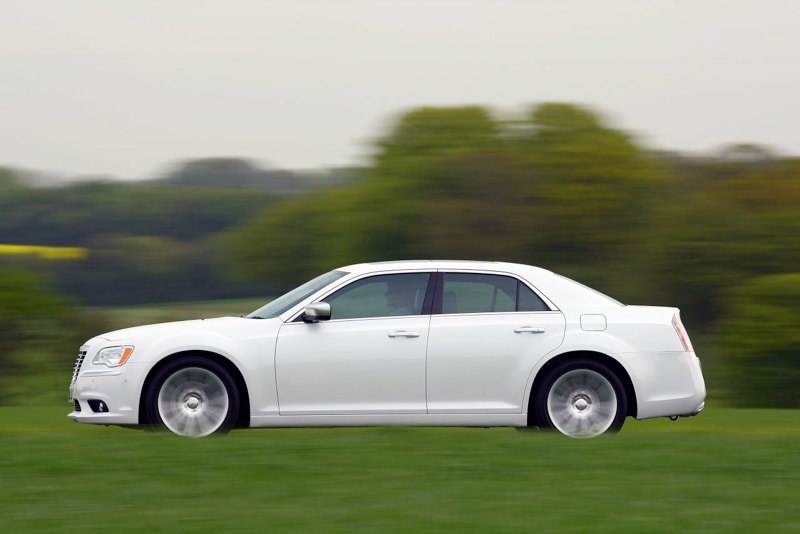
The link being drawn between the aircraft and the car was explicit; the finest of American technology wrapped up in an aggressive, iconic shape. The 300C, now significantly re-worked, is back on Irish roads for the first time since 2010 and whatever you may feel about its being compared to a nuclear bomber, the old  300C value of S-Class-size-for-E-Class money remains intact.

The old 300C had felt old even when it was new, though. Based on a mid-nineties Mercedes E-Class chassis, it looked mean, but you could feel the age in dopey dynamics and a terribly lo-rent interior.

Under Fiat's guidance, the 300C has been made-over from stem to stern, with crisper exterior styling and an entirely new cabin that, almost, erases the memories of the dreadful old one. Inside, it's as spacious and as comfy as before, but now the quality of the plastics, leathers, woods and metals is up to German standards, nearly. You can still find some cheap, tacky surfaces without looking too hard but the main dials look tasty, backlit in blue neon, the steering wheel feels expensive and the massive colour touch screen, while fiddly to use, looks impressive.

Up front lies a new, bespoke-for-Chrysler VM Motori V6 diesel, with 239bhp and 500Nm of torque. It's the only engine available, and with the standard 5-speed automatic transmission, averages 7.1-litres per 100km (39.7mpg) and emits 185g/km of Co2. That puts it in an uncompetitive tax band (E, €677 motor tax) compared to a 530d or Audi A6 3.0 TDI but a forthcoming update with a new 8-speed auto should help reduce that figure a little. For now, it's a smooth, powerful, effortless and exceptionally refined drivetrain.

The 300C certainly has a character of its own and it doesn't follow the strict German executive saloon template. The ride is soft and pillowy, even on optional 20" alloy wheels, and the whole car has a very relaxed demeanour. Grab it by the scruff, and it it will corner briskly and responds well enough to being thrown around, but you can tell it would rather be cruising. Comfort is king.

For a basic price of €57,995, it comes rammed with standard equipment including full leather, heated and cooled front seats, heated rear seats, touchscreen satnav and infotainment, chilled and heated cup holders, and keyless entry and go. The only options available are high-tech safety items like radar guided cruise control, blind spot monitoring and emergency braking systems.

Whether or not you will want one will depend very much on your taste for Americana. The styling and mien is quite brash. Get it in a nice dark metallic and it's a very good looking car. Silver looks too plain, white just ridiculous on one so large. As a value proposition, compared to its direct opposition, it is in good shape and even against its lesser 2.0-litre rivals, you wouldn't be long dipping into the German options list to get their prices to match that of the larger Chrysler. True, the poor emissions and tax performance will be a stumbling block, and potential buyers will have to walk past the German giants and Jaguar and Lexus dealerships to get into a 300C, but it could, just, be worth the effort. It has its shortcomings (the chief one being that it's not German) but it is immensely likeable and characterful.

It all depends on whether you prefer Obama to Merkel, Dan Rather to Brian Dobson or Happy Meals to haute cuisine.


Facts & Figures

BMW M5
Price as tested: €57,995
Range price: €57,995 to €62,495
Capacity: 2,987cc
Power: 236bhp
Torque: 500Nm
Top speed: 231kmh
0-100kmh: 7.4secs
Economy: 7.1/100km (39.8mpg)
CO2 emissions: 185g/km
Tax Band: E. €677 road tax
Euro NCAP rating: Not yet tested