Showing posts with label Hybrid. Show all posts

Sunday, 27 January 2013

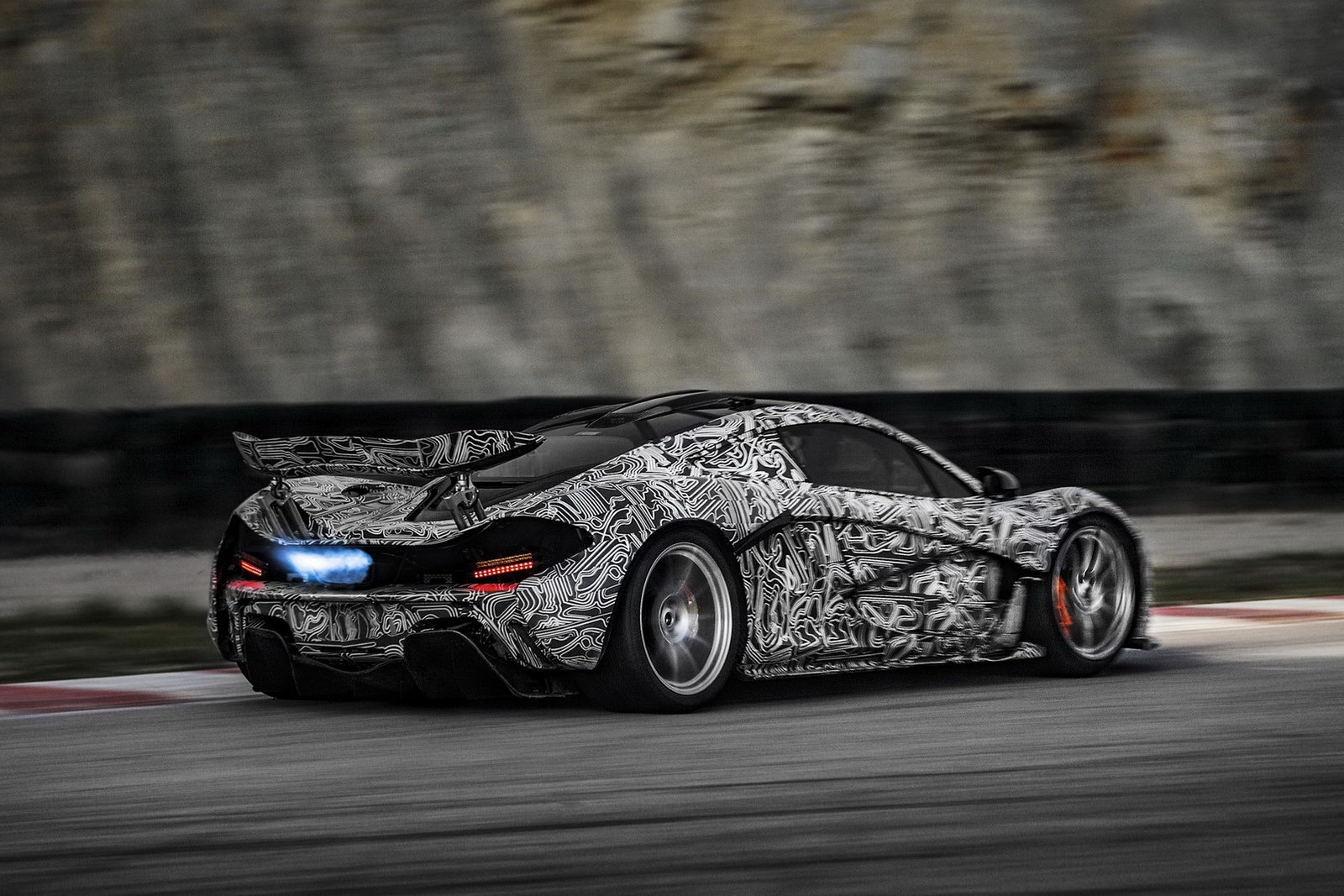
News: McLaren's P1 supercar hits the test track


It was almost exactly 20 years ago that we car enthusiasts were getting all girlishly excited about the prospect of McLaren's first ever road car, the original F1. That went on to be the fastest car in the world, and to win Le Mans at its first attempt. So just imagine how excited we are at the prospect of this, the P1, McLaren's successor to the F1...

Just 500 of this amazing looking car will be built, and while its engine is structurally similar to the 3.8-litre V8 turbo that's in the existing MP4-12-C supercar, not only will the P1 get a power boost, it will also get a hybrid KERS setup that will boost power again for overtaking bursts. Quite what you'd need an overtaking burst to get past in one of these remains unexplained. A Veyron perhaps?

Anyway, expect power to be at least 750-800bhp, and with all the active aerodynamics and computer controlled suspension that you'd expect from McLaren. And judging from the still-camouflaged styling (why, when they showed the car un-disguised at the Paris Motor Show last year?) it will look remarkably like being violated by a Le Mans racer when it does overtake you, boost or no boost.

Enjoy the photos and check out the video too. It spits fire...


Tuesday, 22 January 2013

News: General Motors stands by electric cars in the face of dismal sales

 
57,000 sales out of just over 14-million. That's how many electric cars sold in the United States last year, causing more than a few people to announce the second death of the electric car. But General Motors' US president Mark Reuss has come out fighting for the battery car, saying that he expects Americans to embrace the technology more and more. 


“The electric vehicle is not dead. We at GM believe that the public will accept and embrace electric vehicles. Some people already have" said Reuss at the Automotive News World Congress in Detroit. 

 He also promised that not only would the next generation of Chevrolet Volt, sold here as the Opel Ampera, have a greater battery range, it would also be thousands of dollars cheaper, as GM is now able to make batteries and electric drivetrains more efficiently. 


News: Porsche's ground breaking 918 gets a price tag

  
Porsche's 918 Spyder supercar, which claims to offer the performance of a true road-racer with the emissions of a Prius, has officially gone on sale... but only in the US for now. We Europeans will have to wait just a little longer for a price tag for our dream car.
And the price tag for American Porsche-philes? $845, 000, or around €634,000, and yes, that's before taxes, delivery and related charges. Wow. Time to start a Post Office savings account, chaps...

Of course, this being a German car, that $845k is just the starting point. There are extras...

If you want the track-focused 'Weissach Pack' which lowers the car's weight by around 34kg, you're going to have to find $929,000 down the back of the sofa. And things like those retro-seventies Martini racing stripes will cost a wee bit more too. 

Still, with a reported output of 729bhp and a plug-in hybrid transmission that allows you to cruise around town in silent, zero-emissions mode, perhaps knocking on for a million dollars is cheap at the price, really.

Wednesday, 9 January 2013

News: Lexus strikes at 3 Series with dramatic new IS


You're looking at the first pics of the ultra-aggressive face of the new Lexus IS, the compact sports saloon that Lexus is hoping will, at long last, really take the fight to the heartland of the BMW 3 Series and Audi A4.

Depending on how you feel about the styling of the current Lexus GS, you may or may not love the new IS' styling, with that outrageous sucked-in grille (vampire fangs, anyone) but while we're sitting slightly on the fence at the moment, we're loving the way the grille design makes it look as if the Lexus badge is being sucked into a black hole. Cool.

Of more practical concern, the new IS is going to be longer, more spacious (good – the current one is way too small inside) and lighter. The driving position is going to be lower and more overtly sporting too, and just have a gander at those gorgeous all-digital instruments. They've been lifted more or less straight from the fantabulous V10 LF-A supercar. 

There is a concern that Lexus is going to hobble itself with regard to engine choice though. Once again, only two powerplants will be available but this time around there's no diesel option, or at least none has been officially announced. For now, you'll have to choose between a 2.5-litre petrol V6 IS250 (which no-one in Ireland is going to buy) or a new IS300 Hybrid. Now, we're not 100% sure what the petrol engine component of the IS300 will be just yet, but it is already rumoured to have Co2 emissions in the region of 99g/km. Now, seeing as Toyota can get around 85g/km out of the Prius; 1.8-litre petrol hybrid, we're going to go out on a limb here and suggest that the Lexus' unit will be rather more muscular. 

Will being a hybrid hold the IS back, in sales terms, against the more conventional, but very engaging to drive, BMW 320d and Audi A4 2.0 TDI? Yes, it very well could, although it should be noted that the hybrid-only GS450h is at least as engaging and enjoyable to drive as any diesel 5 Series, so if the same engineers are working on the IS300 then perhaps, at last, we'll have a compact hybrid that's as good to drive as a diesel, but just as (if not more) economical and efficient.

We'll find out more when the IS gets its official public unveiling at next week's Detroit Motor Show.


News: Electric vehicles to get noisy


Electric vehicles are set to lose one of their most distinctive features this year, as a new US law compels them to make noise at low speeds.

In spite of the slience that mass electric motoring could potentially bring to our cities and towns, US lawmakers have decided that all electric and hybrid cars must emit an automatic warning sound at low speeds so that blind or partially sighted pedestrians don't walk out in front of them.

The move is set to prevent 2,800 injuries and as many as 35 deaths per year.

Currently, the Toyota Prius is designed to automatically emit a low whirring noise at low speeds (below 25kmh) and the Nissan Leaf has a similar system that works at the drivers' discretion. From this year though, all similar cars will have to have a system that works automatically, without driver intervention or choice. The proposed law is being introduced by the National Highway Traffic Safety Administration.

"Our proposal would allow manufacturers the flexibility to design different sounds for different makes and models while still providing an opportunity for pedestrians, bicyclists and the visually impaired to detect and recognize a vehicle", said NHTSA Administrator David Strickland.

Wednesday, 28 November 2012

News: Volvo puts V60 plugin hybrid through safety wringer


Volvo has a reputation for safety that is second to none and it believes that an electrified car should be as safe as any other new Volvo car. 


This is now highlighted by the latest EuroNCAP crash test results. The new Volvo V60 Plug-in Hybrid has achieved the highest ever score for a plug-in hybrid. The five stars in the recent test, which included a frontal offset collision at 64 km/h (40 mph), demonstrates that the V60 Plug-in Hybrid has the same high safety level as the standard V60.

"We apply the same high standards to all our products. The Euro NCAP score demonstrates that the ingenious V60 Plug-in Hybrid features the same outstanding safety level as the standard car," says Jan Ivarsson, Senior Manager Safety Strategy & Requirements at Volvo Car Group.


"The Plug-in Hybrid has been exposed to an extensive test programme during the development phase, as all our new car models," says Ivarsson. "This includes full-scale crash tests with different load cases, such as frontal collision, rear and side collisions to verify that also the battery technology fulfils our stringent safety requirements. The V60 Plug-in Hybrid also offers all unique Volvo active safety functions, such as City Safety, Collision Warning with full Auto Brake and Pedestrian Detection."


Production of the new V60 Plug-in Hybrid is ramping up and the first 1,000 ‘Pure Limited' cars were sold out even before they reached the showrooms. After this initial production of cars for model year 2013, production of the Plug-in Hybrid will increase to 4,000-6,000 cars for model year 2014 – and next year's build slots are already filling up.


The Volvo V60 Plug-in Hybrid is the synthesis of close cooperation between Volvo Car Group and Swedish electricity supplier Vattenfall. The two companies have financed the development project jointly.


The driver of the V60 Plug-in Hybrid need make no compromise in their motoring by using the car's three driving modes: Pure, Hybrid and Power. Fuel consumption is just 1.8 l/100 km (48 g/km CO2) in Hybrid mode (NEDC driving cycle).


In addition, the driver can choose to cover up to 50 kilometres (31 miles) on electric power with zero tailpipe emissions - or release the combined capacity of the diesel engine and electric motor to create a performance driver's car delivering 215+70 horsepower, 440+200 Nm of torque and acceleration from 0-62 mph in 6.1 seconds. The car is due to go on sale in Ireland towards the middle of 2014, with prices likely to start from around €50,000.

Tuesday, 6 November 2012

Road Test: Citroen DS5 Hybrid4


Price as tested: €43,645

+ Style, technology, comfort, improved ride over standard car
– Still too firm, cramped in the back, not economical enough
= The best of the DS5 range by far

If ever you find yourself down the pub, debating whether or not cars can be considered as a form of art (I know, I know, not again...) then wait for everyone to exhaust their arguments and throw in the hand grenade that is the Citroen DS5 Hybrid4. It combination of looks (stunning enough that you’d seriously consider buying one just to be able to look at it every day) and technology (cutting edge diesel hybrid drivetrain) mean that it walks so deftly the line between art and science that everyone will have to re-set their arguments back to zero.

Which is not to say that it’s perfect. The DS5, as a whole, suffers from two significant issues. One; its ride quality is just too harsh and jittery for it to ever truly live up to its luxury billing (especially in an era when the formerly-rough-riding BMW 3 Series now glides over obstacles like a limo) and two; it’s a Citroen. Now, I count myself as a true fan of the great French marque, a Citroenista if you will, but the harsh fact of the market is that against the German ‘Big Three’ Citroen is a brand with a lot to prove in the premium segment.

This DS5 Hybrid4 is bringing some seriously cutting edge technology to the party though, and that might just be enough to allow it to jam a foot in the door. Up front lies Citroen’s familiar 163bhp 2.0-litre HDI diesel engine, which is, and always has been, a very fine unit. Behind, under the boot floor, lies a 37bhp electric motor, driving the rear wheels and fed by a stack of rechargeable batteries. We’ve become used to hybrids ever since Toyota introduced the Prius, but the DS5 (along with its cousin, the Peugeot 3008 Hy4) is the first to tie the potential fuel savings of battery power to an already frugal, low-emission diesel engine.

The result is mostly rather pleasing. There’s a rotary control switch that watches over the hybrid system mounted between the front seats. Leave it set in Auto, and the computer will effortlessly shuffle around power from the diesel, the batteries or both as needed. Keep an eye on the fighter-jet-style heads-up-display, which projects ghostly speed and sat-nav information onto the windscreen, and you’ll notice the frequency with which the speed figure turns a light blue, meaning that you’re running on pure electric power.

Flick the controller around to Sport, and suddenly you remember that 200bhp is still quite a lot of grunt, even in a car weighing a not inconsiderable 1,800kg. Now the DS5 feels very fleet of foot indeed, and what other car can you think of that can combine 99g/km Co2 emissions (depending on which wheels you specify) with an 8.3-sec 0-100kmh time?

All of that is being done while you recline in a sumptuously comfortable seat, with optional leather trim that mimics the shape of a high-end watch strap, surrounded by a battery of instruments and buttons that make you feel like you’re the pilot of a rather avant-garde jet fighter. An F-15 by Hermés, if you like.

Sadly, there are still a few flies in this otherwise lovely ointment. The ride quality, although better than in other versions of the DS5 we’ve driven, is still too harsh-edged and you really need to keep to perfectly smooth roads for the DS5 to feel at its best. Fuel economy isn’t as god as advertised either; Citroen claims that you can hit just 3.8-litres per 100km on the combined cycle (a massive 74mpg) but we could only manage a test average of around 6.5-litres per 100km (43mpg). It’s so often the case that hybrid cars are never as economical in real world driving as they claim to be, but it’s disappointing that Citroen’s combining hybrid with diesel couldn’t liberate any extra efficiency.

That love-hate relationship continues in other areas. I love the little individual sunroofs above the driver and passenger – they make you feel as if each seat should come with a massive yellow handle marked 'eject.' I love the switches mounted on the roof and I adore that swept-back chrome blade that runs from the back of the headlights to the base of the windscreen. But I hate the robotised six-speed gearbox (too... slow... at... changing... up) and the fact that the hybrid batteries really chew into your boot space.

Still, while the DS5 has to climb the steep hills of being to thirsty, too rough-riding and too French in a corner of the market that only seems to want German, the fact that it does so is testament to two things. On the one hand, its quality and technology are right up there with the Germans. On the other, it is a truly beautiful car, and in a world that seems to be a touch uglier every day, that’s a beauty that would be most welcome on the streets of Ireland.

Of course, if you wanted to buy a striking looking Citroen that can mange 40-odd-mpg and is actually a huge amount more fun to drive, you could save yourself around €10,000 and go for the DS3 Racing, the latest version of which we got to try in the same week we were driving the DS5.

Now, while our affection for the DS5 is tempered by our criticisms of its ride and economy, out love for the DS3 knows few, if any, bounds. The first premium hatch to convincingly take the fight to the doorstep of the mighty Mini, in standard form, the DS3 combines gorgeous looks, decent practicality and a peachy chassis of rare balance and deftness.

The Racing version is something else again. Based on the standard 155bhp 1.6 THP model, it and its 1.6-litre turbocharged engine are taken away and tweaked by the same people that design and build the DS3 rally cars for the unstoppable Sebastian Loeb, a man who has almost literally won more rallies than we have had hot dinners.

So the Racing looks more butch, thanks to a 15mm suspension drop, a 30mm track widening and a gorgeously subtle carbon fibre exterior trim spruce-up. Inside, there are hip (and everything else) hugging sports seats, more carbon fibre (the real thing too, not just appliqué) and a squared-off steering wheel. It’s a delightful environment in which to sit, and thanks to this being a Citroen, comfort hasn’t bee thrown out with the sporty bath water. In fact, even on those chunky 18” rims, the DS3 actually rides better than the DS5 Hybrid...

It’s got the same 200bhp as the Hybrid too, but with only 1,165kg to haul around, it goes a good bit harder. 0-100km comes up in just 6.5secs, which is decidedly brisk. Interestingly though, this DS3 Racing feels a touch different to the last version we drove. It feels a bit less manic, less unruly. That is until you push the throttle all the way to the stop, and then it feels plenty manic enough, thanks, but there’s definitely a sense that Citroen has tried to build-in a little more day-to-day useability into what was originally supposed to be a short-run special edition. It’s a well-judged move, leaving enough mental-ness at the top end, while making the Racing feel more sensible around town. And yes, it really will do 43mpg on a long run.

Citroen DS5 Hybrid4 200 Airdream DStyle
Price as tested: €43,645
Price range: €33,195 to €46,695
Capacity: 1,997cc + hybrid battery drivetrain
Power: 200bhp
Torque: 300Nm
Top speed: 210kmh
0-100kmh: 8.3sec
Economy: 3.8l-100km (73mpg)
CO2 emissions: 99g/km (on 17” wheels)
Road Tax Band: A. €160
Euro NCAP rating: 5-star; 89% adult, 83% child, 40% pedestrian, 97% safety assist


Wednesday, 3 October 2012

News: Is this Ferrari's new 900bhp engine?

 We know that Ferrari is currently hard at work on F70, areplacement for the blistering Enzo hypercar, and in fact we've already seen its all-carbon chassis, at the Paris Motor Show. But now, here is the first image of its 900bhp hybrid engine...

It's a bit blurry, but Dutch website Autoblog.nl is pretty sure that this is the first image of Ferrari's new wonder engine nestling in its carbon-fibre cradle. The large grey box, with the orange wires, sitting at the back between the exhausts, is the KERS unit which, F1-style, harvests electric power from braking and various other systems and allows the driver to thumb a button for extra overtaking oomph, or for a short trickle on pure, zero-emissions electric power.

Quite why you'd need extra overtaking oomph from a 7.3-litre V12 in a carbon-chassis supercar that will probably weigh about as much as a Fiesta is a bit beyond us though...


Thursday, 27 September 2012

Road Test: Lexus GS450h F-Sport


Price as tested: €72,950

+ Drivetrain, refinement, comfort, chassis balance, quality
– Silly grille, numb steering
= The best hybrid we’ve yet driven


Here’s a funny thing. Lexus can’t tell me how much torque the new GS450h has. Nerdy fact that it is, a healthy torque figure is deeply significant for driving both relaxed and invigorating. A lack of torque is inimical to fun and lots of it gives you that lovely, deep-down thumpy feeling as you accelerate hard out of a tight corner. It’s what makes American V8s so addictive and its absence is what makes small petrol engines such hard work. Normally you just look up the figure, either in Newton-Metres (Nm) or foot-pounds (lb-ft) in a car’s technical data list. And it’s not that the GS has no torque; quite the opposite. You can feel its presence every time you tap the throttle.

The thing is that the GS450h, a hybrid as was its predecessor and almost every other Lexus, draws its torque from two sources. A 3.5-litre V6 petrol with 352Nm and an electric motor with 275Nm. Add the two together and you get a fairly tyre-shredding 627Nm or about what you’d get from a 1970s Can Am racer...

It’s not that simple though, says Lexus and I seriously doubt that the GS ever gets the full combined 627Nm or the rear Bridgestones wouldn’t be long for this world. Instead, the fearsomely clever computer management system (which can presumably calculate lunar orbit trajectories and file your tax returns) juggles and apportions the power and torque outputs of the two motors until you have an essentially seamless whole.

Now, hybrids have been criticised in the past, and frequently on these pages, for not being up to snuff. The idea of backing up a downsized petrol engine with an electric motor seems entirely sensible and effective, but never in the past have we driven a hybrid that either lived up to its fuel economy claims or gave us much in the way of driving pleasure. (The Honda CR-Z gets a by here because it’s fun in spite of being a hybrid.) The old GS450h was fun enough in a straight-line, drags-strip kind of way, its combination of petrol and electric grunt sufficient to hurl it up the road in a most uneconomical fashion, but it felt a bit lead-footed in handling terms and its economy and emissions were soon out-classed by the new hordes of hyper-efficient diesels.

This GS then, has rather a lot to prove, both as a hybrid and as a car. Can a hybrid ever match or beat the latest diesels in economy and emissions terms? Can Lexus produce a truly convincing challenger to the likes of the BMW 5 Series?

Well, you certainly can’t accuse Lexus of keeping its light under a bushel this time around. The new GS, when seen from the back and side is crisply handsome and subtly muscular. And that new grille, with its chrome fangs? Well, I can certainly see what Lexus was trying to do – to inject both distinctiveness and aggression, but for my money it just doesn’t work. It look inelegant and a bit OTT. A shame.

There’s better news on the inside though, where the previous GS’s slight sense of clunkiness is banished by a very slick and stylish cabin, with beautifully simple, clear instruments, a big central screen for controlling the infotainment and HVAC systems and a distinctly inviting sense of comfort and style. The seats a big, comfy and supportive. The space in the rear seats is excellent. I love the way that, when you push the Sport button, the instruments switch from a charging metre to a red-lit rev counter.

Way out back, boot space has dramatically improved. In the last GS, the hybrid system’s batteries ate so deeply into the luggage room that you were left with a narrow slot that wouldn’t hold very much at all. Now, thanks to better packaging, there’s a decent (if not class leading) 482-litres. That’s better.

Slip behind the wheel and push the starter button and there’s the usual hybrid car silence as the batteries take the strain for the initial few metres. When the 3.5-litre 292bhp petrol V6 engine comes to life, you’ll struggle to notice it. The usual Lexus superlatives of refinement and noise suppression apply.

Where that V6 really makes itself felt and heard is when you accelerate hard. We’ve become so used, over the past few years, to big executive cars being exclusively diesel-powered, so the crisp, sharp-edged snarl of the GS’s engine as it passes 4,000rpm (the point at which most diesels just give up and go home) is as refreshing as lemon zest and just as tasty. Combined with the batteries and electric bits, it makes for a very satisfying drivetrain to use, probably the best hybrid we’ve ever tried. There never seems to be a gap in the power, or a step when one system or the other dominates. The CVT gearbox doesn’t seem to suffer from the same problems that afflict over continously variable ‘boxes, such as letting the engine needlessy blare its head off at high rpm when accelerating. And it’s decently economical too. Lexus claims 6.0-litres per 100km on the combined cycle, which you probably won’t get near, but we averaged mid-sevens and that’s about what you’d get out of a comparable 3.0-litre diesel. Impressive.

Impressive too that emissions have been kept down to a Band B-friendly 139g/km, so you can match a BMW 520d buyer for tax smugness while matching a 535d for performance. That’s quite a combination, and it’s nice to notice how often the car automatically kicks into EV mode, not just when cruising around town, but also on the open road. It makes you feel like it was worth going down the hybrid route, even if in reality, a constantly-running diesel is little less efficient.

Our F-Sport spec test car came with option four-wheel-steering, and eighties Japanese obsession that seems to be making something of a comeback. I can honestly say that, in spite of trying, I could never actually feel the rear wheels doing anything much, but there’s no doubting that the GS felt unusually agile and chuckable for such a big car. A shame that the steering is too remote and distant for you to truly enjoy punting it along, but there’s no doubt that a pretty terrific chassis dwells beneath; an achievement made even more impressive when you remember that the GS’s is still packing the extra weight of all those batteries. Impressive too that the ride quality is generally excellent, only occasionally feeling too firm and mostly just cosseting nicely.

At €72,950, the F-Sport’s rear-steer and sporty bodykit and wheels may seem a bit of an extravagance over the cost of a €59,950 Executive model, but there’s no doubt that for the first time, Lexus has really hit the 5 Series market dead-on. It won’t be to the tastes of the me-too hordes who will only ever buy German at this price level, but here at least is a hybrid that’s a frugal as it should be and as invigorating to drive as you’d hope. Here is a Lexus of true character and enjoyment, as well as the expected quality and refinement.

Lexus GS450h F-Sport
Price: €72,950
Range price: €59,950 to €76,250
Capacity: 3,456cc
Power: 345bhp
Torque: See text
Top speed: 250kmh
0-100kmh: 5.9sec
Economy: 6.0-100km (47.0mpg)
CO2 emissions: 139g/km
Tax Band: B. €225 road tax
Euro NCAP rating: Not yet tested




Thursday, 20 September 2012

Road Test: Porsche Panamera Hybrid S


Price as tested: €170,000 (approx)

+ Efficient, striking looks, great cabin, fast
– Diesel is better to drive and more economical
= Kudos to Porsche for tech, but the (cheaper) diesel is a better all-round car

In describing the new Panamera Hybrid S as ‘the most economical Porsche of all time’ you suspect that Porsche is in a way damning its own car with faint praise. We have become used to Porsche describing its new models as being the sharpest to drive, the fastest, the most powerful or able to lap the Nurburgring faster than all-comers. But most economical? It seems odd, at least at first, and it’s not even true...

It is true to describe the Panamera Hybrid S as the most efficient Porsche of all time though. Thanks to its clever hybrid system, some useful low-rolling-resistance tyres and some very good aerodynamics, this big, luxurious super-saloon clocks in with a Co2 rating of just 159g/km. Good enough for a Band D rating and an annual road tax bill of just €447. Or cheaper than a pre-2008 Ford Mondeo 1.8, in other words.

As for fuel efficiency, Porsche claims that the Hybrid S will return a very healthy 6.8-litres per 100km (or around 41mpg). Hmmm. Not so sure about that. With some mixed driving on main roads, back roads, in town and motorways, our best average was closer to 9.4-litres per 100km.

There’s no doubting the cleverness of Porsche’s hybrid system though. It combines a supercharged 3.0-litre V6 petrol engine with a synchronous electric motor fed power from a stack of nickel-metal batteries under the boot for a total of 380bhp and a hefty 580Nm of torque, Performance is, to say the least, fleet, with 100kmh coming up from a standstill in just 6.0secs and a potential top speed of 270kmh.

And while it does the usual hybrid tricks of shutting down the engine when standing in traffic and allowing for limited (about 2km) electric-only running, the Panamera’s battery system will also allow it to completely shut down the engine when running at speed. It does this when you’re cruising on, say, a motorway and there’s enough charge in the battery to propel you without needing the engine. The electronics will engage the clutch and shut down the engine, without you noticing it, until more power is needed. It only does so for a few seconds at a time (Porsche calls it ‘sailing’) but it does mean that, part of the time, the big Panamera is operating as a pure electric vehicle, even at speeds above 100kmh.

All of this is controlled from within a cabin which scores exceptionally high in terms of comfort (even in the back), quality and design, if not quite so high in terms of instrument or switchgear layout.

There’s a but coming though, and you may have been sensing it. Whether it’s the weight of the batteries in the back, or the overlight Servotronic steering or maybe the distancing effect of the standard air suspension, but the Panamera Hybrid S simply isn’t as good to drive as it could be. Compared to others in the range, the steering feels too light and detached, the chassis a noticeable touch slower to react.

Perhaps expecting Porsche to create the most economical model in its history and still expect it to be invigorating to drive was expecting too much. Except that it’s not. Not the most economical model in the Panamera range. That honour falls to the new Panamera diesel, which returns 6.3-litres per 100km on the combined cycle and which is every bit as stimulating to drive as a big Porsche should be.

With the extra weight of the 3.0-litre 250bhp V6 diesel over the nose, the Panamera’s steering comes alive, and if it does give in to understeer earlier than the hybrid, then at least the sensations are better telegraphed to you. 250bhp sounds weedy, compared to the Hybrid’s output (never mind the Turbo S’s unhinged 550bhp) but with 550Nm of torque, the Panamera Diesel absolutely flies. It feels little short of phenomenal to drive, and if its Co2 figure of 172g/km means that it costs more to tax than the hybrid, our observed fuel economy of 8.0-litres per 100km proves that there’s an upside.

It does raise the question of how the Hybrid, which uses more fuel per 100km than the Diesel still manages to post a superior Co2 figure, but perhaps that’s down to the inconsistencies in the official European fuel economy test.

So, you have a three way choice. To experience all that the Panamera can be, you could go for the brutally fast Turbo S (which can bend space and time on its way to 100kmh from rest in just 3.8secs) or you could choose to appeal to the greener side of life, sacrifice some of the driving experience and go for the Hybrid. But our choice would be the diesel. It may seem sacrilege to say it of a Porsche, but in this case, it does seem to be the best of all worlds.

Facts & Figures

Porsche Panamera Hybrid S
Price as tested: €170,000 (approx)
Price range: €125,000 to €250,000 (approx)
Capacity: 2,995cc + electric motor
Power: 380bhp
Torque: 580Nm
Top speed: 270kmh
0-100kmh: 6.0sec
Economy: 6.8l-100km (41.5mpg)
CO2 emissions: 159g/km
Road Tax Band: D €447
Euro NCAP rating: Not yet tested