Showing posts with label safety. Show all posts
Tuesday, 22 January 2013
News: Ford claims B-Max MPV is child-proof
Ford is claiming that its newly-launched B-Max MPV has a child-proof interior. They obviously haven't met my kids...
Every parent is familiar with the challenge of keeping a new car clean in the face of everyday use by children and pets. Ford has now tried to make that job easier for mums and dads by “child-proofing” the new B-MAX.
Engineers subjected the new B-MAX to laboratory tests that simulate the toughest treatment that children and pets can dish out, including soaking materials in milk and fizzy drinks; testing fabrics 0with a “mace”; and pounding plastics with a heavy rubber ball.
“By testing for everything from soft drink spills to muddy boots, we’ve made sure the B-MAX interior is ready for anything,” said Mark Montgomery, senior materials engineer, Ford of Europe. “I’ve got young children myself, so I’m very familiar with the mess they can create.”
Samples of all leathers and fabrics used in the Ford B-MAX’s interior were tested for stain resistance and ease of cleaning after being soaked for 24 hours in the liquids and being smeared with soil and grease.
Engineers also tested resistance to damage that can be caused by abrasive zips and fasteners found on children’s clothing and bags. The “mace test” used a metal ball with needle-sharp spikes to brush fabrics 600 times and replicate the effect of snagging zips and studs. Engineers also carried out a special test to repeatedly rub the seat material with Velcro.
Impact tests – conducted at temperatures as low as -30 degrees Centigrade when plastic is more brittle – used a rubber ball 10 times heavier than a regulation football to ensure that plastic parts could withstand bumps and knocks. Fabrics were also rubbed 60,000 times in a 17-hour non-stop wear test; metal spikes were scraped across plastic parts to test scratch resistance; and carpets were checked for durability on a special test rig fitted with rough abrasion wheels.
“These tests make sure we’ve done everything possible to make sure the car looks as good the thousandth time that families sit in it as it does the first time,” added Montgomery.
Labels:
B-Max,
Band A,
children,
comfort,
durability,
economical,
eDrive,
family,
Ford,
interior,
Ireland,
MPV,
new car,
News,
reliability,
safety,
strength
Wednesday, 9 January 2013
News: Electric vehicles to get noisy
Electric vehicles are set to lose one of their most distinctive features this year, as a new US law compels them to make noise at low speeds.
In spite of the slience that mass electric motoring could potentially bring to our cities and towns, US lawmakers have decided that all electric and hybrid cars must emit an automatic warning sound at low speeds so that blind or partially sighted pedestrians don't walk out in front of them.
The move is set to prevent 2,800 injuries and as many as 35 deaths per year.
Currently, the Toyota Prius is designed to automatically emit a low whirring noise at low speeds (below 25kmh) and the Nissan Leaf has a similar system that works at the drivers' discretion. From this year though, all similar cars will have to have a system that works automatically, without driver intervention or choice. The proposed law is being introduced by the National Highway Traffic Safety Administration.
"Our proposal would allow manufacturers the flexibility to design different sounds for different makes and models while still providing an opportunity for pedestrians, bicyclists and the visually impaired to detect and recognize a vehicle", said NHTSA Administrator David Strickland.
Tuesday, 8 January 2013
Road Test: Dacia Sandero TCe 90 Alternative
Price as tested: €11,990
+ Cheap, cheerful, well equipped, ESP as standard
– Rear seat space could be better
= Solid, undemanding and affordable
When Renault’s budget brand, Dacia, launched itself into the Irish market last summer, it did so with just 10 dealers and a single model, the Duster SUV. Except it didn’t really even have a single model, as right-hand-drive production of the Duster didn’t begin until just last week, so all Dacia could do in Ireland was show potential customers some left-hand-drive demos, with an older design of cabin than would be arriving from the factory when Irish cars rolled off the line. Sounds like a recipe for disaster, but with that astonishingly low €15,995 price tag (around €10,000 less than most direct competitors) the Duster has already been a success; it’s sold out until April, with 500 orders just starting to be filled. Just goes to show what you can do with a headline-grabbing price.
Of course, price isn’t everything and Dacia has come in for much criticism since the Duster’s launch for its attitude to safety equipment. Many reviewers were upset to notice that the Duster (an obvious family car, don’t forget) doesn’t come with standard electronic stability control, and the Lodgy MPV (currently only available in Europe) was severely marked down by crash test experts EuroNCAP.
So with the arrival of this, the second-generation Sandero small car (the first gen was never built with right hand drive) Dacia has to prove that it can expand beyond the niche appeal of the Duster and take on the big (small) boys such as the Fiesta, Polo and Yaris.
Thankfully, a quick glance at the spec sheet reveals that the Sandero does indeed come with ESP as standard, as are ABS and brake assist. Why the standard ESP on a smaller car when the Duster continues to do without? According to Dacia, it’s because the Sandero sits on an all-new platform, so under EU regulations, has to have ESP as standard. The Duster, based on the original 2004 Dacia Logan, can get away for a while without it.
For a basic price of €9,990 (around €5-6,000 less than most of the competition) the Sandero comes with four airbags, Daytime Running Lights, height adjustable headrests, 60/40 split folding rear seat, electric front windows and Radio with CD, MP3, USB and Bluetooth phone connection alongside its standard safety toys, which seems pretty generous. Step up a level to the Signature trim and you get alloys, air conditioning, a trip computer and more.
That basic model comes with an old Renault 1.2-litre petrol engine developing 75bhp, which looks alluringly priced but whose Co2 emissions of 135g/km will set you back €280 a year in motor tax. You could go for the 90bhp 1.5 dCi diesel engine, but we reckon you’re much better to upgrade yourself to the 895cc turbo three cylinder TCe 90 engine. It’s not only cutting edge (a first for a Dacia, which usually just sticks with older Renault tech) which cuts your Co2 emissions to 116g/km and your tax bill to €200.
Quite apart from which, it’s a terrific engine, pulling cleanly from low rpm and proving both entertainingly muscular and really very refined. It would be an outstanding engine in any car, but in an €11,090 Dacia (€13,090 if you want it in the ritzier Signature grade), it’s close to amazing.
If you’ve ever owned a Renault in the past decade, you can amuse yourself for a few minutes by just sitting in the Sandero’s cabin and playing Spot The Switch. A little bit of old Clio here, some Laguna there and a smattering of Megane over there. Still, while it may be a ‘bitsa’ the Sandero feels well put together and Dacia’s reliability record is generally very good. Space in the front is fine and there’s a 320-litre boot (with a rather too high loading lip) but it would be good to see a touch more legroom in the back. It’s OK back there, but taller passengers, or those loading up bulky child seats, will feel the pinch. There are a few rough edges to the quality of the plastics, and the seats are a little too narrow and perched-up for taller drivers, but otherwise there’s nothing to complain about.
That goes equally for the dynamic performance. Certainly, the Sandero’s chassis case is helped by the performance of that TCe 90 engine, whose 90bhp and 135Nm of torque help to cover up any holes in the cornering deportment, but the plain fact is that the Sandero is perfectly fine, if totally unexceptional, to drive. It rides very well, especially around town where it’s particularly good at shrugging off speed bumps, and on the motorway it feels planted and secure. On a twisty road, well, you’re not going to get up early to drive it for fun, but it’s fine, although the mute, rubbery steering discourages any attempts at enthusiastic driving.
The Sandero is an avowedly simple car, and in an era when car makers are constantly trying to surprise and delight us with yet more gadgetry and gimmickry, that’s a rather refreshing take. It’s quietly handsome (Germanic, claims Dacia, as opposed to its cousin, the more Latin Renault Clio), practical and quite fine to drive. With those temptingly low prices, and now without the caveat of having to worry about trading up to get safety equipment, it’s a tough proposition to argue with.
Facts & Figures
Dacia Sandero TCe 90 Alternative
Price as tested: €11,990
Range price: €9,990 to €14,990
Capacity: 898cc
Power: 90bhp
Torque: 135Nm
Top speed: 169kmh
0-100kmh: 11.1sec
Economy: 4.9l-100km (56mpg)
CO2 emissions: 116g/km
VRT Band: A4. €200 road tax
Euro NCAP rating: Not yet tested
Range price: €9,990 to €14,990
Capacity: 898cc
Power: 90bhp
Torque: 135Nm
Top speed: 169kmh
0-100kmh: 11.1sec
Economy: 4.9l-100km (56mpg)
CO2 emissions: 116g/km
VRT Band: A4. €200 road tax
Euro NCAP rating: Not yet tested
Labels:
affordable,
cheap,
Dacia,
diesel,
eDrive,
ESP,
family,
hatchback,
Ireland,
low Co2,
low emissions,
new car,
petrol,
Road Test,
safety,
Sandero,
small car
News: Lexus shows off new safety tech at CES
It may not be the prettiest Lexus you've ever seen, but this LS-based contraption is almost certainly the safest Lexus, possibly the safest car, of all time.
It's called the Safety Research Vehicle and Lexus is showing it off at the vast (and vastly important) Consumer Electronics Show in Las Vegas.
The car has been built to demonstrate ongoing efforts around autonomous vehicle safety technologies and explain Toyota's approach to reducing global traffic fatalities and injuries. The vehicle, based on a Lexus LS, advances the industry toward a new era of integrated safety management technologies.
The vehicle systems are capable of tasks such as scanning movement of objects around it, identifying a green light from a red light and measuring the trajectory of the vehicle on the road by using a 360-degree LIDAR laser on the roof of the vehicle which detects objects around the car up to about 70 meters; three high definition colour cameras to detect objects about 150 meters away, including traffic light detection using the front camera and approaching vehicles using the side cameras.
Radars on the front and sides of the vehicle measure the location and speed of objects to create a
comprehensive field of vision at intersections. There's also a distance measurement indicator located on a rear wheel measures travel distance and speed of the vehicle and an inertial measurements unit on the roof measures acceleration and angle changes to determine vehicle behaviour.
GPS antennas on the roof estimate angle and orientation even before the vehicle is in motion and the research vehicle is a testing platform aimed at the development of systems capable of enhancing the driver’s perception of their environment, assisting in the decision-making process and improving overall driving skills.
“In our pursuit of developing more advanced automated technologies, we believe the driver must be fully engaged,” said Mark Templin, Toyota group vice president and general manger of the Lexus Division. “For Toyota and Lexus, an autonomous vehicle does not translate to a driverless vehicle, but rather a car equipped with an intelligent, always-attentive co-pilot whose skills contribute to safer driving.”
Toyota has committed to new research toward an Intelligent Transportation System (ITS), integrating the car with the driving environment. To accelerate development of vehicle-to-vehicle and vehicle-to-roadside infrastructure communications, Toyota began full-scale operations in November at new 8.6 acre ITS proving grounds, located within the Higashi-Fuji Technical Center in Toyota City, Japan. Modelled after urban roads, the driving environment replicates roads and traffic signals and simulates real-life traffic situations using other vehicles, pedestrians and control devices.
The system is designed to help prevent accidents involving pedestrians and other vehicles using information continuously collected by the vehicle from other vehicles, infrastructure and pedestrians. Connecting people, vehicles, traffic environments and infrastructure with state-of-the-art electronic and telecommunications technologies will help move toward safer and more efficient traffic environments. The Toyota ITS Proving Grounds will assist the company work toward the early practical adoption of evermore reliable systems by repeatedly conducting testing that can be difficult to perform on public roads, with changing environments.
“The real value of research projects like this is reinforcing our focus on what a few years ago seemed an impossible dream and is now becoming more plausible,” Templin said. “We, at TMC and Lexus, consider the elimination of traffic fatalities and injuries the ultimate goal of a society that values mobility.”
Labels:
2013,
accident prevention,
autonomous car,
CES,
Consumer Electronics Show,
eDrive,
Ireland,
Japan,
Japanese,
Las Vegas,
Lexus,
new car,
News,
road deaths,
safety,
self-driving cars,
technology
Sunday, 6 January 2013
News: Road deaths at lowest level ever
Provisional road casualty figures for 2012 published this week show that a total of 161people tragically lost their lives on Irish roads in 2012. This is 25 fewer fatalities compared to 186 deaths last year and 51 fewer deaths compared to 2010 when 212 people lost their lives on the roads.
Road deaths have now fallen every year since 2006. Furthermore it is also the fifth year in a row that a new record low for fatalities in this country has been achieved.
The third Road Safety Strategy 2007 to 2012, which will be replaced in early 2013 with a new eight year strategy, set a target of reducing road deaths to no more than 252 deaths per annum by the end of 2012. Not only was this target achieved ahead of schedule in 2009, it was significantly surpassed. Since the beginning of 2007 there has been a 56% decrease in road deaths. While the total number of serious injuries sustained in crashes in 2012 is not yet available, there has been a 51% reduction in these injuries up to the end of 2011.
Minister for Transport Tourism & Sport Leo Varadkar, said, “For the seventh year in a row the number of people killed on the roads has dropped. In 2012 the loss of life was the lowest ever recorded. The ongoing effort to reduce the tragedy of road deaths is working. Further key road safety measures will be implemented this year, and the new Road Safety strategy will be published. But this change really comes down to the efforts of every single road user. We can never forget those who lost their lives on the roads in 2012, but next year we can take it a step further. I urge everyone to change one thing about their behaviour on the roads next year. It will make a difference.”
Commenting on the release of the provisional figures Mr. Gay Byrne, Chairman, Road Safety Authority said “At the end of 2006 the year before the third Road Safety Strategy was launched, we were losing a life on the road every single day. Six years later and this has dropped to three lives lost every week. So as a result of your actions, the road using public, you are preventing four deaths every week now compared to 2006. While one death is one too many, this is an extraordinary achievement and something of which you should all be very proud. The challenge now is to build on this success. We have three more lives a week to save.”
“We know we can do better because countries like Sweden, the UK and the Netherlands have done it. The task begins with the development and publication of the new Road Safety Strategy, which will cover the period 2013 to 2020. Key elements of this new strategy will focus on serious injury reduction, tackling repeat road traffic offenders and developing more forgiving roads. While government agencies will work tirelessly to implement this new strategy, ultimately if we want safer roads only you can get us there.”
RSA Chief Executive, Mr. Noel Brett, paid tribute to the work of the Gardai and Emergency Services, “It is important, as we come to the end of another year, that we acknowledge and thank those on the front line in road safety. The Gardai, Ambulance and Paramedic crews, Fire Brigade personnel, Nurses, Doctors and Carers who are responsible for ensuring we stay safe on the roads and for caring for those who have been affected by road trauma”.
“2013 will be another challenging year, but one which the Board and staff of the RSA are looking forward to as it will see the launch of a new Road Safety Strategy, the introduction of a new plastic card driving licence, the transformation of the Commercial Vehicle Roadworthiness Testing system, and Ireland’s presidency of the European Union, which will include the hosting of a major EU conference on road safety in March 2013.”
Commissioner of An Garda SÃochána Mr Martin Callinan said today: “We wish to thank all road users who have made a conscious and positive change to both their attitudes and behaviour on our roads. This change has resulted in another record low in terms of road safety in Ireland. This is evident in particular in our drink driving arrests which are down for the fifth year in a row, whilst there have been more Garda Mandatory Alcohol Checkpoints in 2012, compared to 2011. In 2007 the rate of detection was approximately 1 in 25, now it’s approximately 1 in 50. This clearly shows increased compliance by responsible members of the public.”
Commissioner Callinan continued: “Although we have saved 25 lives compared to 2011, we can all do more to reduce fatalities and serious injuries for 2013 and beyond. In 2012 we identified Sunday as being the most dangerous day of the week on our roads, and in particular between 4pm and 6pm. To some Sunday is a day of leisure but this fact serves as a reminder to all that collisions can happen to anyone at any time. We all must remember that complacency can cost lives.”
Labels:
eDrive,
Ireland,
Irish roads,
killed,
lowest ever,
News,
road deaths,
safety,
tragedy
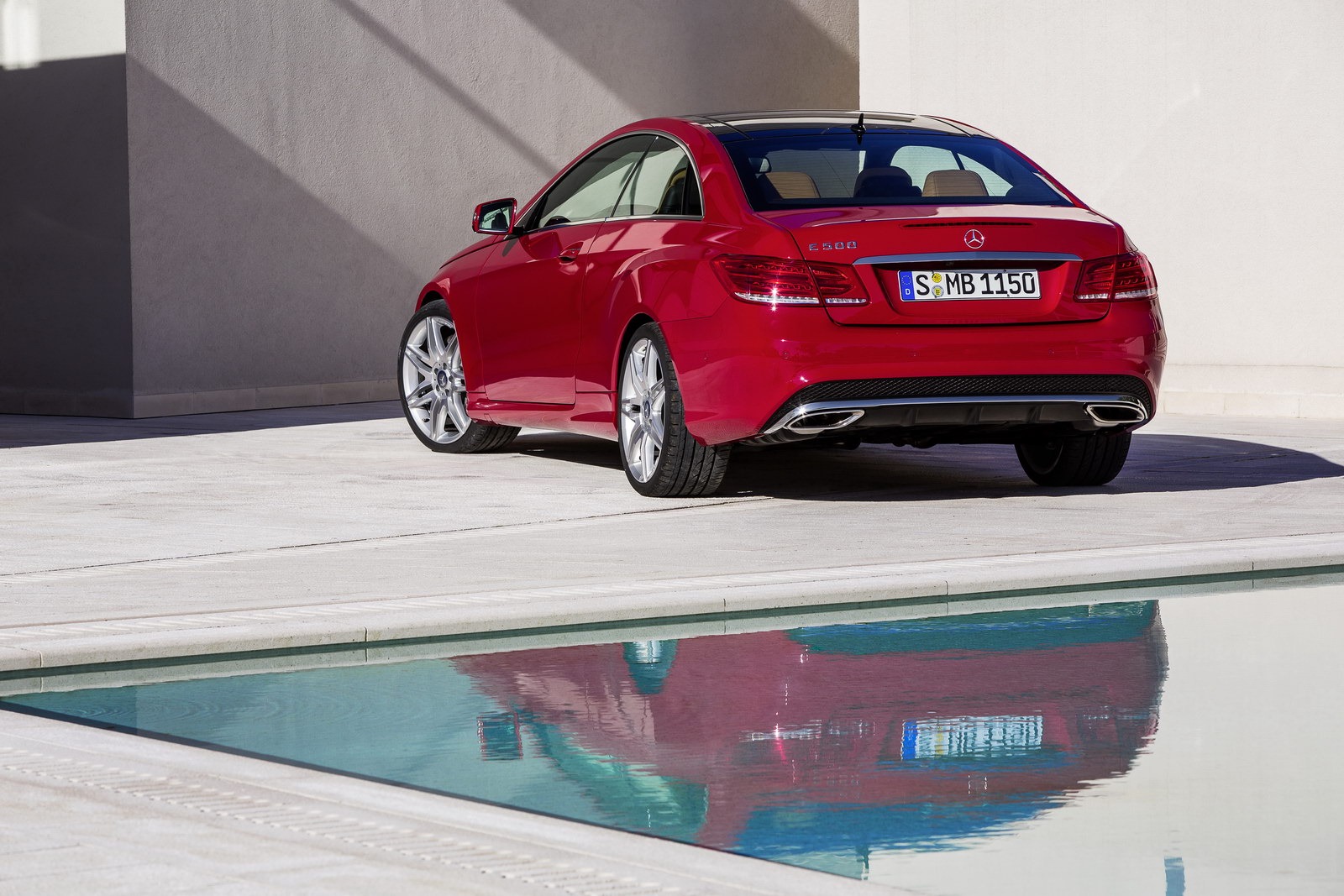
News: Mercedes' E-Class nose-job continues
Just before Christmas, Mercedes revealed a striking new look for the E-Class saloon and estate, doing away with almost two-decades of upright, four-headlamp tradition. Now, it's moved on to the E-Class coupe and cabriolet, with equally arresting results.
Gone, once again, are the four separate headlamp units, replaced by strikingly curvy single lamp setups (albeit with a hint of the old four-lamp shape in the LED daytime running light highlights) while the slatted grille has been replaced by a gaping SLS-style maw.
Oddly, and unlike the saloon and estate, the awkward-looking retro coachline above the rear wheel, meant to evoke memories of the classic fifties 'Pontoon' Mercs, has been retained.
Inside, there are only minor changes, and the cabin retains its obvious C-Class links (in spite of the name, the E-Class coupe and cabriolet are more closely related to the smaller C-Class). There's a new steering wheel, some updated displays, an analogue clock and some updated trims and materials.
Mechanically, there are no changes of significance, bar some minor engine and transmission details that bring the Co2 figures down a small bit, and safety equipment also remains the same as the saloon's, including the newly updated DISTRONIC PLUS system which watches for possible accidents ahead, PRE-SAFE PLUS which preps all the safety systems for an incoming collision and lane keeping assist to wake you up if you drift out of your lane.
“Three words sum up both the E-Class Coupe and the four-seat Cabriolet model: captivating, athletic, passionate”, said Mercedes-Benz head of sales and marketing Dr. Joachim Schmidt. “It is especially pleasing that the two vehicles also incorporate the most intelligent technology ever. This makes them true dream cars.”
Wednesday, 28 November 2012
News: Volvo puts V60 plugin hybrid through safety wringer
Volvo has a reputation for safety that is second to none and it believes that an electrified car should be as safe as any other new Volvo car.
This is now highlighted by the latest EuroNCAP crash test results. The new Volvo V60 Plug-in Hybrid has achieved the highest ever score for a plug-in hybrid. The five stars in the recent test, which included a frontal offset collision at 64 km/h (40 mph), demonstrates that the V60 Plug-in Hybrid has the same high safety level as the standard V60.
"We apply the same high standards to all our products. The Euro NCAP score demonstrates that the ingenious V60 Plug-in Hybrid features the same outstanding safety level as the standard car," says Jan Ivarsson, Senior Manager Safety Strategy & Requirements at Volvo Car Group.
"The Plug-in Hybrid has been exposed to an extensive test programme during the development phase, as all our new car models," says Ivarsson. "This includes full-scale crash tests with different load cases, such as frontal collision, rear and side collisions to verify that also the battery technology fulfils our stringent safety requirements. The V60 Plug-in Hybrid also offers all unique Volvo active safety functions, such as City Safety, Collision Warning with full Auto Brake and Pedestrian Detection."
Production of the new V60 Plug-in Hybrid is ramping up and the first 1,000 ‘Pure Limited' cars were sold out even before they reached the showrooms. After this initial production of cars for model year 2013, production of the Plug-in Hybrid will increase to 4,000-6,000 cars for model year 2014 – and next year's build slots are already filling up.
The Volvo V60 Plug-in Hybrid is the synthesis of close cooperation between Volvo Car Group and Swedish electricity supplier Vattenfall. The two companies have financed the development project jointly.
The driver of the V60 Plug-in Hybrid need make no compromise in their motoring by using the car's three driving modes: Pure, Hybrid and Power. Fuel consumption is just 1.8 l/100 km (48 g/km CO2) in Hybrid mode (NEDC driving cycle).
In addition, the driver can choose to cover up to 50 kilometres (31 miles) on electric power with zero tailpipe emissions - or release the combined capacity of the diesel engine and electric motor to create a performance driver's car delivering 215+70 horsepower, 440+200 Nm of torque and acceleration from 0-62 mph in 6.1 seconds. The car is due to go on sale in Ireland towards the middle of 2014, with prices likely to start from around €50,000.
Labels:
accident,
crash,
crash test,
eDrive,
Hybrid,
Ireland,
life saving,
new car,
News,
plugin,
road deaths,
safety,
V60,
Volvo
Wednesday, 24 October 2012
News: Classic VW camper dies next year
It is a sad, sad day when you get news like this. *sniff* After 63 years of production, the original Volkswagen Type 2 van and camper will finally cease production. *sob*
Of course, European production of the dear old bay-window Type 2 ended decades ago when the square-rigged Type 3 was introduced, but production has continued, unabated, in Brazil ever since, and you can still get proper, brand-new, right-hand-drive versions through specialist importers like Danbury Caravans in the UK.
But now, thanks to a change in Brazilian law which states that all vehicles sold there must be equipped with anti-lock brakes and driver and passenger airbags from 2014, the original VW bus will end production on December 31st, 2013.
Awwwwww...
Although the car meets all emissions regulations for Brazil, modifying it to take airbags and ABS would just push the price up way too high, and with Brazil being the biggest market for the car, that's just a no-no.
According to Autocar magazine, VW reckons that you could buy two Type 2s for the price of just one 'normal' car.
Farewell old friend...
Labels:
bay-window,
Brazil,
bus,
eDrive,
Ireland,
microbus,
new car,
News,
regulations,
safety,
split-window,
T2,
Type 2,
van,
Volkswagen,
VW
Tuesday, 23 October 2012
News: Volvo celebrates 25 years of airbags
The first Volvo car equipped with an airbag left the assembly line in 1987 – and since then the company has extended the technology with several world-firsts.
Volvo was first with both the seat-mounted side airbag and the Inflatable Curtain (IC) - and in 2012 the technology's 25th anniversary was celebrated with the introduction of the groundbreaking pedestrian airbag in the all-new Volvo V40.
"It is the first time airbag technology has been used to help protect vulnerable road users, in this case pedestrians, outside the car," says Lennart Johansson, Senior Manager for Interior safety at Volvo Car Corporation.
Lennart Johansson, who was part of the pioneering work in the 1980s, adds: "The benefit of modern airbag technology is that it takes very little space and still helps provide a good level of protection that can be optimized for the occupant and the crash situation. However, when we see a need for enhanced protection we always search for a total safety solution. The airbag is one solution and it can be combined with other measures."
Another recent example is the new knee airbag in the all-new Volvo V40. It is designed to distribute the load on the driver's lower body in a frontal collision.
The airbag has been a standard feature in all cars for several years, but in the early days both the technology and its reliability created intense debate. At that time, many of these anxieties were justified.
"Getting an airbag to deploy is not a challenge, but making it deploy at exactly the right moment is," explains Lennart Johansson, adding: "In recent years, the timing and the performance level of inflation have been in focus. And in modern airbag technology, the inflation level can be adapted to match crash severity."
The use of sophisticated radar and cameras in recent cars paves the way for the possibility of activating protective safety systems even before the impact if necessary.
A look in the rear-view mirror shows that the first airbag solutions emerged back in the early 1950s. However, the technology was far from mature. One 1955 patent describes a system similar to today's, but with the significant exception that the driver himself had to deploy the bag by pressing a button. Another early debate focused on the use of a pyrotechnic charge to inflate the airbag with gas.
A controversial bill in the United States in 1984 speeded up the airbag development process. Focusing on the dangers of not using the safety belt, the bill stipulated that within three years new cars must be equipped with protective safety devices that did not have to be activated by the occupants.
The airbag was quickly recognised by many observers as the best solution and some even believed that it even would replace the three-point safety belt that was invented by Volvo Car Corporation back in 1959.
However, Volvo successfully argued that the best safety result would be achieved by co-operation between the safety belt system and airbag technology.
"More airbags will not necessarily improve the overall safety level. It is important to regard the airbag as part of a systematic approach where the car's structure, the safety belts, the airbags and other details such as the steering column interact to ensure optimum absorption of the collision forces in an accident," comments Lennart Johansson.
In the late 1990s, the airbag became standard equipment in the Volvo 850.
In 1994, Volvo Car Corporation took the technology further by introducing a side airbag that is integrated in the seat backrest, ready to help protect the chest in a side impact. "We took a huge step forward by making the side airbag part of our patented Side Impact Protection System that is integrated in the body structure," says Lennart Johansson.
By then, it was already time for the next world-first from Volvo Car Corporation - the Inflatable Curtain (IC).
The IC is designed to enhance head protection for both front and outer rear seat occupants in a side impact. In some car models, it is also helps protect the occupants in a rollover situation.
The roof-mounted version was introduced when the new Volvo S80 was launched in 1998 and is a standard feature in all Volvo models except the C70.
Instead, the convertible Volvo C70 is equipped with door-mounted inflatable curtains that are deployed upwards in a side collision and remain inflated to help provide protection if the car rolls over. Volvo has taken this technology another step further by extending the curtain to also provide enhanced protection in offset collisions and for children in the rear seat.
Airbag technology has changed a great deal since it was introduced 25 years ago - and Volvo has been one of the key players in the refinement process.
"Airbag performance has been improved significantly. Today's technology is much more adapted to the collision sequence and the way occupants are moved by the crash forces. After 25 years, refining the airbag technology is a vital part of our aim to build the safest cars in the world," explains Lennart Johansson.
Meanwhile, Volvo Car Ireland has announced that Bluetooth phone connection will now be standard on four of its most popular models, the V40, S60 and V60 ranges. This feature is part of the High Performance Audio system which includes USB connectivity, AUX-input, 8 speakers and Steering wheel audio controls.
The High Performance Audio system provides USB audio connection for iPod, iPhone and USB 2.0 memory sticks. The audio streaming and USB capability enables the driver to play music through the High performance Audio system. The driver can control the music selection through the use of the steering wheel controls. Information such as the artist name, album and track is displayed on the multi information display.
Bluetooth® technology allows safe hands-free phone calls whilst driving. This is becoming an increasingly important feature for drivers particularly in light of recent moves by the government to double penalty points for motorists caught using a mobile phone when they are driving.
The High Performance Audio system normally retails at €500. The addition of this option as a standard feature will further enhance the already generous specification levels of these models which have City Safety and a world first pedestrian airbag as standard (on V40).
Labels:
25 years,
airbag,
anniversary,
Bluetooth,
crash test,
eDrive,
Ireland,
new car,
News,
safe,
safety,
saving lives,
Swedish,
Volvo
Tuesday, 16 October 2012
News: Too many drivers with soft tyres, says Michelin
Sixty per cent of motorists drive with tyres that are underinflated – that’s according to tyre manufacturer Michelin which is currently advising Irish motorists to be sure and get a grip this winter.
According to experts at Michelin, cold weather can affect a tyre’s pressure because as air temperature drops, so does tyre pressure.
Also, with normal tyres, low temperatures can harden the tread, reducing grip on slippery surfaces so much so that, during winter, when temperatures drop below 7˚C, the advice is to fit tyres designed specifically for winter conditions. These have rubber compounds that remain flexible to improve grip and braking performance.
According to Michelin PR Manager for the UK and Ireland, Paul Cordle, tyre choice can significantly affect safety and performance on icy roads as braking distance can be multiplied by up to eight times in certain conditions.
“Simple measures such as checking tyre pressures and fitting dedicated cold weather tyres designed to improve grip, reduce the risk of aquaplaning and improve wet braking in cold winter conditions can have a significant impact on road safety” Mr. Cordle said.
Labels:
Bibendum,
crash,
eDrive,
grip,
incorrect pressures,
Ireland,
Michelin,
new car,
News,
rubber,
safety,
soft,
traction,
tyre pressures,
tyres
Thursday, 11 October 2012
News: Mainstream media gets into a panic over Toyota recall
Yes, Toyota is on the recall trail once again, calling in 7.4-million vehicles around the globe to have a potential electric window switch glitch fixed. And the world's media morons have really descended on this one...
(Sorry if this deviates from news and into opinion from this point on but this is annoying us...)
OK, so we all remember the Toyota recall debacles of 2010 and 2011 when millions of Toyotas were recalled because they could RUN TOTALLY OUT OF CONTROL and KILL YOU AND YOUR LOVED ONES and OH MY THE HUMANITY WON'T SOMEONE PLEASE THINK OF THE CHILDREN?!?!?!??!
Except of course it was all tosh. Rubbish. Toyotas weren't running away from their drivers, and as NASA and the us National Highway Traffic Safety Authority proved, it was mostly down to either dodgy floor mats or people mistaking the throttle pedal for the brake. Nonetheless, the world's mainstream media descended on Toyota and proceeded to batter it black and blue for daring to sell us THESE DANGEROUS CARS!!!!!
Now, Toyota is recalling more cars, a huge number in fact, over a potential electric window switch. The fault is this; over time, the window switches might get a bit sticky or stiff to operate. If they do, and if the cars' owner attempts to use an incorrect lubricant on the switch to get it working smoothly again (Butter? Baby oil? That pleasure-max stuff that Durex sells?) it could cause a short circuit which could, maybe, infintessimaly possibly cause an electrical fire.
Please note at this point; this hasn't happened, and for it to happen, first the switch has to get stiff and secondly the owner has to become sufficiently concerned about it to try greasing it up with petrol-tainted hog-fat or something.
36,000 Irish Toyotas are affected by this recall; a mixture of Yaris, Auris, Corolla and RAV4. The fix takes about 60 minutes and can be done at any Toyota main dealer and if you're concerned that your car might be affected, then simply call Toyota on 01 4190222.
Yesterday, this blog witnessed an appallingly badly produced and silly report on this subject on BBC News which seemed to ignore several salient facts. One; no-one has been or is likely to be hurt by this. Two; this doesn't mean Toyota is about to go to the wall or sue for bankruptcy. Three; cars are made of hundreds of components which can, over time, wear or break. Four; most people presented with a sticky electric window switch are unlikely to even notice it or to try and do anything about it. Come on people, get a life. Recalls happen and this is a spectacularly unserious one.
In the meantime, keep the Vaseline away from the window switches, OK?
Monday, 8 October 2012
News: Road Safety Authority urges drivers to check their fitness
The Road Safety Authority (RSA) is using the opportunity of Road Safety Week to publicise the need for us all to pay attention to our health and how it affects our driving ability and thus our safety and that of those around us.
A series of lectures was given on Monday by Professor Desmond O’Neill, Director of the National Office for Traffic Medicine, RCPI / RSA and Professor Richard A Marottoli, Associate Professor in Geriatric Medicine at Yale University of Medicine. In his presentation, Professor O’Neill cited new research which showed that road collisions decreased by 45% in cases where appropriate advice was given to drivers with medical conditions.
Minister for Transport, Tourism and Sport, Mr Leo Varadkar TD opened the lecture, addressing almost 150 delegates in the Royal College of Physicians of Ireland (RCPI).
“Traffic medicine is a relatively new area of specialty so I am delighted to be here at today’s lecture to hear the experience and research in this area from other countries. I am particularly pleased that the RCPI and the RSA, through the National Office for Traffic Medicine, are working towards the development of guidelines on medical fitness to drive. This will go a long way towards generating understanding among medical professionals and road-users of the effect of certain medical conditions and their treatment on the safety of road-users.”
Mr Noel Brett, Chief Executive, Road Safety Authority said: “The purpose of this year’s lecture is to review and discuss international best practice in an effort to develop similar standards in Ireland. Understanding the impact of an injury or disease, or the way certain medicines might affect driving, is vital to the safety of road-users and will have a significant impact on reducing collisions on our roads.”
“The RSA is currently working with the RCPI on the development of medical fitness to drive guidelines so that medical professionals and drivers can better understand the potential risks associated with certain conditions and medications. This is not about preventing people from driving, but promoting and prolonging safe driving by supporting medical practitioners and drivers in making decisions about their fitness to drive.”
At the lecture, Professor Desmond O’Neill, Director, National Office for Traffic Medicine, RCPI / RSA, cited recent research from Canada in his presentation, ‘Mobility and Traffic Safety, A Lifespan Approach’.
“We are currently looking at international best practice to gain an insight into how best to address this issue in Ireland. A recent study* conducted in Canada showed that road collisions decreased by 45% in cases where appropriate advice was given to drivers with medical conditions. The new guidelines that we are developing with the RSA will help to ensure that medical professionals and road-users are aware of the risks associated with certain conditions and treatments, and how they should be managed in the context of safe driving.”
Attendees also heard from Professor Richard A. Marottoli, Associate Professor in Geriatric Medicine at Yale University of Medicine who presented his research into enhancing older driver safety. In his presentation, 'Enhancing Older Driver Safety: Assess, Intervene, and Advise', he outlined how no longer being able to drive can be detrimental to many older people and severely affect their mobility and independence.
Professor Marottoli said: “It is important to have a holistic view: how do we maintain out-of-home mobility while optimising safety? Most older drivers are safe. The difficult part for clinicians is to identify those at increased risk and helping their transition to driving less or not at all, and there is recent evidence for a number of interventions to help prolong safe driving.”
The lecture also signified the first outing of the recently established RCPI / RSA National Office for Traffic Medicine. An early priority for the Office has been the creation of fitness to drive guidelines for medical professionals as well as the necessary training and support to enable the smooth and consistent implementation of the rules. Guidelines relating to car and motorcycle drivers (known as Group 1 licence holders) are planned for issue before the end of the year. Work in relation to Group 2 licence holders (trucks and buses) is commencing and will be complete by mid 2013.
The RSA Lecture is the first in a series of events taking place during ‘Irish Road Safety Week’. Full details on all of the events taking place throughout the country are available on www.rsa.ie
A series of lectures was given on Monday by Professor Desmond O’Neill, Director of the National Office for Traffic Medicine, RCPI / RSA and Professor Richard A Marottoli, Associate Professor in Geriatric Medicine at Yale University of Medicine. In his presentation, Professor O’Neill cited new research which showed that road collisions decreased by 45% in cases where appropriate advice was given to drivers with medical conditions.
Minister for Transport, Tourism and Sport, Mr Leo Varadkar TD opened the lecture, addressing almost 150 delegates in the Royal College of Physicians of Ireland (RCPI).
“Traffic medicine is a relatively new area of specialty so I am delighted to be here at today’s lecture to hear the experience and research in this area from other countries. I am particularly pleased that the RCPI and the RSA, through the National Office for Traffic Medicine, are working towards the development of guidelines on medical fitness to drive. This will go a long way towards generating understanding among medical professionals and road-users of the effect of certain medical conditions and their treatment on the safety of road-users.”
Mr Noel Brett, Chief Executive, Road Safety Authority said: “The purpose of this year’s lecture is to review and discuss international best practice in an effort to develop similar standards in Ireland. Understanding the impact of an injury or disease, or the way certain medicines might affect driving, is vital to the safety of road-users and will have a significant impact on reducing collisions on our roads.”
“The RSA is currently working with the RCPI on the development of medical fitness to drive guidelines so that medical professionals and drivers can better understand the potential risks associated with certain conditions and medications. This is not about preventing people from driving, but promoting and prolonging safe driving by supporting medical practitioners and drivers in making decisions about their fitness to drive.”
At the lecture, Professor Desmond O’Neill, Director, National Office for Traffic Medicine, RCPI / RSA, cited recent research from Canada in his presentation, ‘Mobility and Traffic Safety, A Lifespan Approach’.
“We are currently looking at international best practice to gain an insight into how best to address this issue in Ireland. A recent study* conducted in Canada showed that road collisions decreased by 45% in cases where appropriate advice was given to drivers with medical conditions. The new guidelines that we are developing with the RSA will help to ensure that medical professionals and road-users are aware of the risks associated with certain conditions and treatments, and how they should be managed in the context of safe driving.”
Attendees also heard from Professor Richard A. Marottoli, Associate Professor in Geriatric Medicine at Yale University of Medicine who presented his research into enhancing older driver safety. In his presentation, 'Enhancing Older Driver Safety: Assess, Intervene, and Advise', he outlined how no longer being able to drive can be detrimental to many older people and severely affect their mobility and independence.
Professor Marottoli said: “It is important to have a holistic view: how do we maintain out-of-home mobility while optimising safety? Most older drivers are safe. The difficult part for clinicians is to identify those at increased risk and helping their transition to driving less or not at all, and there is recent evidence for a number of interventions to help prolong safe driving.”
The lecture also signified the first outing of the recently established RCPI / RSA National Office for Traffic Medicine. An early priority for the Office has been the creation of fitness to drive guidelines for medical professionals as well as the necessary training and support to enable the smooth and consistent implementation of the rules. Guidelines relating to car and motorcycle drivers (known as Group 1 licence holders) are planned for issue before the end of the year. Work in relation to Group 2 licence holders (trucks and buses) is commencing and will be complete by mid 2013.
The RSA Lecture is the first in a series of events taking place during ‘Irish Road Safety Week’. Full details on all of the events taking place throughout the country are available on www.rsa.ie
Labels:
age,
crash,
eDrive,
fitness,
health,
Ireland,
new car,
News,
road deaths,
road safety,
Road Safety Authority,
RSA,
safety
Subscribe to:
Posts (Atom)