Showing posts with label handsome. Show all posts
Wednesday, 16 January 2013
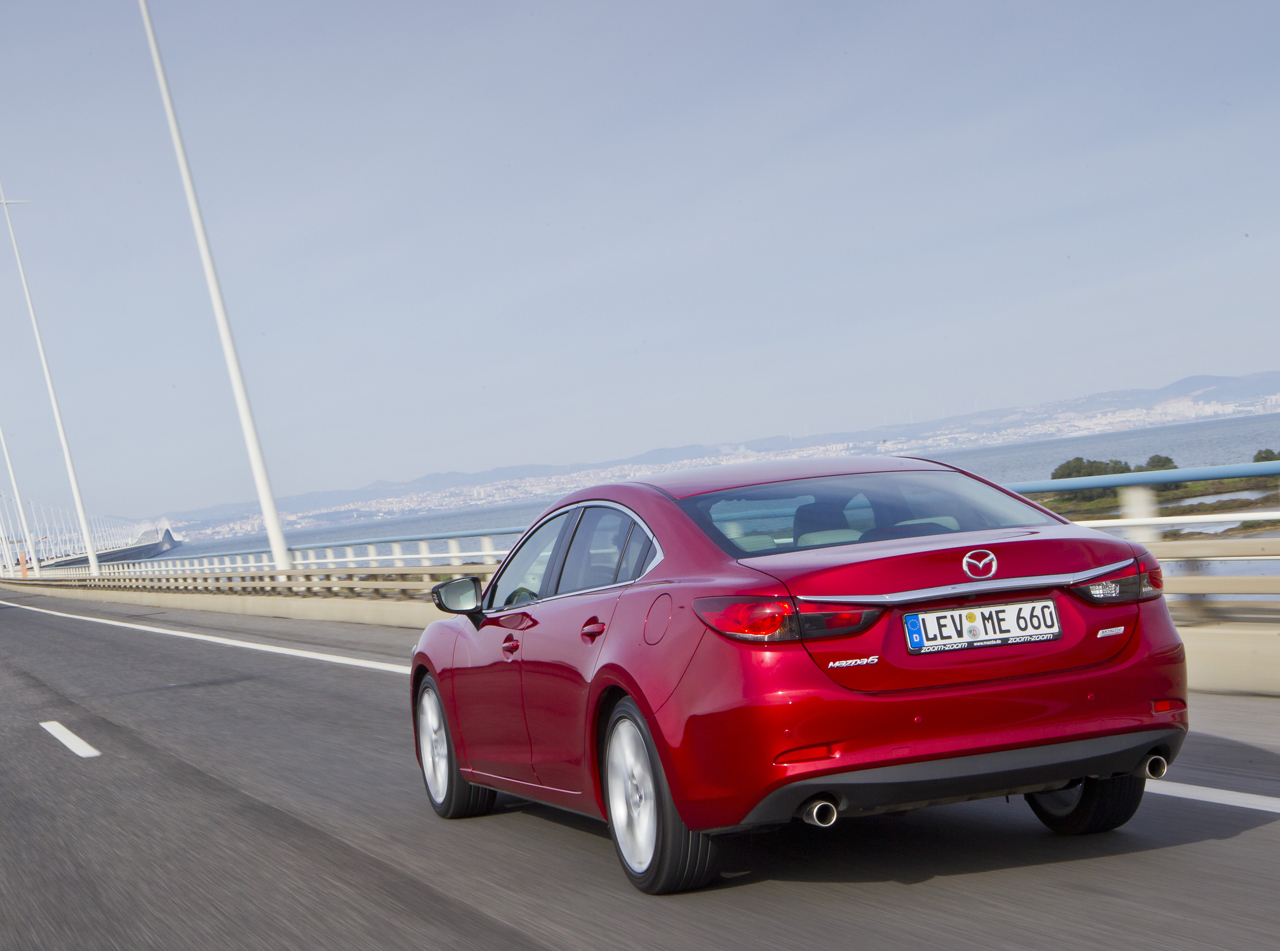
Road Test: Mazda 6 2.2 SkyActiv-D 150 Sport
Price as tested: €31,795
+ Handsome, frugal, fab to drive, solid
– Pretty much nothing
= As good a mid-size saloon as you'll find
An expensive Swiss watch has become a deep desire for so many of us. The thought of the expensive weight of all that carefully assembled stainless steel and titanium, our wrists tingling at the very thought of being topped by the logo of Omega, Rolex or Tag Heuer (delete according to taste), it's a status symbol we'd all love to have. But sadly, few of us will ever afford such a timepiece. Shame.
But what if I told you that you could have something just as good, possibly even better, for a lower cost, simply by trading in your timepiece's Swiss postcode for one from Japan? It's well known in high-end watch circles that, proud though the Swiss boys are of their products and movements, they collectively weep with jealously at the carefully crafted work of Seiko. The famed Japanese watch maker can produce wrist-wear of staggering reliability and accuracy, and no small amount of beauty, for a fraction of the cost of a Rolex.
There's something similar going on in the motoring world, too. Many of us desire a slick German sports saloon; we want our driveway to be adorned with the star of Mercedes, the four rings of Audi or the Munich colours of BMW, but their prices are just out of reach. So what if I told you that you could have a car as good to drive as a 3 Series, better looking than an A4 and more reliable than a C-Class, and all you have to do is pop into your Mazda dealer?
Most of the new 6's rivals come with 1.6 or 2.0-litre Diesel engines with outputs of around 115 to 120bhp, Band A emissions and a price tag circling the €26,000 mark. The Mazda, by contrast, has a price tag of €31,795 (for the diesel Sport model, which Mazda Ireland reckons will be its strongest seller), has a 2.2-litre engine with a muscular 150bhp and 380Nm of torque (an even more powerful 175bhp, 420Nm version is also available) and yet still hits that Band A emissions target, with 108g/km costing you just €180 a year to tax.
How has Mazda done this? Carefully, is the short answer. Its SkyActiv programme, which debuted on last year's very impressive CX-5 SUV, isn't one big whizz-bang fuel saving system but rather, like BMW's EfficientDynamics, a series of incremental improvements in every area. A little less friction here. A saving of a kilogram there. A touch less wind resistance somewhere else. It all adds up and the final sum of these parts is that low Co2 figure and a commensurately low fuel consumption of, claims Mazda, better than 65mpg on average. Part of that efficiency comes from a combination of i-Stop that kills the engine when you're waiting at the lights and a new system called i-ELOOP which uses a capacitor (like a battery; it reacts faster than a conventional battery but won't hold a charge for very long) that can power the electrical systems for up to a minute, independent of the engine, and recharges in just seconds from leftover braking energy. Clever stuff and the re-start time of the i-Stop is impressively fast.
Even so, I doubt you'll be able to match that fuel figure in real world driving, partially because almost no car ever does match its claimed figure, but partly because it's very hard to resist driving the new 6 in a somewhat brisk fashion. The last generation of 6 felt solid, planted and even a touch hefty to drive. This new one continues that tradition in part, but there's also a new-found litheness, a sense of fluidity and a truly engaging driving experience. The steering is the outright star here, feeling almost Jaguar-like in its combination of weight (except at parking speeds when it can occasionally get oddly heavy) and with great levels of feedback. It's a very confidence inspiring car, the 6, and even at very high continental motorway speeds, feels safe, secure and reactive. The ride quality, as long as you don't go for the optional 19" wheels, is also exceptionally supple.
Refined too. There's a rustle of wind noise around the mirrors at 120kmh and a touch of road and tyre noise on coarser surfaces, but the SkyActiv diesel 2.2 is impressively quiet and even manages to sound a little bit entertaining at higher rpm, with a gruff warbling noise rather than the usual bland diesel blare.
The cabin marks a particularly high point for the 6. It's very similar to the CX-5's to look at, but the quality of the materials has kicked up a notch and while it's a touch dark at times, it's also a terrifically comfy and pleasing space in which to spend time, helped in no small part by a well-located driving position and expensive-looking, clear instruments. There's good space in the back too although the boot is a touch smaller than much of the competition. Family buyers will be pleased to see that Mazda is emphasising the safety levels of the 6, with a host of new electronic aids including a city braking system that slams on the anchors if it senses you're going to run up the back of the car in front, a lane keeping warning and a blind spot monitor, as well as radar guided cruise control.
It's also a very good looking car, much more obviously so in the flesh (so to speak) than in photos, where the sweeping lines are more obvious and the muscular stance more noticeable.
That €31,000 price tag may hurt the 6's chances though. Its rivals all have significantly lower price points, even if they are for lesser engines with less equipment. Mazda is effectively competing with bottom-end versions of the BMW 3 Series and Audi A4 at that price too, and while it's a lovely car, that's a tough battle for any mainstream car maker, and Mazda has as yet no plans to try and match or beat the Koreans in the warranty war; three-year unlimited mileage is your lot.
But just as a Seiko will have true watch afficionados nodding in quiet respect, so I reckon this new Mazda 6 will have true car fans doing the same. Gorgeous, lithe to drive and solidly built, and with astonishing fuel efficiency, it's an early nod for one of the best cars of 2013.
Facts & Figures Mazda 6 2.2 SkyActiv-D Sport 150
Price as tested: €31,795
Range price: €28,745 to €38,895
Capacity: 2,191cc
Power: 148bhp
Torque: 380Nm
Top speed: 211kmh
0-100kmh: 9.1sec
Economy: 4.2l-100km (67mpg)
CO2 emissions: 108g/km VRT Band: A3. €190 road tax
Euro NCAP rating: Not yet tested
Tuesday, 25 September 2012
Road Test: Land Rover Range Rover Sport 3.0 TDV6 HSE
Price as tested: €80,710
+ Comfort, versatility, refinement, handling, beguiling character
– Some cheap cabin trim, poor rear seat space
= Forget the eco-cribbing, this is one of the finest cars around
Is it moral to introduce a moral dimension to a road test? After all, a piece of this nature is mostly about consumer advice, significantly about having a diverting read for your lunch hour and really, that’s about it. Road testers are not wont to go into the ethical rights and wrongs of buying a car but, when taking a new Range Rover out for a spin in 2012 Ireland, it’s kind of a hard dimension to escape. After all, with 450,000 people on the dole lines, sea levels and weather patterns going bananas, the question of whether it is right and proper to drive a car of this type has to be asked.
Well, is it right?
Oh for pete’s sake, of course it is. You want proof? How about the fact that this 2012 Range Rover sport comes with host of technical changes that include an updated 3.0 TDV6 diesel engine and the latest, slick-shifting eight-speed ZF automatic gearbox that actually drops the car out of the top band for VRT and road tax. That’s right; there are sports cars and turbocharged hatchbacks that emit more Co2 per km than this big, beefy Rangie.
Besides which, if you take the classic quote of one of Roger Moore’s adversaries in The Man With The Golden Gun (I appear to be channeling Alan Partridge here...) “Guns do not kill Mr Bond, it is the finger that pulls the trigger.” In other words, if you’re that concerned about the potential damage that a Range Rover can do to the environment, then don’t buy one. It’s your choice. But at least if someone is spending the €80k necessary to nab one of these almost-but-not-quote top-spec HSE models (Autobiography is one grade above, SE a grade below) then while they may be waving their wad in your face a touch, by driving a car as ostentatious , at least you can be assured that they’re spending lots of money on other things, generating employment and tax receipts. See? Range Rovers really can save the planet...
Right, moral dimension done with, let’s get back to the real business of driving the car.
As mentioned, for 2012, the RR Sport gets some subtle but very effective upgrades, the most significant of which are that new engine and gearbox. The 3.0-litre V6 twin turbo diesel now comes in two power outputs; 210bhp and 254bhp, but it’s only the 210bhp version that you’ll get in Ireland, thanks to that tax-dodging 224g/km Co2 output. That’s fine as in spite of a a 44bhp disadvantage, we honestly never noticed a lack of forward motion or thrust, thanks to a whacking great 520Nm of torque on tap from just 2,000rpm. The new gearbox, accessed by a Jaguar-style rotary controller on the centre console (not to everyone’s taste, but we liked it) does the usual ZF job of being so slick it’s almost like it’s not even there. You soon learn that the manual override paddle at the back of the steering wheel are entirely superfluous; all you will need to do is occasionally flick the gear selector into Sport to grab a more reactive kickdown.
Economy is surprisingly impressive. Land Rover claims an average of 8.5-litres per 100km, while we managed a still-decent 9.8l/100km overall. That should give you a touring range of around 800km on a full 80-litre tank, which seems decent enough.
The air suspension has been tweaked too, and the jarring edge of roughness and harshness that made the older Sport models an occasional chore has almost entirely gone. Yes, the Sport rides more firmly than either the big Range Rover (with which is shares almost no mechanical parts) or the Discovery (which which it is pretty much a twin under the skin) but now it’s just acceptably planted, rather than annoyingly hard.
The handling has remained virtually unchanged, thankfully, which means that the Sport still handles, net of a body roll and weight, like a big hot hatch on stilts. In extremis, we detected a slight reluctance to turn into a tightening apex that definitely wasn’t there before, but in fairness, if you’re looking for such handling nuances on a big 4x4, you’re already way off the beaten track. The beauty of the Range Rover’s chassis is that it displays a true multi-purpose nature. It’s refined and comfy on a long run, reactive and enjoyable on a twisty road and, surprisingly, agile and manouvreable in town; in spite of what you might perceive as bulk, thanks to excellent all-round visibility and surprisingly modest exterior dimensions, you can actually get the Sport in and out of tight car parks with ease.
The cabin is both the Sport’s trump card and its one Achilles heel. It all looks gorgeous and Land Rover’s ever-improving quality is palpable. The seats; massive and upholstered in beautiful leather upholstery the colour and consistency of butter are immensely comfortable and the full retinue of switches and dials makes you feel suitably well informed as to the car’s condition and your control of it.
But there are just a few too many plastic sections to the cabin that look and feel a bit too scratchy and cheap. It’s not a problem unique to the Range Rover, but it is a problem at this lofty price level, especially in concert with the desperately cheap looking main dials in the instrument binnacle. The other issue is space in the back, or lack thereof. It’s adequate, nothing more and feels especially stingy when you consider how big a car this is.
While we’re on the critical list, there’s the new standard-fit electric tailgate. Now, in general we dislike these things (what’s the point when they’re slower than simply lifting it up and pushing it back down yourself?) and because it means the loss of the Sport’s useful opening tailgate glass section it’s doubly irritating.
Still, the Sport still has one ace up its sleeve and that is its off-road performance. We’ve driven Sports down impossibly steep ravines, along ricky river beds, through waist deep water and, during our week with this one, managed to traverse a tricky off-road section of The Curragh while wearing a suit. It is that ability to deal with the very worst terrain imaginable (aided by the clever and simple Terrain Response System) while remaining unruffled inside that separates the Range Rover from the horde of competitors. There are others as talented in individual disciplines; none that we can think of that offer precisely the same combination.
Quite apart from anything, there is the Range Rover’s natural charm. It’s a handsome, bluff-looking beast, one that beguiles you, makes you feel better about life when you’re behind its wheel. For that alone, we would love it. Taken in concert with its myriad other talents, well, there’ll be no moral dilemma on our minds if our six numbers ever come up...
Facts & Figures
Range Rover Sport 3.0 TDV6 HSE
Price: €80,710
Range price: €75,195 to €118,160
Capacity: 2,993cc
Power: 210bhp
Torque: 520Nm
Top speed: 193kmh
0-100kmh: 10.3sec
Economy: 8.5-100km (33.2mpg)
CO2 emissions: 224g/km
Tax Band: F. €1,129 road tax
Euro NCAP rating: Not yet tested
Labels:
4x4,
agile,
diesel,
eDrive,
fabulous,
handsome,
Ireland,
Land Rover,
new car,
off-roader,
posh,
premium,
Range Rover,
Road Test,
Sport,
sporty,
SUV
Friday, 21 September 2012
Road Test: Hyundai i40 Tourer 1.7 CRDI BlueDrive Executive
Price as tested: €26,495
+ Handsome, spacious, economical, high quality, comfy
– Still some cheap cabin bits, dynamically not quite up to Mondeo standard
= Cracking family wagon
62 miles per gallon. That’s 4.4-litres per 100km in new money. That kind of fuel economy figure would be impressive enough if we were talking about a family hatchback or even a small city car. But we’re not. We’re talking about a big, handsome, spacious, comfortable, useful even luxurious family estate. One that gets 62mpg.
Hyundai has been on a steady roll for some time now. Ever since the current Santa Fe came out, the Korean brand once upon a time best known for producing cheap, but otherwise unremarkable, cars has since then given us the i20 (decent), the i10 (very good), the i30 (properly excellent) and the ix35 (really good). So when lined up against all that, the fact that we reckon that the i40 is a serious breakthrough car for Hyundai should speak volumes.
It’s the first proper stab by Hyundai at the Mondeo-Avensis-Passat axis (the old Sonata had its charms but it was never a serious contender) and as such it lands Hyundai smack dab in the midst of one of the most viciously competitive sectors of the market. Cars in this class have to be only slightly more expensive than a family hatch but as comfy as a limo, as good to drive as a sports saloon and as well built as a solicitor’s safe. And the i40 scores highly in pretty much each of those areas.
Let’s get back to that economy figure. OK, so the 4.4-litre per 100km figure was scored on only one journey we took in the i40, but in fairness, that was a four hour schlep from Galway to West Cork, so it’s pretty representative. Our overall week-long average of 5.0-litres per 100km (56.5mpg) is still very impressive. And at 113g/km of Co2 it’ll cost you just €104 a year to tax.
And it’s from a remarkably refined engine. Hyundai’s 1.7 CRDI diesel has always been impressive, but in the i40 it’s genuinely whisper quiet, only giving up some diesel-y rattle and gargle at low rpm on a cold start.
More good news; the rear seats are impressively spacious and, at 553-litres, the boot is simply massive. Up front, the seats are comfy, space is good and quality is mostly excellent. For our money, those blue-striped dials still look a little low-rent, as do the very cheap feeling column stalks, and why is the rear demister all the way on the opposite side of the dashboard from the driver? Small quibbles, but they do detract from the otherwise almost-premium feeling.
And the i40 does trip up in one other area; the way it drives. To call it bad would be simply wrong. To call it good would be right, but this is a class where excellence is the norm and the maddening thing is, we know that Hyundai can do it better. The suspension is quite soft, the steering a little distant and there’s a slightly wobbly feeling of the whole car being under-damped. It’s not, you might think, something that anyone other than a keen driver would notice, but the Mondeo, Passat, Avensis, Insignia and 508 all feel much better and more confidence-inspiring to drive. And having driven an early prototype i40 earlier this year that had noticeably sharper chassis settings, we know that Hyundai have a sharper-driving i40 tucked away in a cupboard somewhere.
Still, when a car looks this good, is this comfortable and refined, this economical and, for the €26,495 Hyundai is asking for this Executive model (Bluetooth, electronic parking brake, iPod connection, 5-Star EuroNCAP safety rating, stop-start, climate control, reversing camera and a 5-year unlimited mileage warranty) is exceptional value for money... well, would you quibble about some chassis shortcomings and some cheap windscreen wiper stalks?
Facts & Figures
Hyundai i40 Tourer 1.7 CRDI BlueDrive Executive
Price as tested: €26,495
Price range: €24,995 to €26,495
Capacity: 1,685cc
Power: 115bhp
Torque: 260Nm
Top speed: na kmh
0-100kmh: na sec
Economy: 4.3l-100km (65.6mpg)
CO2 emissions: 113g/km
Road Tax Band: A €104
Euro NCAP rating: 5-star: 92% adult, 86% child, 42% pedestrian, 86% safety assist
Subscribe to:
Posts (Atom)